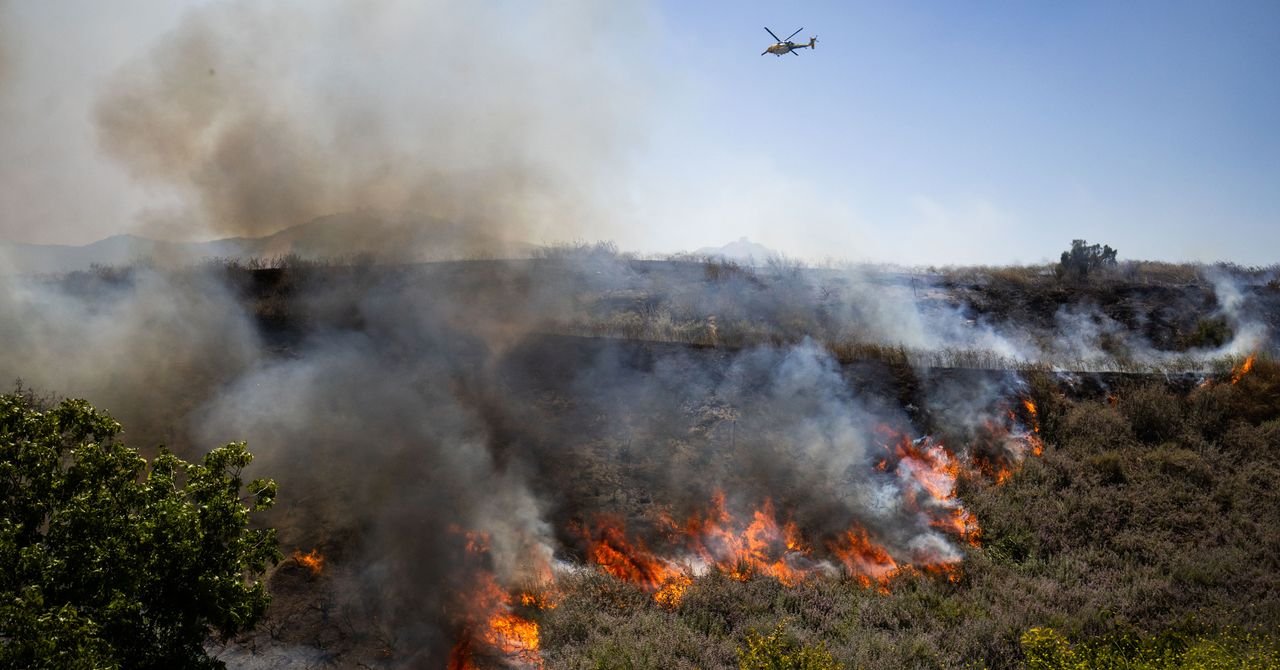
The combination of high winds and heat has contributed to three major fires in Southern California.
The largest of them is the Santa Rosa Island fire, which broke out in Channel Islands National Park over the weekend when a stranded boater used flares to signal for help. The fire has destroyed about 16,600 acres of land – about a third of the entire island. While some structures have been destroyed, the largest is a grove of Torre pines, one of the rarest trees in the world.
Torrey pines are considered critically endangered by the International Union for Conservation of Nature. The group warned that gardens on the island face a “high potential risk from catastrophic fire”. While the Santa Rosa Island fire has burned through forests, there is hope that the worst may not have come to pass.
“Upon initial assessment, firefighters are finding that the intensity of the fire was low and the stand is intact,” Mike Thune, a fire information officer appointed by the federal government, writes in an email. “When it is safe to do so, a fire impact team will be assigned to make a full determination of the situation and any long-term impacts.”
Although small, the Sandy Fire has forced thousands of people to evacuate areas in and around Simi Valley, located about 35 miles northwest of downtown Los Angeles. Fire activity increased Tuesday morning as strong winds fanned the flames to about 1,400 acres.
Only 5 percent of the fire has been controlled, while the Santa Rosa Island fire has not been controlled at all. Because homes and businesses are threatened, the Sandy Fire has received more air resources to extinguish the fire. The River Fire has also burned 3,535 acres in Kern County and is 15 percent contained.
In the early stages of fire season, about 41,000 acres have burned across the state, according to the California Department of Forestry and Fire Protection. But it’s well above the five-year average of 23,380 acres burned to this date and could be a harbinger of what’s to come in the state and across the West.
Record-breaking heat this spring decimated already low snowfall, leaving the state poised to burn. According to federal data, the most recent snowpack measurements show that California’s Sierra Nevada range has only 9 percent of its normal snowpack for this time of year, while many basins in other parts of the West have no measurable snow at all.
Of course, hotter weather is a hallmark of climate change. A recent analysis from the nonprofit Climate Central found that April 1 snowpack — a key date for measuring what’s on the ground — has declined by 18 percent across the West since 1955.
What all this means is that while early season fires have been bad, it’s nothing the West has seen yet.
<a href