That was June 2025. A year later, the legislative proposal now has 73 co-sponsors, a number Palestinian rights supporters say represents “historic” progress.
Recommended Stories
list of 3 itemsend of list
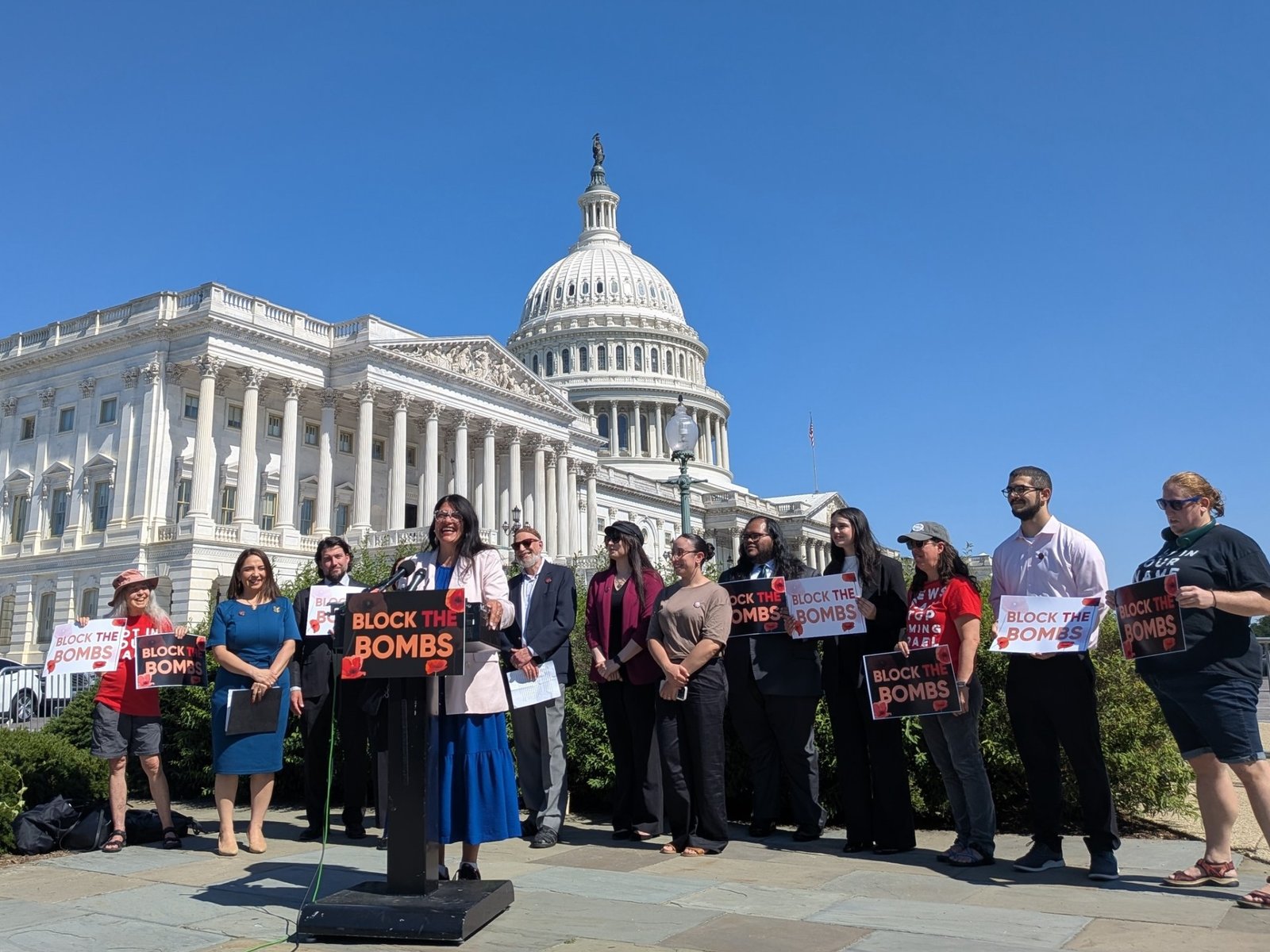
“While some people thought the bill was excessive, in reality, it has become quite mainstream,” Ramirez said at a news conference on Capitol Hill on Thursday.
With 73 members supporting the measure to ban arms to Israel, the bill creates a crack in the decades of near-unanimous bipartisan support Israel has enjoyed in Congress.
Still, this number does not come close to a majority in the 435-member House of Representatives.
Margaret Dares, executive director of the Institute for Middle East Understanding (IMEU), said it was important to “mark the progress” of such a bill, stressing that more lawmakers should join the majority of voters in rejecting unconditional aid to Israel.
“We’re coming from a deficit where there is such a lack of courage to do the right thing in Congress, this is really a huge improvement from where we were,” Derres told Al Jazeera.
“Clearly there is still a long, long road ahead.”
While Congress remains largely pro-Israel, advocates have called on its members to better reflect the changing views of the American public. Multiple polls show Israel is rapidly losing support.
In a recent survey by the Institute for Global Affairs, only 16 percent of respondents agreed that the US should “continue supplying arms to Israel without any new sanctions”.
‘Americans want us to invest here at home’
On Thursday, Ramirez stressed the need to bring his bill to the floor of the House of Representatives for a vote, citing numerous Israeli military operations throughout the Middle East.
However, so far, the bill has been blocked by the House Republican leadership.
The congressman also rebuked Israeli Prime Minister Benjamin Netanyahu and President Donald Trump for their role in the war in Iran, Israel’s attacks on Lebanon and the rising death toll in Gaza, where Israel continues to carry out deadly attacks despite a “ceasefire.”
“Trump and Netanyahu will continue to expand the wars, so that they can continue to consolidate power, so that they can stay in office, and so that they can continue to profit from our pain,” Ramirez said.
Congresswoman Rashida Tlaib also emphasized that it is no longer taboo to question Washington’s support of Israel, highlighting growing public awareness of Israel’s abuses.
“Americans want us to invest here at home. They want us to invest not in death and destruction and bombs. They want us to invest in clean water and housing and child care and much more,” Tlaib told reporters.
“So many people can’t even afford to go to the doctor, yet we’ll raise money in a minute to continue supporting the Israeli government for bombing civilians.”
The Palestinian American congressman credited ordinary citizens for the growing support for the bill, saying change will come from the people, not Congress.
“Regular citizens who don’t share my faith or ethnicity are coming to town halls and saying, ‘Why are you cutting SNAP and why are you starving Gaza?'” Tlaib said, referring to the food assistance program for low-income families.
“You see them come and say, ‘Why are we funding genocide, but not health care at home?'”
inside the bill
The Block the Bombs Act would ban the transfer to Israel of certain heavy bombs and artillery ammunition – weapons used in some of the deadliest attacks during Israel’s genocidal war on Gaza.
The bill originated in Congress with progressives and vocal critics of Israel as its original supporters. But as outrage grows over Israel’s atrocities in Gaza and across the region, some unexpected names have joined the list of co-sponsors.
Congresswoman Valerie Fauci, elected to Congress in 2022, co-sponsored the bill last year with the support of pro-Israel groups including the American Israel Public Affairs Committee (AIPAC).
“We cannot continue to provide weapons to the Israeli government when they are not being used in accordance with international law to maximize the protection of civilians in Gaza,” Foushi said in August 2025.
In May, AIPAC congratulated Congressman Christian Menefee for defeating his Texas colleague Al Green in the primary, which had pitted the two Democratic incumbents against each other as a result of redistricting.
Menefee on Tuesday became the latest co-sponsor of the Block the Bomb Act.
Republican Congressman Thomas Massie, who lost his primary to a challenger backed by Trump and pro-Israel groups, also put his name forward this week, making it bipartisan.
“Israel has used American-supplied weapons to kill thousands of innocent civilians,” Massey said.
“The United States is morally obliged to end Israel’s support for the destruction of Gaza and its people. I am supporting the Block the Bomb Act to limit offensive weapons transfers to Israel.”
Congress changed
The Congressional Progressive Caucus has also supported the bill. On Thursday, its president, Greg Kaiser, said the growing support shows that speaking out, marching and contacting legislators can make change.
“If we want to save lives, we obviously need to both take on the Republican Party, but also change who we are as the Democratic Party,” Kaiser said.
“The idea behind the Bomb Block Act is simple: The United States should not supply bombs that we know will be used to perpetuate one of the worst disasters of our lifetime.”
The legislators stressed that despite the ceasefire, the humanitarian crisis in Gaza persists, with Israel still restricting humanitarian aid to the Palestinian territory.
Congresswoman Latifah Simon said supporting the bill should not be a partisan issue.
Simon said, “We must be clear – not as red or blue, but as Americans – that we must deliver full force and humanitarian aid instead of bombs, especially when you have hundreds of thousands of children and women and elderly people who are starving, who are living in squalor.”
“We’re funding that humanitarian crisis. I think I only have one sentence left to say: Stop the bombs.”
The one-year anniversary of the Block the Bombs Act comes at a time when other legislative proposals that question US relations with Israel have also gained momentum.
On Wednesday, the House passed a resolution to rein in Trump’s powers to attack Iran without Congress’s permission, in defiance of the war launched by the US and Israel against the country.
40 out of 100 senators, including the overwhelming majority of Democrats, also voted in April to block the transfer of military bulldozers to Israel.
Beth Miller, political director of the advocacy group Jewish Voice for Peace (JVP) Action, said the increased support for the Block the Bombs Act is driven by activism in the Palestinian rights movement in the US.
But he said the number of co-sponsors remained “horribly low.”
Miller said, “It’s a sign of how far we have to go that a majority of members of Congress still want to send bombs to a country that is committing genocide.”
“So we will all continue to speak out. It’s time for the entire Congress to take action. It’s time to stop the bombs.”
<a href=