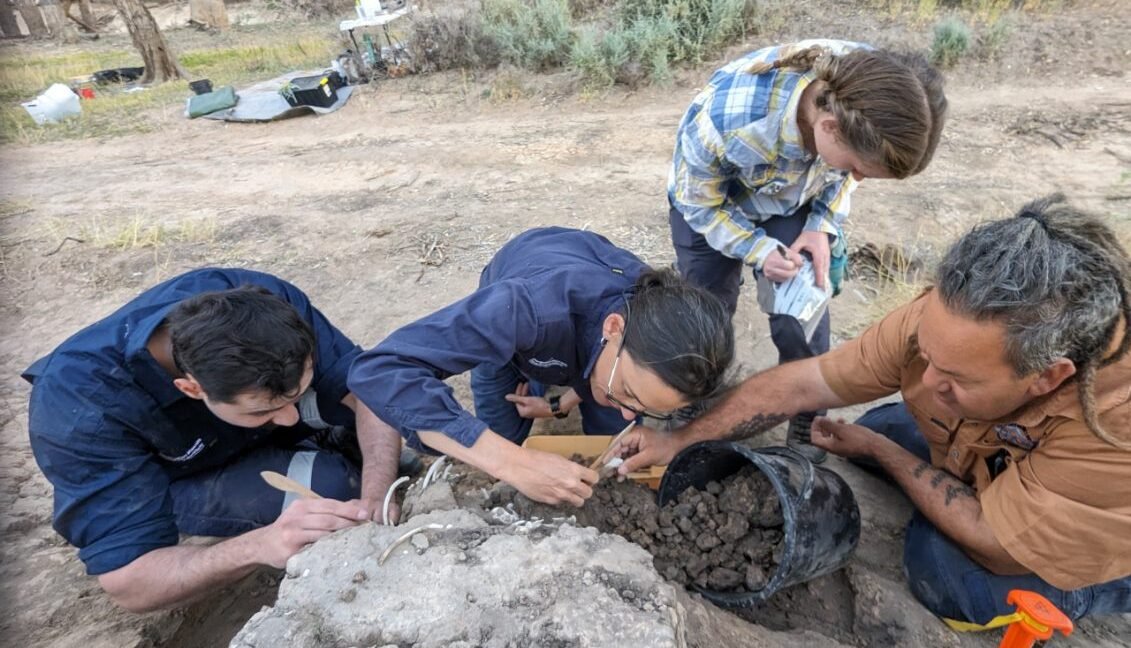
A thousand years ago, the ancestors of today’s Barkindji people carefully buried a dingo (or garli in the Barkindji language) in a mound of shells.
Archaeologists recently studied the burial in New South Wales, Australia. They found that Barkindji ancestors had buried the dingo with the same care and ceremony as any beloved human member of the community and had cared for the grave for centuries. The burials show that dingoes were, as study co-author Amy Way, an archaeologist at the Australian Museum and the University of Sydney, says, “deeply valued and loved” by ancient people in Australia.
long lost dingo
Five years ago, Barkindji elder Uncle Badger Bates and National Parks and Wildlife Service archaeologist Dan Witter discovered bones emerging from a road cutting in Kinchega National Park, an area along the Baka or Darling River in New South Wales, Australia. Badger recognized the bones as those of a dingo, lying to his left in what was once a carefully constructed mound of river shells.
At the insistence of the Menindee Aboriginal Elders Council, which was concerned that erosion would destroy the dingo bones and any information about the past they contained, a team of archaeologists, working with Barkindji elders, excavated and studied the skeleton. The bones turned out to be those of an elderly male dingo, with worn teeth and possible signs of arthritis. Broken and healed bones show that they led a hard, active life, but that people also cared for them.
And layers of shells around him revealed that generations of Barkindji had cared for his grave and ritually “fed” him by adding shells to the mound for centuries after his death. It is certainly not the first dingo burial found in Australia, but it is further north and west than any other example. This reveals a far deeper and more enduring relationship between ancient people and dingoes than outside researchers, at least, had previously fully realized.
<a href