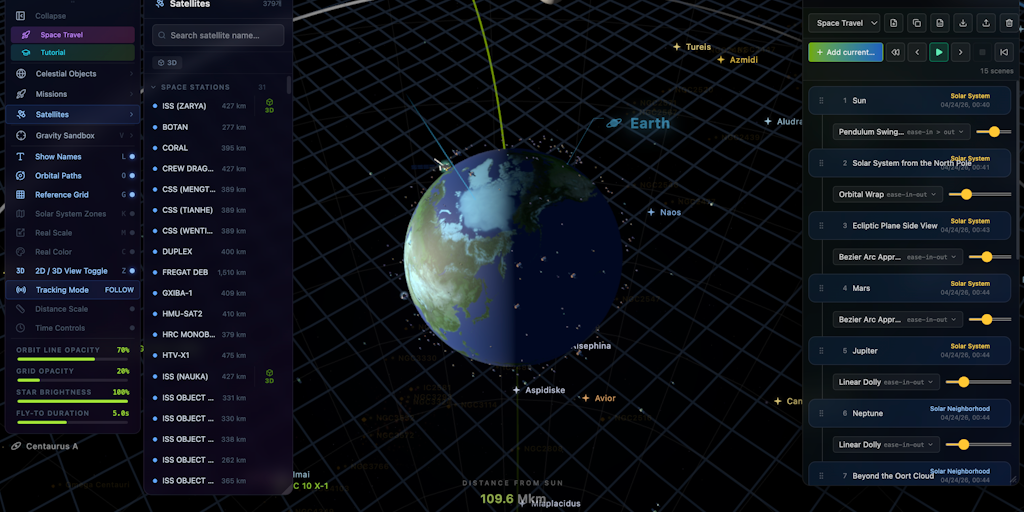
Quick context on why I created AstroGrid: I wanted to create something for anyone curious about the universe, whether you’re a student, a self-learner, a teacher, or just someone who loves staring into space at 2 a.m. Every explainer I found was either a flat textbook diagram or a YouTube video that you’ll watch in 30 seconds. I wanted something you could just hold, tilt, rotate and fly.
It continued to grow, and is now a 3D atlas of the universe that you can view in your browser. No install, no signup. Designed with classroom and self-learner use in mind.
Some things you can actually find out by using it
How big things really are. Park the Earth next to Jupiter, then next to the Sun. Numbers like “100 times larger” don’t really stand out until you see it. It’s the same with distance: flying from Earth to Mars at a certain speed feels very different from reading “225 million km”.
Why Kepler’s laws look the way they do. Speed up time and watch Mercury spin around while Neptune is barely budging. You stop needing to memorize the law and see why it should be true.
Why eclipses do not occur every month? The Moon’s orbit is inclined, and it is almost impossible to depict it with a 2D diagram. In 3D this becomes clear in about five seconds.
The constellations are not flat. Fly out of the solar system and watch Orion explode. The “belt” is actually three stars spaced vastly apart. It really surprises people.
What does a black hole do to light? There is an actual general-relativity lensing effect around the black hole, and you can orbit it and see the background stars bending around it. It’s hard to forget once you see it.
The scale of the universe. Zoom out from your street to the solar system, the galaxy, the Local Group, the cosmic web. The void between things is the part that impresses most.
Everything is based on real astronomical data (NASA JPL for the Solar System, HYG catalog for stars, OpenNGC for deep-sky objects, LIGO data for gravitational wave events, etc.), so what you’re seeing isn’t cosmetic. This is where those things really are.
If you teach, or you’re just curious about the space, I’d really love to hear what’s confusing, what’s missing, or what you wish you could do next. That feedback shapes the next update.
Thanks for taking a look.
<a href