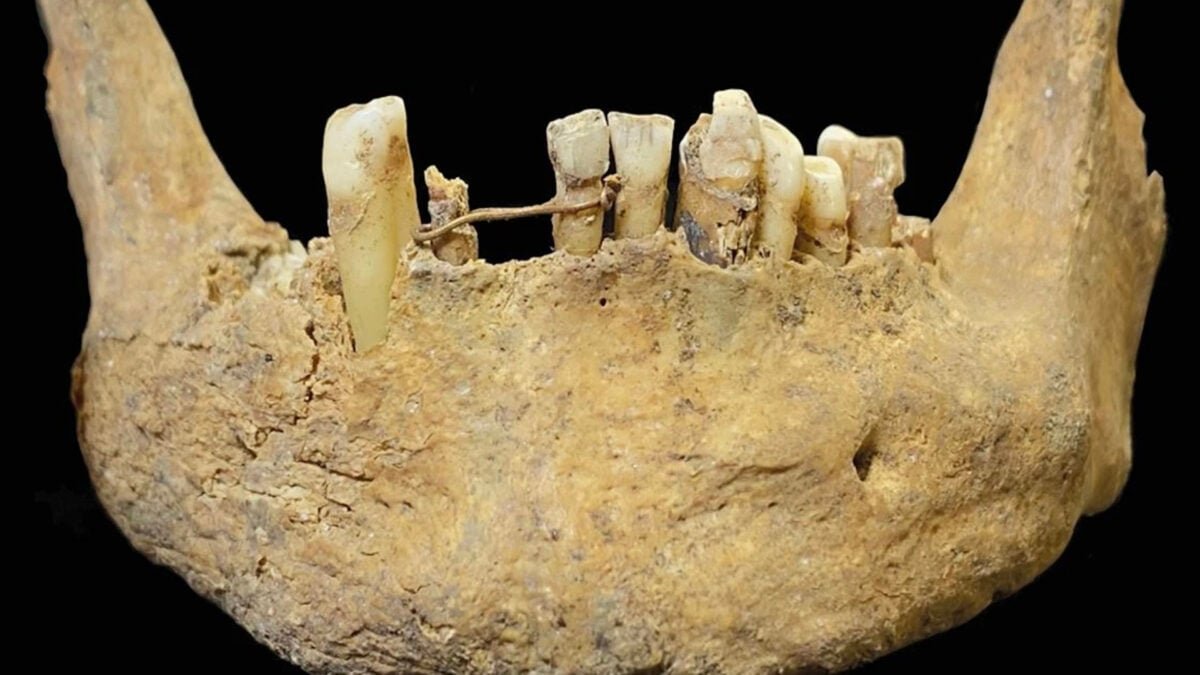
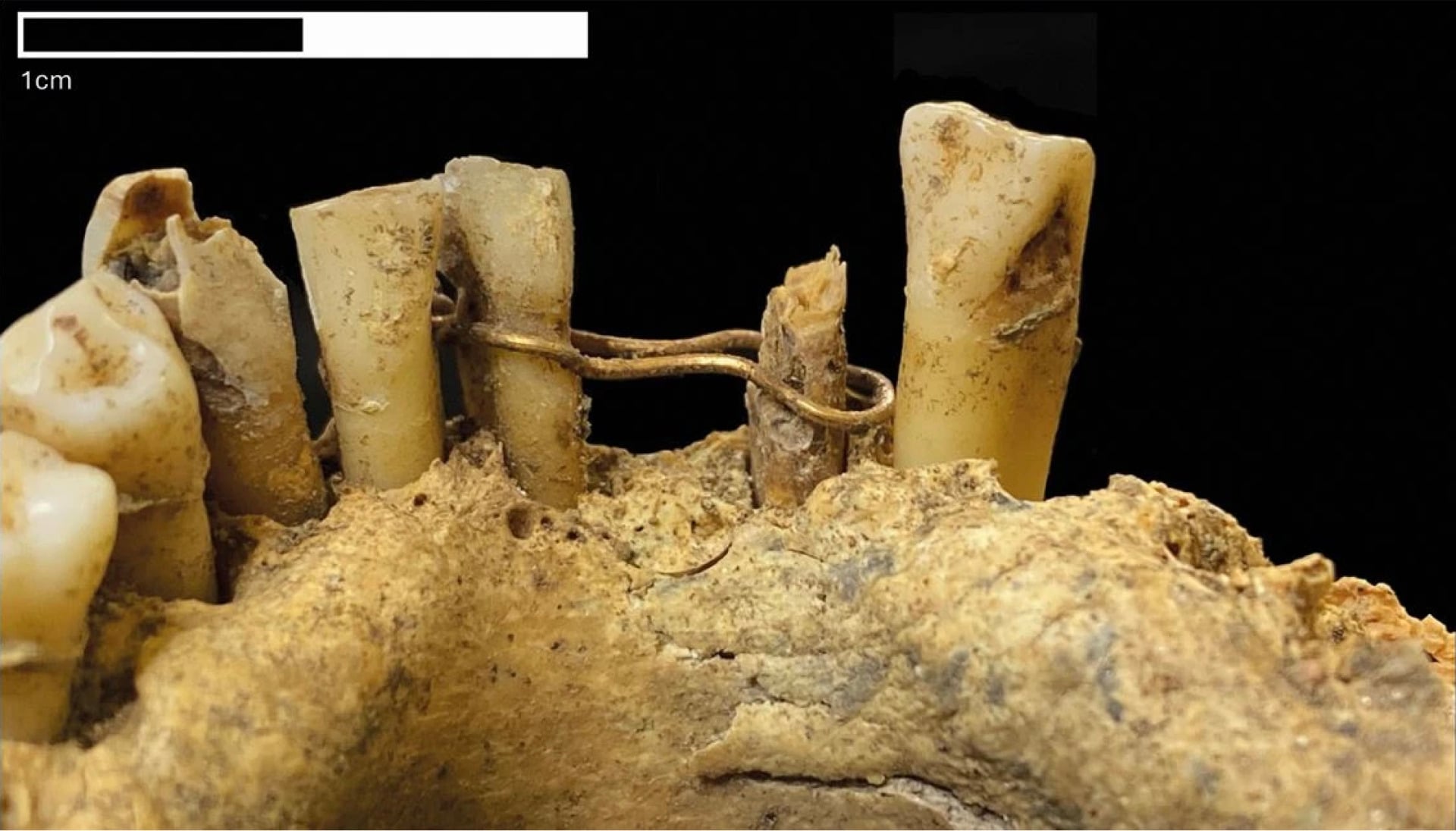
Researchers from universities in Australia, Scotland and the United States gathered details on the new discovery: a thin gold band cleverly wrapped around two old teeth. The ligature, like a modern dental bridge, spans over the healed socket of a tooth now largely lost to history. Its thin metal wire (82.4% gold, 9.8% silver, and 2.5% copper) would be considered 20 karat gold today. It was found carefully threaded around two incisors carved from the jawbone of a man buried in the East Kirk of St Nicholas Kirk in Aberdeen, Scotland.
According to the team that examined this old dental work, “The most likely purpose of this ligature was either to attempt to retain the right lateral incisor or to provide a bridging scaffold to retain the artificial tooth.”
Based on radiocarbon dating carried out at the Scottish University Environmental Research Centre, researchers placed the time of this individual’s life and oral care in the late Middle Ages, between the years 1460 and 1670. This comprehensive assessment, spanning more than two centuries, was the best estimate currently available, he noted, noting that the man’s jawbone was found alone, “separated from its original context.”
But the general location of the interned bone, in the grounds of a prosperous parish church, was enough for them to conclude that he had once been “a relatively wealthy member of the community.”
Unique medieval ‘dentators’
In the centuries before dentistry was officially recognized in the United Kingdom in 1860, the area was filled with entrepreneurial barbers, barber-surgeons, local women with herbal medicine expertise, and even traveling shamans. “Depending on availability, one might also find relief from ‘tooth-drawers,'” the researchers said, “which were often carnival performers who traveled around the country promoting proprietary methods for ‘painless’ tooth extraction.”
Scotland at this time was also blessed with comparatively better trained “dentators”, dental specialists trained in more advanced techniques passed on by Arab doctors, such as Abul Qasim al-Zahrawi who practiced on the Iberian Peninsula in the 1st century AD. (Medical historians credit al-Zahrawi’s medical encyclopedia Kitab Al-Tasarif With the advocacy of dental reconstruction methods that incorporated oxidation-resistant metals such as gold.)
However, dentures were not cheap, and the mere presence of such specialized work “demonstrates that wealthy individuals had access to advanced dental treatment,” as the researchers argue in their study, published in the British Dental Journal this April.
He notes that non-elite Scots were more likely to receive dental treatment in the form of simple herbal remedies for toothache – including “green turf heated with embers” and “cow dung poultice”, a tasty hot mixture that contained exactly what it sounded like. “Such folk remedies were used in Scotland well into the 20th century,” the researchers said.
years of dental work
This latest round of excavations at St Nicholas began in 2021, part of a conservation project to transform the kirk (a Scottish word for church) into a local heritage site.
The study’s lead authors, biological anthropologist Jenna Dittmar and osteoarchaeologist Mark Oxenham, traveled from the Edward Via College of Osteopathic Medicine in Louisiana and the Australian National University in Canberra, respectively, to collaborate on the local excavation.
In a previous project with their hosts at the Department of Archeology at the University of Aberdeen, Dittmar and Oxenham examined teeth and other skeletal remains recovered from local victims of the ‘Black Death’ which devastated Aberdeen from 1644 to 1649. These plague years sit comfortably within the later range of his affluent dental patient’s possible lifespan, which may someday provide clues as to how he died.
As Oxenham said in a statement accompanying the 2024 plague study, “This was a particularly frustrating time in Scottish history to be alive.”
<a href