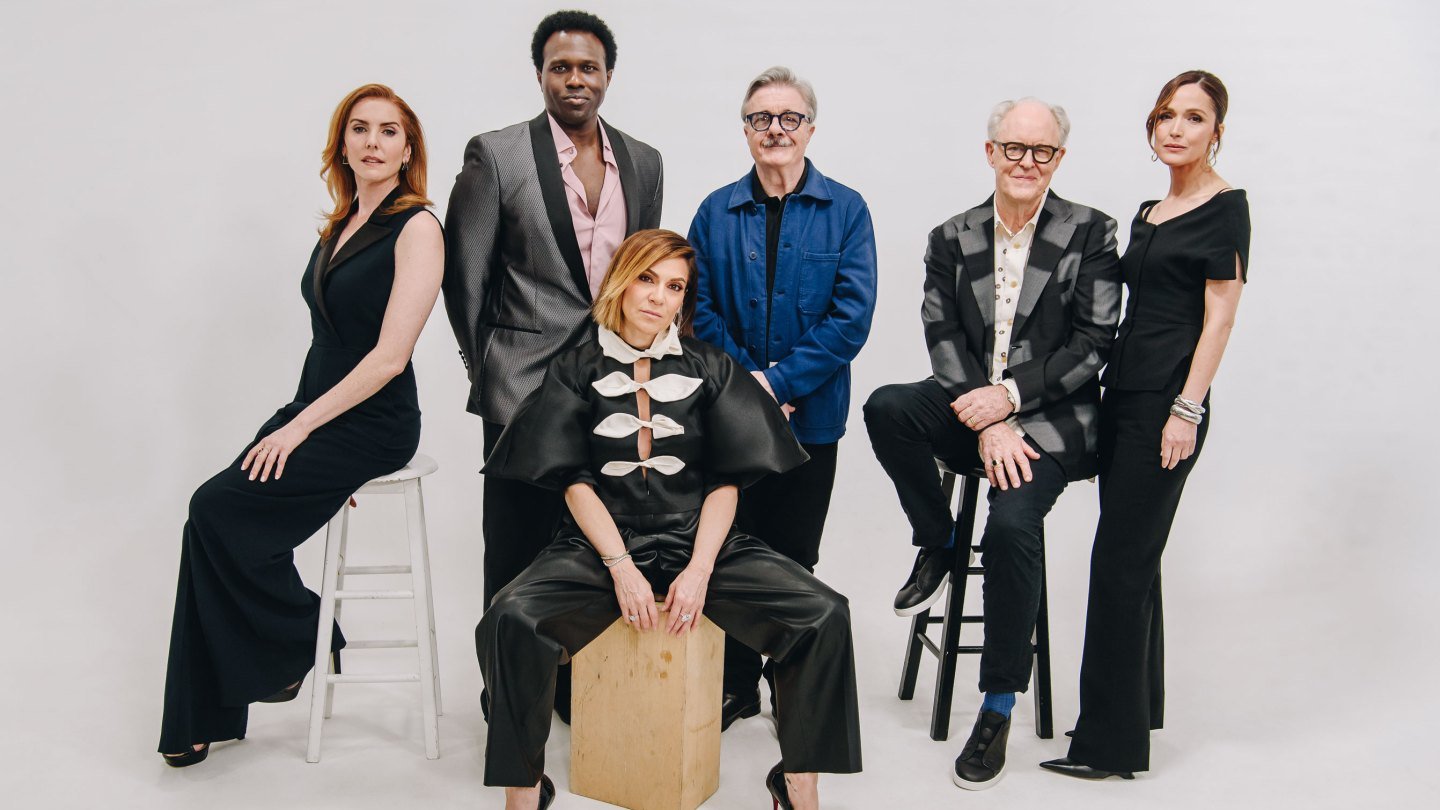
Six of the 2025-26 Broadway season’s standout performers — three men and three women, each of whom is headed to the 79th Tony Awards on Sunday, June 7, as a nominee — convened at PMC’s New York headquarters in late May for this year’s edition of The Hollywood Reporter’s Tonys Roundtable.
The group included two veterans of the stage and screen who are the frontrunners for best actor in a play: John Lithgow, who portrays Roald Dahl, the author of beloved children’s books who also had a darker side, in Giant, his 25th Broadway show, which could bring him his third Tony; and Nathan Lane, who is receiving career-best notices for his interpretation of Willy Loman in the latest revival of the great American play Death of a Salesman, his 24th show on the Great White Way, which could bring him his fourth Tony.
Joining them were two troupers who are known for their booming voices and are widely expected to win for the first time this cycle on their fourth and third nominations, respectively: Joshua Henry, a best actor in a musical nominee for Lincoln Center’s revival of Ragtime, and Shoshana Bean, a best featured actress in a musical nominee for The Lost Boys, an adaptation of the 1987 film of the same name, which is tied with Schmigadoon! for the most nominations of any show this season.
And rounding out the group were two first-time nominees. Mere months after being nominated for her first Oscar, for If I Had Legs I’d Kick You, Rose Byrne is up for best actress in a play for Fallen Angels, a revival of a Noël Coward comedy about two sexually frustrated women in 1920s London. And Marla Mindelle is nominated for best actress in a musical — and best musical and book of a musical — for Titaníque, a wacky comedy in which she plays a version of Celine Dion who believes she was actually aboard the Titanic. (Mindelle is the first woman ever to be Tony-nominated for a leading performance in a show that she also wrote.)
As you can listen or read below (the transcript has been lightly edited for clarity and brevity), the sextet discussed their paths to these shows and the conversations that they are provoking, the behavior of audience members that they find most annoying, the performance schedule they wish they had, how they would feel about being part of a screen adaptation of their current production, plus more.
Marla, you graduated from college and pretty quickly began working on Broadway — you were in South Pacific, Sister Act and Cinderella — and then you elected to walk away. It was 10 years before you were back with Titaníque. Why was that?
MARLA MINDELLE I did Broadway show after Broadway show, and then, when I hit 30, I was like, “God, I really have aspirations outside of this.” I had realized in college that I love writing and I love musical theater. I love it so much. I love it too much. It’s probably why I felt a desire to have authority over my own career. I thought it would be easy for me to do that through moving to Hollywood and trying to become a writer — I was like, “How hard can that be?” And I lost everything — my money, my mind, my sense of self. I wound up doing crappy dinner theater in L.A. for $75 a show.
It was at my rock bottom, trying to pursue a new career, that this whole idea for Titaníque started. I was drunk in a bar and the co-author of the show, Constantine Rousouli, suggested the concept. I was like, “That’ll never friggin’ happen,” and sat on the idea for two years. But Connie and Tye Blue, the director, forced me to do it. With that tiny little dinner theater money and a glass of sauvignon blanc, we just started writing it for fun.
When it was first mounted in New York, what was its venue like?
MINDELLE Titaníque, after the pandemic, started in the basement of a Gristedes (supermarket). It was supposed to be a three-month run. We were getting paid very little. It smelled like beer and urine, and there were rats crawling around, because the Gristedes was about to be condemned. I’m singing “My Heart Will Go On,” and there’s trash juice leaking from the ceiling. But something switched, and people started coming, and it just blew up. And so from that basement, it went off-Broadway to the Daryl Roth (Theatre) and now to Broadway and all over the world. It’s been a 10-year process. And now I get to sit with the likes of you all. It’s a rags to “riches” story. Not to be emotional, but this is just a dream come true.
NATHAN LANE I love that story. Congratulations.
JOHN LITHGOW It’s wonderful to hear.

Marla Mindelle
Photographed by Nina Westervelt
Nathan, in 2010, Charles Isherwood in The New York Times opened a profile of you by declaring, “I wouldn’t dare to venture an opinion as to who is the greatest actor to appear on Broadway in the past decade or so. Most accomplished diva? Definitely won’t touch that. But the greatest entertainer? That one is easy: Nathan Lane.” How did that go over with you?
LANE Well, I can find the dark cloud in any silver lining. I was doing a musical at the time called The Addams Family, which had been reviled by the critics, and yet the public wanted to see it. So I was in the middle of that, and I guess he felt sorry for me and wrote this very complimentary career-assessment piece. But there was something about the fact that he referred to me as an “entertainer” and not an “actor” that stuck in my head. I thought to myself, “Is that how I’m seen? I wonder if I could shift people’s perception?” I have no power in film and television, but in the theater I have a little bit. So it prompted me to do something.
I read an interview with Brian Dennehy, who was a very old friend of mine, and Robert Falls, who ran the Goodman Theatre in Chicago, and they were discussing what they might do next. They mentioned that they were considering doing another production of The Iceman Cometh. Brian had very successfully played it there in 1990, and now he was going to play Larry Slade, and they were thinking about who would play Hickey, famously played by Jason Robards in the first revival of it. And I thought, “Gee, that would shake things up, that would be a big challenge.” So I wrote Bob an email and suggested myself. Eventually it led to me doing it in Chicago, which was a life-changing experience because it’s such a monumental play and near-impossible part. And it was what I was looking for.
That was the beginning of an of amazing run of dramatic parts for you. You soon returned to Broadway as Roy Cohn in a seven-hour production of Angels in America, and now you’re back as Willy Loman.
LANE When I was 10, I saw Death of a Salesman on television — it was a 1966 CBS special presentation with the original stars of the play, Lee J. Cobb and Mildred Dunnock. A year later, my father essentially committed suicide by drinking himself to death — in fact, he sort of announced it to my brother, who was trying to get him to stop drinking, when he just said, “I’m no good to anyone. I’m just going to drink myself to death.” Then I read the play in high school. And then in 1995, the first time I worked with Joe Mantello (who is directing the current production of Death of a Salesman), we were doing a Terrence McNally play, Love! Valour! Compassion!, and, for some reason, he turned to me one day in rehearsal and said quietly, “Someday I’m going to direct you in Death of a Salesman.”
JOSHUA HENRY Wow.
LANE I was like, “Oh, OK.” It took me by surprise. Now he says, “I don’t know why I said that. It was a premonition, maybe.”
Nathan Lane
Photographed by Nina Westervelt
Rose, you made your Broadway debut in 2014 opposite James Earl Jones in a revival of You Can’t Take It With You. There is actually a direct link between that and your return to Broadway this year opposite Kelli O’Hara in Fallen Angels, right?
ROSE BYRNE Well, Scott Ellis directed You Can’t Take It With You. Cut to years later, he was doing a benefit reading for the Roundabout (Theatre Company) and Todd Haimes. The late, wonderful Todd Haimes had brought the play to Scott, having an idea for it, and then Scott stepped in when Todd passed, and we did this reading, and we were like, “Oh, this is special.” From there it took a couple of years, but we found a time when we could all do it. It’s been been a dream of mine to do a true comedy. In You Can’t Take It With You, I was really the straight man. But in this one, the women are transgressive and lustful and violent and ridiculous and funny. So it’s been a real gift and dream to do a true comedic piece onstage.
Joshua, you’ve been so great in a lot of Broadway shows, many of which have been revivals, including Violet, Into the Woods and Carousel. I understand that you were pretty set on not doing another revival. So how did you end up stepping into the large shoes of Brian Stokes Mitchell in the first Broadway revival of Ragtime?
HENRY At the University of Miami, I listened to the Ragtime soundtrack and thought, “This is the kind of work that I want to do.” But more recently, it certainly wasn’t in the plans. After Carousel in 2018, I was like, “I’m done with revivals for a little while.” Lear deBessonet, who directed Ragtime, was directing a new piece of mine called The Conversation, and we were in a reading in 2023, and on a 10-minute break she took me to the side and was like, “I have this idea. Have you ever thought about playing Coalhouse Walker Jr. in Ragtime?” I just started laughing. She was like, “I think this could be really special.” And I was like, “Absolutely!” That role, where it can take you, I just connect with so much as an artist, as a ferocious dreamer, as a musician and as a family man. So I had to jump back onto the revival train.
You connect with it on another level, too, I believe — you’re a first-generation American?
HENRY Yeah. My parents are from Jamaica. They came from Jamaica and went to Canada, which is actually where my siblings and I were born, and then we were raised in America, in Florida. And the idea of them having a dream for us? I am now 20 years into my career, but when I was going to be a musical theater major they were like, (in a heavy Jamaican accent) “What are you going to do now?!” My dad is an engineer and my mom worked at an accounting firm, and that was just not in the cards. But now they get to see it. My mom’s actually going to be there (at the Tonys) on June 7th. To have her there is going to be really special.
Shoshana, your two most recent shows on Broadway were the Alicia Keys musical Hell’s Kitchen, which wound up tied for the most Tony nominations of any show that year, and now The Lost Boys, which is tied for the most Tony nominations of any show this year —
HENRY The Shoshana Factor!
And you personally received Tony nominations for both of them. But I understand you had some reservations about doing them, for reasons that are sort of articulated in your big showstopper in The Lost Boys, “Wild.”
SHOSHANA BEAN I really did not want to be playing another mom. It’s interesting to age and navigate aging inside of this business, and being pigeonholed or seen in a certain way, and feeling like you have more to offer and to prove, feeling like an underdog and unseen in ways, when you know you have things to offer. And so a lot of that I navigated through saying yes to The Lost Boys. I replaced Caissie Levy when she decided to stay in Ragtime. It was a last-minute thing. We were going to start rehearsals in a month, and it just, on paper, did not feel like the next thing I wanted to do. But through that song “Wild,” I feel like I’ve been able to reclaim being empowered at this age (48) — for her as a mom and for me as a woman aging and evolving in this business, and wanting to be seen for all of who we are. And at this point, I cannot imagine not having done this show. A lot of the roles I’ve played have sort of pushed me to one end of the spectrum or another, but this one allows me to use a lot more of my colors and paint. It’s been a gift. And to watch Caissie have a massive gift in Ragtime? (Levy is nominated for the best actress in a musical Tony.) It’s been so cool to literally hold her hand and walk through this season together.
Shoshana Bean
Photographed by Nina Westervelt
John, you and Nicholas Hytner, who is directing Giant, go back to 2002’s Sweet Smell of Success, for which you won one of your Tonys. I believe it was through him that you first heard about Giant, Mark Rosenblatt’s first play, which is about the darker side of the beloved children’s author Roald Dahl, and is set in the aftermath of a 1982 book review that he wrote that many found to be antisemitic.
LITHGOW Yes, Nick is an old friend, starting with Sweet Smell of Success — we even knew each other before then a little bit. By any conventional definition, that show was not a success, but it was a fantastic experience for me — my first time in a musical on Broadway, working with an extraordinary team of people — and my friendship with Nick was the best thing to come out of it. Then along came 2023. I was actually negotiating with another director to do a new play on the West End, which was a very interesting prospect, and because Nick and I were often just in touch as friends, I mentioned, “Oh, I may be in London working in the West End in the fall.” And he just tapped back an email with trembling fingers, “What’s that play? Because I have something that I was about to send you!”
He had not wanted to send me Giant yet — it actually didn’t have a name yet, because he and Mark were still working it. They planned to send it to me — I was the only person they could imagine playing the part, because Dahl was 2 inches taller than me (Lithgow is 6-foot-4) and an old bald man, so there’s simply nobody like him and me, and I was doomed to play this role! (Laughs.) He said, “Let me just send you this,” and he sent it precipitously, before they really wanted an actor to read it. It was over-long, for sure, and it was full of a first-time playwright’s overwrought exposition, but it was unmistakable that this was going to be something extraordinary. I just said, “OK, I’ll get out of the other one, even though we are halfway through negotiations. But a workshop is the first thing we should do.” That was in the month of April, and in the month of September, Nick gathered together five other terrific actors. (They formally agreed to perform the play at the Royal Court on Oct. 5, 2023, two days before the events of Oct. 7.)
What, for each of you, is the moment in or aspect of your show that challenges you the most?
HENRY There’s one moment in a beautiful song called “New Music” that (Lynn) Ahrens and (Stephen) Flaherty, the composer and lyricist, and the late Terrence McNally, crafted so perfectly. I think it’s one of the top three best numbers in musical theater. The music, in a very ragtimey way, is just going up to a certain note, and then coming back down, and going up a little bit higher, and then going back down, and then eventually Coalhouse, after months of searching, just yells, “Sarah, come down to me!” Musically, it’s at a very high point in my register. That moment was one of my favorite moments in all musical theater, listening to it before I got this role. But doing it every night? We all have these moments in the show where it’s just like, “All right, here we go, here we go …”
MINDELLE Like you’re dreading it, almost.
BEAN It’s an iconic moment everyone expects. They’re waiting for it.
MINDELLE I was waiting for it.
HENRY I did a breakdown on Instagram of training for it back in 2024, before I even knew I was going to do it on Broadway. That moment is the moment that challenges me the most, but it’s so exciting.
Joshua Henry
Photographed by Nina Westervelt
Rose, I have heard that playing drunk is about as hard a thing as there is to do for an actor, and your character becomes increasingly drunk throughout your show.
BYRNE Do you guys think it’s hard to play drunk?
MINDELLE Oh, yes.
BYRNE Why is it? It’s a hard thing to capture.
LANE So it doesn’t become, I guess, a caricature of it. Usually when you’re drunk, you’re trying not to seem drunk. You’re trying to keep it together.
BYRNE Totally. But Coward structures it well through the play, because it sort of starts out like excited-drunk; then confessional, “I love you”; then falling apart; and then violent. It’s done very well, but it is challenging. You’ve just got to track it, right? And then all the drinking and eating and that stuff, which is just technical, it’s like a dance a little bit. But I don’t know how you guys (Bean, Henry and Mindelle) sing and stuff, that’s crazy!
Rose Byrne
Photographed by Nina Westervelt
Well, let’s talk about that. Doing anything eight times a week must be physically draining, but vocally, how do you do it? Does it get easier with time?
MINDELLE No. Not for me anyway, not for me. Well, Celine Dion songs? I mean, she’s the greatest singer in the world.
BEAN They’re the hardest songs.
MINDELLE It’s the hardest singing of my life. But for me, the hardest moment of the show is the whole section that’s just completely improv. Again, the show was born and bred in a dinner theater, and we didn’t know how to transition from one scene to another, so they were like, “Marla, just improv something,” and I was like, “OK!” That little tiny moment that we were doing in a basement just kind of blew up, so now there’s a whole section of the show that is completely improv’d by myself every single night. You could to come see the show 30, 40, 80 times — there’s somebody who’s seen it 600 times — and it will never be the same. Sometimes it’s political satire — when that whole Kristi Noem and Bryon Noem thing came out (it was revealed that the husband of the secretary of homeland security, at the time, had a “bimbofication” fetish), I did a whole riff on that. Sometimes, because I haven’t seen any of the other Broadway shows, I do scenes from other shows (imagining what they’re about). But to have to think about something to do eight different shows a week has been the hardest challenge of my life — it’s like stand-up comedy.
John and Nathan, you guys have been doing Broadway forever — John, your debut was in 1973, and Nathan, yours was in 1982. Are the things that daunted you in the early days still the things that you think about today?
LANE Well, because I’m older, I take very good care of myself. It’s like an athletic event and it depends a lot on your stamina. You have to get a lot of sleep. As Ethel Merman said, “You’ve got to live like a fucking nun!” So with something like Death of a Salesman, the whole thing is challenging, to be honest with you. It’s a big challenge, but that’s why I wanted to do it. You want to be giving 100 percent, but on the second show of a two-show day, it becomes a little like an out-of-body experience. And some of that works for Willy Loman because it’s all happening in his head, and he’s living in the past and the present at the same time. But what makes him interesting is he’s fighting to the end. He believes in what he’s told his kids, this flawed version of the American dream, that it’s all about being well-liked. His whole self-worth and idea of success is based on the opinion of others — which, as actors, we all can relate to!
So many great actors have given fabled performances as Willy Loman. Is that something that gets in your head, Nathan, or are you able to shut that out?
LANE Sure. Unfortunately, I’ve seen a lot of them, going back to Lee J. Cobb on television, and yes, I have been haunted by some of that, and I’ve had to block it out. I also had to let go of a lot of my own deeply ingrained feelings about the play. It was challenging through rehearsal, but all you can do is go moment to moment, and talk to the other actors. That’s how you start to create your own Willy Loman. Whatever it is, that’s for other people to judge, but it’s very different from what I initially thought it might be.
John, you’ve said the third act of your show is walking home at the end of the night, because everybody stops you and wants to talk about it! Giant has provoked so many think-pieces and conversations and debates, which have caused people to flock to the show — you guys made your money back in 10 weeks, which just doesn’t happen. But can you share if that feedback has caused even you to think about the show differently?
LITHGOW Of course it has. I think the best art comes from people who create things that they can’t not create. I love new material and working with writers. Of the 25 shows I’ve done, I would say only about six have been revivals — that’s probably one of the reasons why a lot of the shows have been flops! It’s very hard to take a brand new play and turn it into a smash hit on Broadway. That is one of the astounding things about Giant. For me, the great challenge was navigating how cruel, wittingly and unwittingly, and indisputably antisemitic, this man was, and how adored he was. His work was adored, but he was also adored as a person. I had the great advantage of knowing someone who knew him extremely well, the actress Maria Tucci, who is the widow of Bob Gottlieb, the great editor who was Dahl’s editor at Knopf and fired Dahl from Knopf, even though he was a money machine for them, because he couldn’t stand his people being treated so abominably. I went to Maria as soon as I read the play and I said, “Tell me everything.” She loved him and she hated him and she could describe every aspect of his character that gave you that love and that hate. My job in playing this part is revealing — like peeling an onion — the very core of his truly horrifying cruelty, to find the reason for it, where it came from.
John Lithgow
Photographed by Nina Westervelt
I have a touchy follow-up, John. Giant is a show about an author of beloved children’s books who said some closed-minded things that turned a lot of people off. You’ll soon be seen in the TV series adaptation of Harry Potter, which was written by J.K. Rowling, who has said some very closed-minded things about trans people. I wonder if Giant has made you think about her and any of that conversation differently? And before you say anything, I want to underscore that you have been an incredible figure in this conversation going back to The World According to Garp, in which you played a trans character, and nobody is responsible for anybody else’s comments or behavior. But I think I’d be remiss to not ask about this, given the conversation that Giant provokes.
LITHGOW Well, the entire issue of J.K. Rowling’s feelings about the transgender issue, it’s something I take very seriously. Interestingly, I was offered Dumbledore in Harry Potter just after the premiere at Sundance of a film called Jimpa that I made with a bunch of Australians in Amsterdam, a great filmmaker named Sophie Hyde, which was her own story as the mother of a trans teen. I played her mother, Olivia Colman played her, and Aud (Mason-Hyde) played this trans teen. And to my mind, it is the best and the most warm-hearted, open-hearted and positive creation of any film or play on this subject, in total support of kindness and acceptance on this issue, and saw a wonderful opening premiere at Sundance. I then got offered Dumbledore, and only months later did I really understand the depth of this issue in a lot of people’s minds. J.K. Rowling created a fantastic canon for young people. I feel about entertaining young people just the way Roald Dahl did, and the Potter stories are beautiful, Dumbledore is a beautiful character — gay, incidentally, or not so incidentally — and it’s a series of stories and episodes that are all about empathy and love compared with cruelty and hate. To my mind, that is the great value of what J.K. Rowling has done, and what I respect her for. The other thing is, I still have not met her. I certainly will. She’s not directly involved with production, at least as far as I’ve experienced it. But I think for the most part, she’s a deeply empathetic person, or she couldn’t have created this. I just disagree with some things she seems to believe.
Let’s close with some fun rapid-fire questions. What’s the most unusual thing in your dressing room?
LITHGOW I have a wonderful photograph that was brought to me by an actor named Mark Winkworth, who was in the original cast of The Changing Room, my Broadway debut 53 years ago. We had a cast of 22 men, and concurrently with us on Broadway, there was a big starry revival of The Women with a whole bunch of famous women, including Myrna Loy and Alexis Smith. The Broadway League staged a press event, a softball game between all the men in The Changing Room and all the women in The Women. And Mark brought a photograph of all of us, 53 years younger, in our Broadway League T-shirts.
HENRY Well, I’m at Lincoln Center, and it’s bougie! In those bathrooms, we’ve got, what do they call it? A bidet. I’ve never had a dressing room that has had that!
BYRNE At The Roundabout it’s so lovely, they put in the dressing rooms photos of all the actors who were there before. So I’ve got my friends like Ethan Hawke and Lily Rabe up there. It’s magic. I just get lost looking at these photos that are watching over you.
What’s the behavior of audience members in 2026 that you find most annoying?
BEAN The wrappers and the ice. It’s like someone pulled them aside and taught them to begin to open them in the quietest moment.
LANE They’re filming the curtain call with their phones! They’re not experiencing it, they’re just filming it for later. It’s weird.
MINDELLE Our show is the complete opposite of Death of a Salesman — it’s like a gay Super Bowl — so at the end of the show, we do encourage people to film. But people think that I’m Celine Dion so much that they will sometimes rush the stage and start touching me and trying to hug me as if I’m her. And so, we’ve had to get security down there.
If you could snap your fingers and make it so, what would be the ideal number of performances your show would offer per week?
BYRNE Six.
LANE Six.
LITHGOW Six.
HENRY I feel like five.
MINDELLE Four.
Which are we losing?
LITHGOW Matinées.
BEAN Matinées are inhumane.
LITHGOW Although I have to say, our matinées have been so crisp and wonderful. I’m a matinée fan.
LANE Yes, I love matinées, too. I have more energy. And those people really want to be there.
LITHGOW They’re grateful. So let’s cancel the Wednesday nights.
HENRY And just do the Saturday matinée?
BEAN Maybe it’s plays versus musicals. Our matinée audiences are sleepy. I do love a Sunday matinée, though, because your body knows Monday is coming.
LITHGOW When I saw Nathan in The Producers, I had just begun rehearsing for Sweet Smell of Success. We didn’t know each other very well at that time, but after the show I went to your dressing room to thank you, and you got up from your makeup table and said, “Don’t do it, John!” (Laughs.)
LANE When I saw Josh do Ragtime — and he’s just magnificent in this — I did think, “How the hell did I ever do musicals?” I don’t know.
We are The Hollywood Reporter, so I have to ask: Would you be interested in being part of a big screen adaptation of your current production?
LITHGOW Rose and I have the same experience — they’re doing “captures” of our shows. They filmed ours with three cameras over three nights a performance in London, and it will be released in October.
But let’s say you hear from Steven Spielberg or somebody, and they want to film it as a film, not just filming the stage, are you into that?
BEAN Absolutely. I think it’d be cinematically glorious.
MINDELLE Oh, absolutely. This might be my only shot at the silver screen. For my particular show, you could do it like a Reefer Madness, a fun, underground kind of thing. I would absolutely want to be a part of it.
BYRNE You know, they did one with Joan Collins, it was a TV movie. I’ve got to check it out and see how it holds up.
LITHGOW Sure, of course. Mainly because if somebody else played it, I would sulk.
LANE It would be hard to do with ours. I mean, you could do a version of it. But this particular production, it’s so theatrical and abstract and psychological. You could do a capture, like what John’s talking about. But if it’s a film, it’s going to be a completely different experience.
HENRY Absolutely. A thousand percent. I’m perfectly in the groove of what Coalhouse Walker Jr. is, with life experience, and have the chops to do it. So, like, let’s go!
LANE You so should do that. It would be great to see that as a big film.
Excluding family, whose attendance at your show has meant the most to you?
LITHGOW We had Jerry Seinfeld in. I had a wonderful visit from Timothée Chalamet, who played my grandson in Interstellar before he was Timothée Chalamet. And I’ve had two high school girlfriends, one just last night — women I haven’t seen in 60 years! They look pretty good. (Laughs.)
LANE We had Meryl Streep and that was pretty great.
HENRY Michelle Obama came the other day, and then she came backstage and for 10 minutes took pictures with us and told us how important the story was and how incredibly moved she was. That was special.
BYRNE Steven Spielberg. I was like, “Oh my God!” And he was so lovely. And Chris Rock came. Chris is a good friend of my husband’s (Bobby Cannnavale), and he’s like the greatest comedian of all time, so I was like, “Thank God I didn’t know he was there (until after the performance),” because I wouldn’t have been able to do it.
MINDELLE Because Frankie Grande is in the show, Ariana Grande came — an incredible Celine Dion impersonator and also the greatest singer in the world — and I saw her in the opening number, and I had a panic attack the entire show. Lorne Michaels also came to see the show. Growing up, SNL was a huge thing. And then Patti LuPone came the other night, and she’s featured in our musical as a cardboard cutout, so that was very important for me. (Laughs.)
Here’s the big question. Marla: What would you do if Celine showed up?
MINDELLE I would fully die onstage. And she would get up from the audience, walk over my dead body, and be like, “OK, girlfriends, I got it, I’ll take it from here!” And the show would be exactly the same.
Last question. Put it out into the universe: If you could play any role on Broadway that you haven’t played before, what would it be?
BEAN Coalhouse Walker Jr.! It’s just also one of the best-written roles and they don’t always write that shit for girls.
LITHGOW I always think that I’m better off with other people’s brainstorms. Many times other people are more creative about what you can do than you are yourself. When I was asked to be Winston Churchill (in The Crown), I thought they were mad — although I said yes immediately. I thought, “Well, if Stephen Daldry and Peter Morgan think I can do this, well, of course, I’ll do it.” I let things surprise me.
LANE There is something about the play Harvey that fascinates me, especially for right now. I think you could do more in terms of the technical aspects of the magic of it, more than just a door opening and closing. But I see it as sort of a parable. Not to sound pretentious, but Elwood Dowd is sort of like a Christlike figure. And it’s all about empathy and kindness and the effect that it has on other people who all think he’s just a drunk or crazy. There’s something about it I find very moving.
LITHGOW Lovely idea.
BYRNE I’m a bit like you, John. There are plays I love — God of Carnage is one of my favorite plays, and I love August: Osage County. There are all these great works in the canon that I’ve long admired. But I don’t like to (aggressively go after things).
LITHGOW I have to also say, Giant feels like a complete experience. It’s been so thrilling. And it’s exhausting. It’s completely draining me. And I have turned 80 years old and, honestly, at this point I can’t imagine doing another Broadway show. I think this is the perfect way to round it up.
BEAN Thank God I saw it. It was a master class.
From left: Marla Mindelle, Joshua Henry, Shoshana Bean, Nathan Lane, John Lithgow and Rose Byrne
Photographed by Nina Westervelt
<a href=