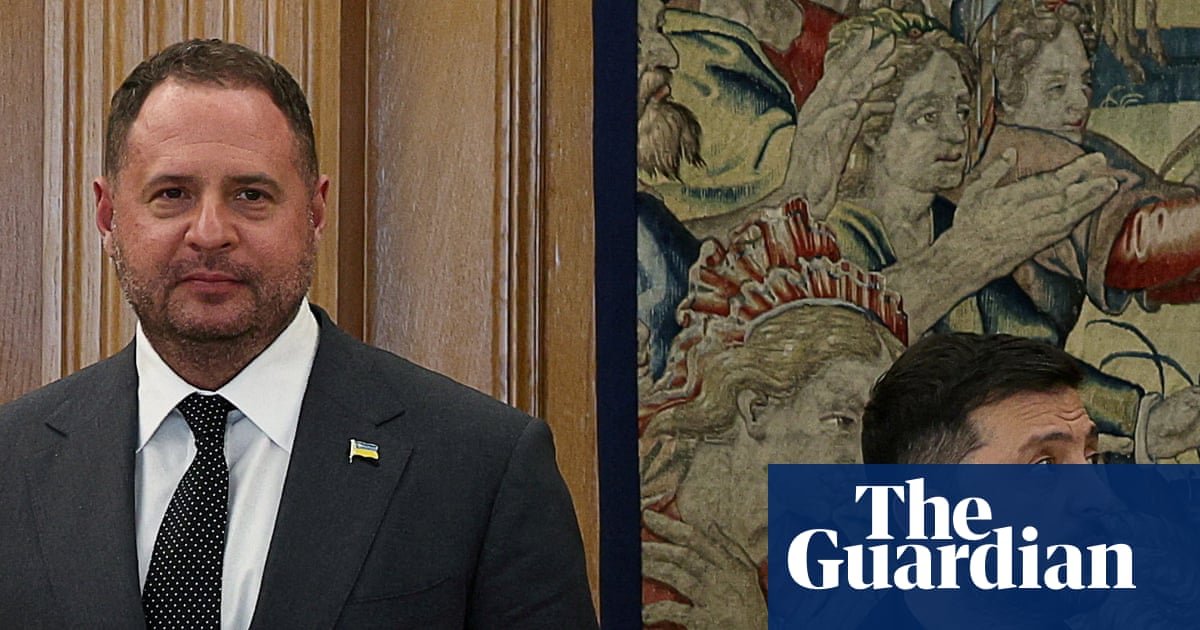
Ukraine’s political system is preparing for a “mini-revolution” as President Volodymyr Zelensky is forced to adapt to life without his closest adviser, chief enforcer and most loyal ally, Andriy Yermak, who resigned on Friday after his apartment was searched as part of a broader anti-corruption investigation.
Yermak’s resignation could have tremendous consequences for domestic governance as well as Ukraine’s negotiating position in negotiations to end the war with Russia, where he served as head of Ukraine’s delegation to peace talks with the White House.
“This is a small revolution in the political system and the system of governance,” said Volodymyr Fesenko, a Kiev-based political analyst. “Yermak was a key element in the system of power that Zelensky built.”
Yermak, a former intellectual property lawyer turned B-movie producer and then lawyer for Zelensky’s production company, when Zelensky was still an actor. When his friend won the 2019 presidential election, Yermak followed him into politics, first as a foreign policy advisor and then as chief of staff a year later.
As Yermak grew closer to the presidency during the years of full-scale war, it appeared that he had become untouchable. He ran the most sensitive tracks of Ukraine’s foreign policy, spoke regularly with national security advisers of friendly countries and was in charge of the team working on peace talks.
He was also Zelensky’s main political fixer, often giving orders to ministers, and was widely considered to be in line with the president’s wishes. It was Yermak who traveled to London to meet with former army commander Valery Zaluzhany, widely seen as the most dangerous political challenger to Zelensky, and encouraged Zaluzhany to join Zelensky’s team.
Some of the Ukrainian elite liked Yermak, but many expressed grudging admiration for his work ethic and his ruthless planning. Some believed that level of control, unusual in a democracy, was justified by the wartime context. Additionally, his role as a hate figure often helped protect Zelensky.
Even when Yermak’s apartment was searched on Friday, few expected it would force him out of office, as a widespread understanding had developed that Zelensky was unlikely to abandon his most trusted aide at any cost.
Although Yermak has not been charged at this point, amid growing public discontent over corruption, the anti-corruption investigation threatens to dominate the news agenda and create a full-blown crisis.
Zelensky’s approval ratings had already suffered a serious blow due to the scandal. On Saturday, the Ukrainska Pravda outlet reported through sources that investigators had seized several laptops and mobile phones from Yermak’s apartment for analysis.
“For Zelensky, this decision would have been difficult to make; he understood the political necessity but was psychologically dependent on Yermak,” said Fesenko, who suggested that it was most likely that Yermak’s resignation was his own decision, not a case of Zelensky ordering him to leave. “I think Yermak understood that if he went down, he would bring Zelensky down with him, and he decided to sacrifice himself to save Zelensky.”
As always after the fall of a powerful political figure, the period of readjustment can be messy. Some of Yermak’s loyal retainers will now fear for their jobs, while many others in the elite will breathe a sigh of relief, and will be hoping to gain more direct access to the President.
“Yermak was not only monitoring the president’s contacts with the outside world, but also passing information to the president,” said Olena Prokopenko, senior fellow at the German Marshall Fund.
After newsletter promotion
Yermak was widely believed to control a network of Telegram channels that spilled dirt on those who crossed him, and was known for brutal policing of access to Zelensky. “There were about five or six people who had direct access to the president and Yermak systematically attempted to take them out,” Fesenko said.
One of those who has managed to hold back is longtime military intelligence chief Kirill Budanov, who has survived several alleged attempts to fire him under Yermak. Others who displeased Yermak or were seen to be becoming too popular were unceremoniously fired.
Zelensky is expected to announce a replacement soon. Most of the names that have emerged so far are from the president’s inner circle, but whoever is chosen is unlikely to have Yermak-like power, at least initially.
This could prove challenging for a weakened Zelensky, especially if the corruption investigation leads to further revelations. Alternatively, it could give his presidency, which has already been extended by more than a year from its planned endpoint due to the impossibility of holding elections during martial law, the influx of new ideas and more unanimous decision-making, that many are demanding.
“There is a very strong demand in Ukrainian society for the revision of the social contract between the president and the people and for the restructuring of relations between the president and the cabinet and parliament,” Prokopenko said.
<a href