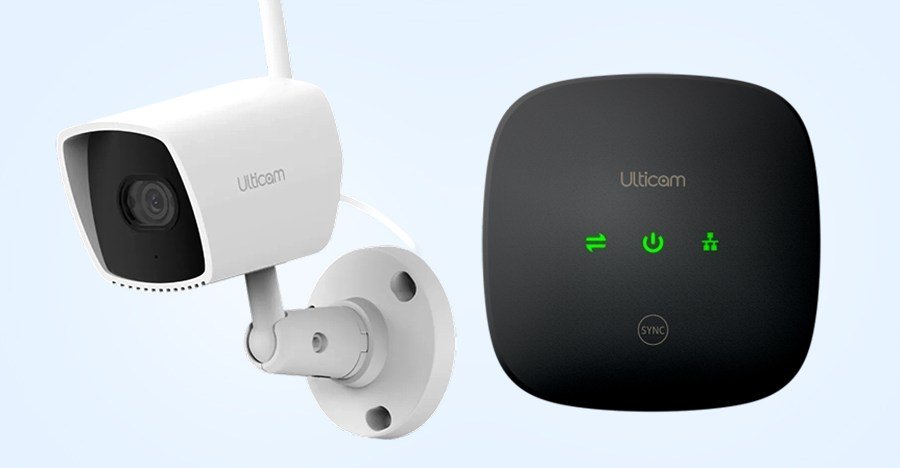
First announced at CES 2026 earlier this year, Xthings plans to release two new long-range wireless security camera kits in the second quarter of this year, with prices ranging from $489.99 to $989.99 depending on the number and type of cameras included. The cameras will use the Wi-Fi HALO (802.11ah) protocol to transmit video wirelessly at distances up to 1,000 meters (more than 0.6 miles) despite obstacles such as buildings in the way, making installation easier for larger facilities and properties.
The UltiCam Long-Range Wireless AI Security Kit is the smaller of the two kits. It combines the company’s four B25W outdoor cameras that record at 4MP (2560×1440) with a HaLow Wi-Fi gateway since very few wireless routers currently support the long-range protocol.
For larger campuses and campuses, the UltiCam Wireless Long Range 8-Camera Bullet Kit + NVR includes eight weatherproof 4MP outdoor cameras with built-in mics and speakers for two-way communication, Halo support, and the option to use a wired Ethernet connection instead. The kit includes a network video recorder (NVR) that records video locally from all eight cameras to a pair of hard drives, as well as seven days of rolling cloud storage for redundancy.
While many security cameras on the market rely on infrared motion sensors to detect motion and then begin recording, this approach may miss the first few moments of an incident. UltiCam’s Halo systems instead use proprietary Always-On video technology, where the cameras operate in low power conditions, continuously capturing video at a low frame rate and analyzing it with AI to detect triggers including people, vehicles and animals, or events such as fire and smoke. This helps ensure that entire events are recorded, including the moments leading up to them.
Wi-Fi HaLow first made its debut over a decade ago at CES 2016 as an alternative to Bluetooth for low-power IoT devices. It uses sub-GHz signals that can travel farther and penetrate more obstacles, including foliage and walls, than traditional Wi-Fi, but at lower bandwidth. Many of its use cases include allowing wireless cameras to be installed over considerable distances without the need to rely on long cables, Wi-Fi repeaters or cellular connections. But the technology has been slow to catch on. While companies like Abode have also announced HaLow-compliant security devices, its Edge camera hasn’t been released yet, two years after its debut at CES 2024.
<a href