Ona MaroccioAnd
Sara Buckley,BBC Eye Investigation

 Shutterstock
Evidence gathered by the BBC shows that Georgian authorities used World War I-era chemical weapons to crush anti-government protesters last year.
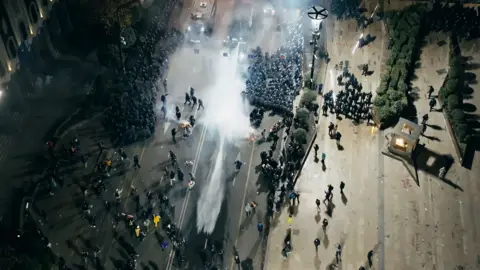
“You can feel (the water) burning,” one of the protesters said of water being sprayed on him and others on the streets of the capital, Tbilisi. A sensation, he said, which cannot be washed off immediately.
Protesters against the Georgian government’s suspension of a bid to join the European Union have also complained of other symptoms – shortness of breath, cough and vomiting that have persisted for weeks.
 gela khasaiya
The BBC World Service has spoken to chemical weapons experts, informants from Georgia’s riot police and doctors and has found that evidence points to the use of an agent that the French military named “camite”.
Georgian officials said that the findings of our investigation were “absurd” and that police had acted legally in response to “the illegal actions of brutal criminals.”
Camite was deployed by France against Germany during World War I. Little documentation exists regarding its later use, but it is believed to have been taken out of use in the 1930s due to concerns about its long-term effects. CS gas – often called “tear gas” – was used as a replacement.
Constantine Chakhunashvili was one of those who gathered outside the Parliament of Georgia in Tbilisi during the first week of protests that began on 28 November 2024. The protesters were angry at the ruling party’s announcement that it was halting EU accession talks. The goal of EU membership is enshrined in the Constitution of Georgia.

Georgia police responded with various riot-control measures, including the use of water cannon, pepper spray, and CS gas.
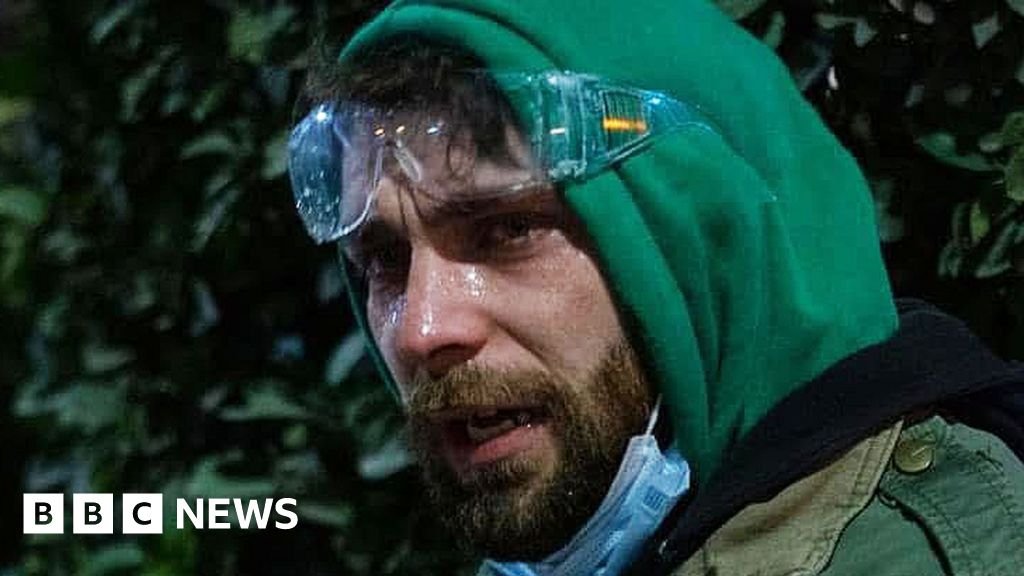
Dr. Chakhunashvili, a pediatrician who was among those sprayed from the cannons, and who has participated in many demonstrations, said that his skin felt as if it had been burning for days, and the sensation could not be washed off. In fact, he said, “it was even worse when trying to wash it off”.
Dr. Chkhunashvili wanted to find out if other people suffered similar effects. He therefore appealed, via social media, to people targeted by crowd control measures during the first week of demonstrations to fill out a survey. About 350 people got in touch, and about half said they suffered one or more side effects for more than 30 days.
These long-term symptoms ranged from headache to fatigue, cough, shortness of breath and vomiting.
Their study has since been peer-reviewed and accepted for publication by Toxicology Reports, an international journal.
He also examined sixty-nine of the people surveyed by Dr. Chakhunashvili and found that there was a “significantly higher prevalence of abnormalities” in the electrical signals in the heart.
Dr. Chakhunashvili’s report reiterated the conclusions that local journalists, doctors, and civil rights organizations had come to that the water may have been mixed with chemicals. They asked the government to identify what was used, but the Ministry of Internal Affairs, responsible for the police, refused.
Several high-level whistleblowers associated with the Special Operations Division – the official name of Georgia’s riot police – helped the BBC determine the possible identity of the chemical.
Lasha Shergelashvili, a former head of weapons at the department, believes this is the same compound he was asked to test for use in water cannon in 2009.
 Lasha Shergelashvili
He says the effects of the product were unlike anything he had experienced before. He had difficulty breathing after standing close to where it was sprayed and he and the 15-20 colleagues who tested it with him could not wash it off easily.
“We noticed that the effect was not diminishing, as is the case with (regular) tear gas. Even when we washed our faces with water, and then with a special solution of baking soda and water that had been prepared in advance, we still could not breathe freely.”
Mr Shergelashvili says that as a result of his tests, he recommended against the use of the chemical. But he says the water cannon vehicles were still filled with water – and that situation continued until at least 2022, when he quit his job and left the country.
Speaking from his new home in Ukraine, he told the BBC that when he saw footage of protests last year, he immediately suspected that protesters were being subjected to the same chemicals.
He further said that colleagues with whom he has been in contact and who are still in office have also told him that this is the case.
And the BBC spoke to another former high-level police officer, who confirmed that much of what was loaded into the water cannon vehicles when Mr Shergelashvili was in office was the same compound that was deployed in the November-December 2024 protests.
- Viewers in the UK can watch more on Global Eye at 19:00, 1 December, on BBC Two
- Outside the UK, watch the film bbc world service youtube
When Mr Shergelashvili was asked whether the product he tested might just be CS gas – which irritates the eyes, skin and respiratory system, but only temporarily – he said it appeared to be much stronger than that.
“I can’t cite any examples or compare it to anything else,” he said, adding that it is “probably 10 times” stronger than traditional riot-control agents.
“For example, if you spill this chemical on the ground, you won’t be able to stay in that area for the next two to three days, even if you wash it off with water.”
Mr Shergelashvili does not know the name of the chemical he was asked to test.
But the BBC managed to obtain a copy of the December 2019 Department of Special Operations list.
We found that it contained two unnamed chemicals. These were listed simply as “chemical liquid UN1710” and “chemical powder UN3439”, along with instructions on how they should be mixed.
We wanted to check if this list was authentic, so we showed it to another former high-ranking riot police officer, who confirmed that it looked genuine. They identified two unnamed chemicals that were likely mixed into the water cannon.
Our next step was to find out what these chemicals were.
UN1710 was easy to identify because it is the code for trichlorethylene (TCE), a solvent that enables other chemicals to dissolve in water. Then we had to find out which chemical it was helping to dissolve.
UN3439 was very difficult to identify because it is an umbrella code for a whole range of industrial chemicals, all of which are hazardous.
The only one of these that we have used as a riot-control agent is bromopropyl cyanide, also called camite, which was developed by the Allies for use in World War I.
We asked Professor Christopher Holstege, the world’s leading toxicology and chemical weapons expert, to assess whether our evidence points to chamite as the likely agent used.
 Shutterstock
Based on the results of Dr. Chakhunashvili’s study, the victim’s testimony, the riot police lists, and the details of Mr. Shergelashvili’s chemical tests, Professor Holstege believes that this is the case.
“Based on the available evidence…the clinical findings reported by exposed individuals and other witnesses are consistent with bromopropyl cyanide.”
He ruled out the possibility of the symptoms being caused by more traditional crowd control measures such as CS gas, which was also being deployed by Georgia riot police last year.
He stated, “The persistence of clinical effects… is not consistent with typical agents used to disperse crowds such as CS.”
“I have never seen camite being used in modern society. Camite is obviously irritating (and) persistent with its irritation.”
He speculated that it may have been used because it would act as a strong deterrent.
“It will keep people away for a long time. They can’t disinfect (themselves). They have to go to the hospital. They have to leave the area. If that is indeed the case – that this chemical has been brought back – then it really is extremely dangerous.”
Chemite was used as a riot control agent for a short time by American police after World War I, but was abandoned after the invention of safer alternatives such as CS gas.
Under international law, police forces are allowed to use chemicals as crowd-control agents, as long as they are considered proportionate and have only a short-term effect.
According to weapons experts consulted by the BBC, an obsolete and more powerful agent could be classified as a chemical weapon, given that police have safer and more conventional riot-control agents available.
Alice Edwards, the UN special envoy on torture, said our findings were worrying. Ms Edwards previously wrote to the Government of Georgia regarding allegations of police violence and torture during protests.
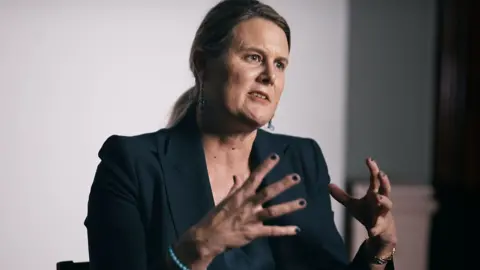
The lack of strict regulation regarding the use of chemicals in water cannons is a problem she would like to address: “This leads me to regard (this practice) as an experimental weapon. And populations should never be subjected to experiments. This is a complete violation of human rights law.”
He stressed that any effect of riot control measures must be temporary under international law, and that the symptoms described “go beyond what is considered temporary and acceptable. Therefore all cases should be investigated, including those under torture or other ill-treatment”.
Georgia officials described our findings as “grossly frivolous” and “absurd.”
It said law enforcement had acted “within the bounds of the law and the Constitution” when responding to “the illegal actions of brutal criminals.”
The size of the protests on Tbilisi’s Rustaveli Avenue has shrunk since the government increased fines and prison sentences, but their frequency has not.
Almost every night for the past year, protesters have called for the resignation of a government they accuse of rigging elections, favoring Russian interests and passing increasingly harsh laws against civil society.
The ruling Georgian Dream party has denied that the government or the party’s honorary chairman, Bidzina Ivanishvili, are either pro-Russian or pursuing Russian interests. It told the BBC that legislative changes last year served the best interests of the “public welfare”.
<a href