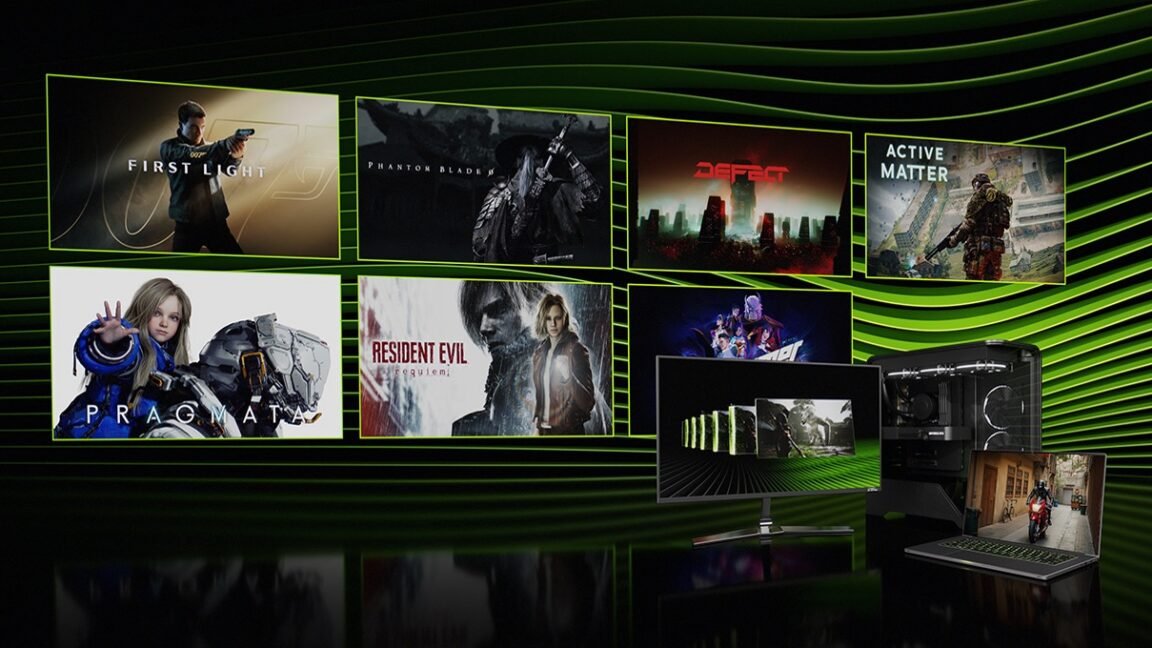

For the first time in years, Nvidia declined to introduce new GeForce graphics card models at CES. CEO Jensen Huang’s 90-minute keynote focused almost entirely on the company’s core AI business, leading to the company’s gaming-related announcements in a separate video posted later in the evening.
Instead, the company focused on software improvements for its existing hardware. The biggest announcement in this sequence is DLSS 4.5, which adds some new features to Nvidia’s basket of upscaling and frame generation technologies.
DLSS upscaling is being improved by a new “second-generation Transformer model”, which Nvidia says has been “trained on expanded data sets” to improve its predictions when creating new pixels. According to Nvidia’s Brian Catanzaro, this is especially beneficial for image quality in Performance and Ultra Performance modes, where the upscaler has to guess more because it is working from a lower-resolution source image.
DLSS multi-frame generation is also being improved, increasing the number of AI-generated frames per rendered frame from three to five. This new 6x mode for DLSS MFG is being combined with something called Dynamic Multi-Frame Generation, where the number of AI-generated frames can change dynamically, increasing the number of frames generated during “demanding scenes” and decreasing the number of frames generated during simpler scenes “so it only calculates what is necessary.”
The standard caveats for multi-frame generation still apply: it still requires an RTX 50-series GPU (the 40-series can still only generate one frame for each rendered frame, and older cards can’t generate extra frames at all), and the game still needs to run at a reasonably high base frame rate to minimize lag and weird rendering artifacts. This remains a useful tool for making fast-paced games run faster, but it won’t help make unplayable frame rates playable.
<a href