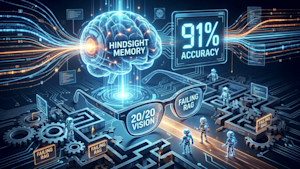

In 2025 it has become clear that retrieval augmented generation (RAG) is not sufficient to meet the growing data requirements for agentic AI.
Over the last few years, RAG has emerged as the default approach for connecting LLMs to external knowledge. The pattern is straightforward: segment documents, embed them in vectors, store them in the database, and retrieve the most similar passages when a query arrives. This works well enough for one-off queries on static documents. But the architecture breaks down when AI agents need to work across multiple sessions, maintain context over time, or separate what they have seen from what they believe.
A new open source memory architecture called Hindsight tackles this challenge by organizing AI agent memory into four distinct networks that separate world facts, agent experiences, synthesized entity summaries, and evolved beliefs. The system that was developed by vectorize.io The collaboration, from Virginia Tech and The Washington Post, achieved 91.4% accuracy on the LongMemEval benchmark, outperforming existing memory systems.
"RAG is on life support, and Agent Memory is about to completely kill it," Chris Latimer, Co-Founder and CEO vectorize.iotold VentureBeat in an exclusive interview. "Most of the existing RAG infrastructure that people have installed is not performing at the level they would like."
Why can’t RAG handle long-term agent memory?
RAG was originally developed as an approach to provide LLMs with access to information beyond their training data without having to retrain models.
The main problem is that RAG treats all retrieved information equally. A fact observed six months ago is treated the same as an opinion formed yesterday. Information that contradicts earlier statements sits side by side with the original claims and there is no way to reconcile them. The system has no way to represent uncertainty, track how belief evolved, or understand why it reached a particular conclusion.
The problem becomes worse in multi-session conversations. When an agent needs to retrieve details from hundreds of thousands of tokens spanning dozens of sessions, the RAG system either fills the context window with irrelevant information or is missing important details altogether. Vector similarity alone cannot determine what matters for a given question when that question requires understanding temporal relationships, causal chains, or entity-specific context accumulated over weeks.
"If you have a one-size-fits-all approach to memory, then either you’re carrying too many references that you shouldn’t be carrying, or you’re carrying too few references," Naren Ramakrishnan, professor of computer science at Virginia Tech and director of the Sangani Center for AI and Data Analytics, told VentureBeat.
The shift from RAG to agentic memory with hindsight.
The shift from RAG to agent memory represents a fundamental architectural change.
Instead of treating memory as an external retrieval layer that dumps text segments into signals, Hindsight integrates memory as a structured, first-class substrate for logic.
The main innovation in Hindsight is the division of knowledge into four logical networks. The World Network stores objective facts about the external environment. The bank captures the network agent’s own experiences and actions, written in the first person. Opinion networks maintain subjective judgments with confidence scores that are updated as new evidence arrives. The observation network maintains a priority-neutral summary of entities synthesized from the underlying facts.
This separation addresses what researchers call "epistemic clarity" By structurally separating evidence from inference. When an agent forms an opinion, that belief is stored separately from the facts supporting it, along with a confidence score. As new information arrives, the system may strengthen or weaken existing opinions rather than treating all stored information as equally certain.
The architecture consists of two components that mimic how human memory works.
TEMPR (Temporal Entity Memory Priming Retrieval) handles memory retention and recall by running four parallel searches: semantic vector similarity, keyword matching via BM25, graph traversal via shared entities, and temporal filtering for time-constrained queries. The system merges the results using Reciprocal Rank Fusion and applies a neural reranker for final precision.
CARA (Coherent Adaptive Reasoning Agent) handles preference-aware reflection by integrating configurable dispositional parameters into the reasoning: skepticism, literalism, and empathy. This addresses inconsistent logic across sessions. Without a priori conditioning, agents generate locally plausible but globally inconsistent responses because the underlying LLM has no stable perspective.
Hindsight achieved the highest LongMemEval score at 91%
Hindsight is not just theoretical academic research; The open-source technology was evaluated on the LongMemEval benchmark. The test evaluates agents on conversations spanning up to 1.5 million tokens over multiple sessions, measuring their ability to recall information, reason across time, and maintain a coherent viewpoint.
The LongMemEval benchmark tests whether AI agents can handle real-world deployment scenarios. One of the major challenges enterprises face are agents that perform well in testing but fail in production. Hindsight achieved 91.4% accuracy on the benchmark, the highest score recorded in the test.
The comprehensive set of results revealed where structured memory provides the biggest benefits: multi-session queries increased from 21.1% to 79.7%; Temporal reasoning increased from 31.6% to 79.7%; And knowledge update questions increased from 60.3% to 84.6%.
"This means your agents will be able to do more work, more accurately and consistently than before," Latimer said. "This allows you to get a more accurate agent that can handle more mission-critical business processes."
Enterprise deployment and hyperscalar integration
For enterprises considering how to deploy Hindsight, the implementation path is straightforward. The system runs as a single Docker container and integrates using LLM wrappers that work with any language model.
"It’s a drop-in replacement for your API calls, and you start filling memories immediately," Latimer said.
The technology targets enterprises that have already deployed RAG infrastructure and are not seeing expected performance.
"Much of the existing RAG infrastructure that people have in place is not performing at the level they would like, and they are looking for more robust solutions that can solve the problems companies face, which are typically the inability to get the right information to complete a task or answer a set of questions," Latimer said.
Vectorize is working with hyperscalers to integrate the technology into cloud platforms. The company is actively partnering with cloud providers to support its LLM with agent memory capabilities.
What does this mean for enterprises
For enterprises leading AI adoption, Hindsight represents a way beyond the limitations of current RAG deployments.
Organizations that have invested in recovery augmented generation and are seeing inconsistent agent performance should evaluate whether structured memory can address their specific failure modes. The technology is particularly suitable for applications where agents must maintain context across multiple sessions, handle contradictory information over time or explain their reasoning.
"RAG is dead, and I think Agent Memory is going to kill it all." Latimer said.
<a href