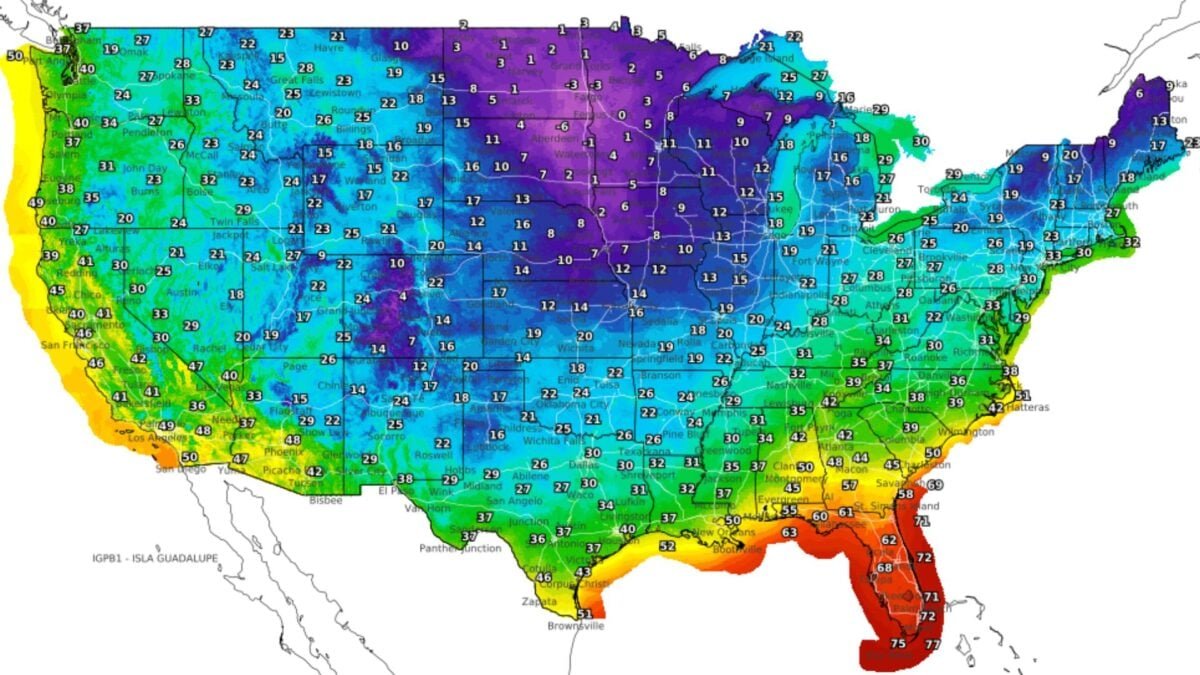

A blast of Arctic air caused temperatures to drop across the eastern US over the weekend, and two more cold waves are expected. Meanwhile, a major hurricane currently impacting Central America is moving east, and cooler temperatures could help it rapidly transform into a bomb cyclone.
As of Monday – the first day of meteorological winter – the National Weather Service (NWS) has issued winter weather advisories for 17 states from Oklahoma to New York, as well as a winter storm watch for much of New England. CNN meteorologists expect the storm to undergo bombogenesis – a pressure drop of at least 24 millibars in 24 hours – as it tracks over the East Coast, bringing the first widespread snowfall of the season to parts of the Northeast.
Even as the storm moves north toward Canada late Tuesday, forecasts show the cold will persist. A major polar vortex disruption could continue to send waves of icy Arctic air toward the US into early next week.
“Not one, not two, but three blasts of cold air could reach the United States this week, each moving a little further south and east than the last,” Washington Post meteorologist Ben Noll posted Sunday.
Not one, not two, but three blasts of cold air could reach the United States this week, each moving a little further south and east than the last.
Meteorological winter starts from Monday. pic.twitter.com/eDV5VRCvZV
– Ben Noll (@BenNollWeather) 30 November 2025
How Arctic blasts fuel bomb cyclones
The storm’s amount of snow and ice will largely depend on how it interacts with the incoming Arctic air. By Tuesday, overnight temperatures are expected to drop below zero across the Northern Plains and Midwest and as far south as North Texas.
Bombogenesis occurs when a cold air mass collides with a warm air mass, which is happening now as the Arctic blast meets warm, moist air near the Gulf Coast. Meteorologists expect the interaction between these opposing air masses to cause a rapid drop in pressure that will strengthen the winter storm moving across the eastern US.
Bomb cyclones produce stronger winds and heavier rainfall than your typical rain or blizzard. Although the impact of this week’s Bomb cyclone remains to be seen, it will compound the impact of heavy snowfall that accumulated in many states over the weekend.
here comes the snow
Local snowfall amounts of several inches to a foot have already been reported across the Midwest, according to the NWS. Hazardous conditions caused a pileup of 45 cars in Indiana and a Delta jet skidded off the runway in Iowa on Sunday — one of the biggest travel days of the year.
Over the next several days, parts of the Midwest and Great Lakes region will see even more snowfall, with accumulations ranging from a light dusting to several inches, according to CNN. As the storm moves towards the northeast on Tuesday morning, traffic is likely to be affected. Parts of northern New England, including coastal Maine, central New Hampshire and southern Vermont, could get up to 15 inches of water.
For much of the Northeast, this will be the first impactful winter storm of the season, according to the NWS. “Although uncertainty remains regarding specific totals, there is an increasing risk of significant snow accumulation in the interior, with more than 6 [inches] Possible north and west of the I-95 corridor,” officials said in a Monday update.
With more arctic air coming down, winter is certainly off to a brutal start. The season has just begun, but the coldest days of December may still be on the horizon.
<a href