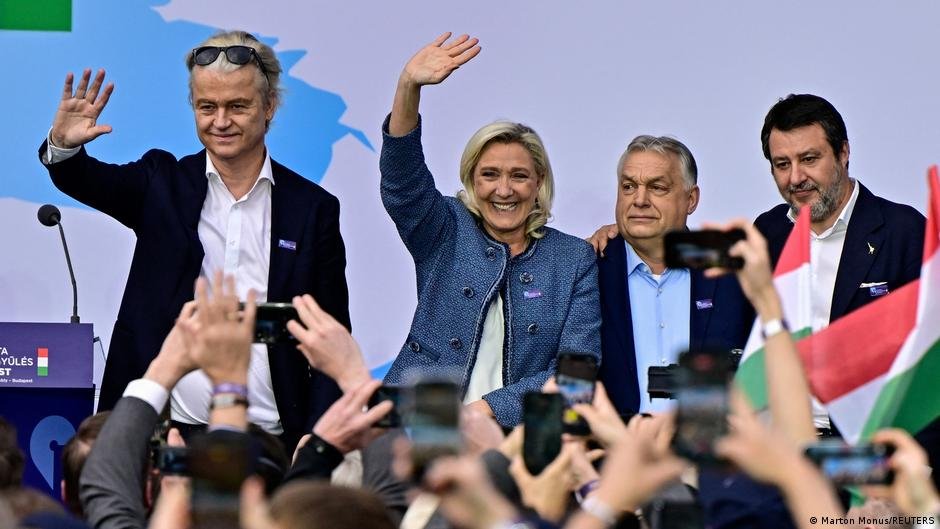
Hungarian Prime Minister Viktor Orbán appeared alongside other prominent leaders of European populist and far-right movements, including Geert Wilders of the Netherlands, France’s Marine Le Pen and Spain’s Santiago Abascal. The crowd appeared to be mostly made up of longtime supporters of Orbán’s Fidesz party.
“I want Fidesz and peace to remain,” an elderly woman who lived in the United States for a long time and recently returned to Hungary told DW. Another participant explained that she was there because, “I’m a Hungarian, a peace-loving Christian and I stand up for conservative values.”
Orbán’s prominent guests praised the Hungarian prime minister in a way that bordered on a personality cult. Wilders called him a “lion”, Italy’s Matteo Salvini praised him as a “true hero” and Austria’s Herbert Kickl said in a video message that Orbán was “the only man among the blind in Brussels who can see.”
Orbán himself gave an uninspired speech full of the clichés he is known for. Once again, he promised that “patriot forces will capture Brussels.” He told the audience that EU countries led by liberal-progressive governments were headed towards economic and social ruin, while Hungary under his leadership was flourishing with a rapidly growing economy.
In his speech, there were parallels to former communist dictators who had declared victory over capitalism as their countries sank into desolation and misery – a situation that exists in many parts of the Hungarian countryside.
Fidesz lags behind the opposition
“Such events are a communications offensive in line with the pre-election period,” says political scientist Bulsu Hunyadi, head of research at the Political Capital consultancy in Budapest. “They are meant to demonstrate how many international allies Viktor Orbán has and to portray him as an important player in global politics. But if you look closely, they only reach audiences that are already sympathetic to Orbán.”
On Saturday, Orban took the stage at the Conservative Political Action Conference, commonly known as CPAC Hungary, where he made a similar protest. In both incidents, the Prime Minister came across as an aging autocrat who is running out of ideas but stubbornly clings to power.
In fact, Orban is in serious trouble ahead of parliamentary elections on April 12. The Hungarian government is devoting all available state financial resources and even state apparatus personnel to the election campaign – which is not legal. Orbán’s party, the Hungarian Civic Alliance, or Fidesz, still trails the opposition party Tisza, or Respect and Freedom Party, by a wide margin in the polls.
corruption and scam
Orban has built his election campaign entirely around Ukraine and the European Union, with the theme of “war or peace”. But domestically, he is hampered by corruption and environmental scandals, as well as questions about how much the self-proclaimed “sovereignist” he is is under Russia’s thumb.
The latest corruption scandal focuses on the former head of the National Bank, György Matolsi. Several years ago, he spectacularly renovated the National Bank of Hungary, or MNB, building in Budapest at a cost of approximately €275 million ($319 million). Among other things, Matolassi had himself a deluxe bathroom made of gold and black marble, complete with golden toilet brushes and golden toilet paper holders.
The Matolsky family and National Bank have been making headlines for years. The former MNB chairman was revealed to have embezzled public funds into a complex scheme which was used by Matolesi’s son Adam and his group of friends to finance their lavish lifestyle. The latest scandal involving the MNB building renovation came to light as independent media outlet, 444.hu, won a lengthy legal battle to release relevant documents. The golden toilet brush has become a symbol of the decadence and arrogance of the Orban elite.
Also, a scandal at a battery factory north of Budapest is stoking public anger in Hungary. Samsung had violated environmental rules there For years more workers were exposed to toxic heavy metal dust. Although the government was aware of this, it did not take any action.
It is even said that Foreign Minister Peter Szijjarto had prevented the factory from being approved. For many Hungarians, this only reinforces the perception of an elite that seeks to enrich itself at the expense of citizens’ health and the environment.
close ties to the Kremlin
Additionally, there is growing controversy over Russian influence during the Hungarian election campaign and on the country’s government. Investigative journalist Szabolcs Pani published a transcript of a 2020 conversation between Foreign Minister Szijjarto and his Russian counterpart Sergei Lavrov, in which Szijjarto politely asks for campaign assistance for populist and far-right nationalist parties in Hungary’s neighbor Slovakia.
A few days ago, it emerged that Szijjarto was regularly calling Moscow during European Council meetings in Brussels to brief the Kremlin leadership. Szijjarto himself acknowledged the talks but described them as standard diplomatic practice. Yet, this is the exact opposite of the “sovereignty” that the Orbán government often emphasizes. It often denigrates political opponents as paid puppets of foreign powers who undermine Hungary’s sovereignty.
That’s why the “Patriots’ Grand Assembly” – the event was named after the political grouping of nationalists in the European Parliament – also rubbed some Budapest residents the wrong way.
On Székely Kalman Square, only a few hundred meters from Milenaris Park, many passers-by had not even heard of the gathering. But others expressed displeasure. Dani, a young man in his early twenties, called the incident “pathetic.” Recent scandals have weakened the reputation of nationalists, he said.
He concluded, “The fact that they still think it is credible to play the great Hungarian is obnoxious.”
This article was originally published in German.
<a href