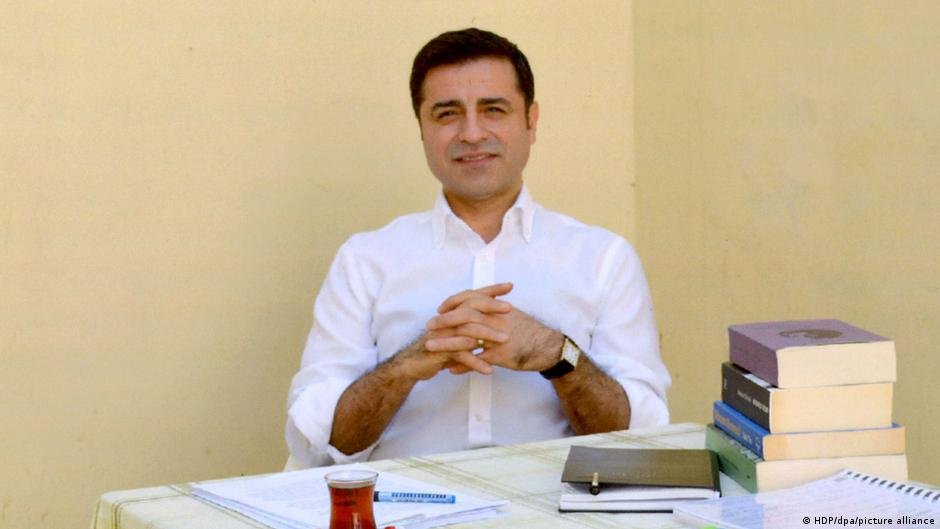
Many Kurdish voters in Türkiye still remember an incident that occurred during Selahattin Demirtaş’s election campaign in 2014.
Demirtas’ tour bus was moving slowly and a young paper collector was walking beside it. “Selahattin Baskan, my President Selahattin!” The young man said smiling. The incident became a symbol of the hopes that young Kurds in Turkey placed in Demirtas, head of the pro-Kurdish Peoples’ Democratic Party, or HDP, after decades of tension between Kurdish militants and the Turkish government.
As a candidate, Demirtas was a surprisingly successful newcomer. Polls indicated that many voters thought he was intelligent, charming, polite, and even funny – even if they did not vote for him.
Demirtas received about 10% of the votes in the 2014 presidential election. If all Kurdish locals had voted for him his vote would have been 7%, indicating that he was popular beyond ethnic lines.
Then only 40 years old, Demirtas became a beacon for the long-divided Turkish left. In subsequent parliamentary elections, they prevented the ruling Justice and Development Party, or AKP, from regaining the absolute majority it has enjoyed since coming to power.
But then in 2016, he was arrested and accused of being a member of a terrorist organization – the Kurdistan Workers’ Party, or PKK, a militant Kurdish group – and inciting violence. Last year he was sentenced to 42 years imprisonment.
For years now, the European Court of Human Rights, or ECHR, has condemned Demirtas’ arrest, called his trial unlawful, and called for his release. The government in Türkiye had previously ignored the International Court of Justice.
In November, the ECHR rejected Türkiye’s appeal against its decision and again concluded that the politician’s trial was politically motivated. But this time Turkish President Recep Tayyip Erdogan said his government would abide by the judiciary’s decision, a statement that gave Demirtas’ supporters hope he could be released.
Who is Selahattin Demirtas?
Demirtas was born in 1973 in the Eastern Anatolian province of Elazığ. He studied law at Ankara University and after graduating, he settled in the Kurdish-majority metropolis of Diyarbakir and worked on cases involving human rights violations. He also became the head of the Diyarbakir branch of the pro-PKK Human Rights Association.
In 2007, the young lawyer was elected to the Turkish Parliament for the first time as a representative of Diyarbakir. Demirtas then held a number of senior roles in various pro-Kurdish political parties, until in 2014, he became co-chairman of the HDP.
At the time, the first peace process was underway with Kurdish anti-government groups and the pro-Kurdish HDP wanted a majority in Kurdish-majority cities in Türkiye. It promoted itself as a liberal party for all Turkish voters.
Demirtas contacted Türkiye’s leftist parties and the local Green Party and formed an alliance with them. In the parliamentary elections in June 2015, the HDP won about 13% of the vote and 80 seats.
It dealt Erdogan’s AKP party the biggest blow in 13 years as voters denied it a majority for the first time since 2002. It also made Demirtas Erdoğan’s main political rival.
Because no government was formed within the legally mandated time, another election had to be held in November 2015 and this time, the AKP regained its lost votes.
42 years jail sentence
All peace talks with anti-government Kurdish groups ended soon thereafter and an attempted coup against the government followed in 2016. Subsequently, the Erdogan-controlled government cracked down on all rivals; Demirtas and 10 other HDP members were arrested.
Reha Ruhavioglu, director of the Center for Kurdish Studies in Diyarbakir, believes that Erdogan had actually harbored a grudge against Demirtas since the 2015 election shock and had wanted to imprison him ever since.
Ruhavioglu says Demirtas has lost almost all contact with his supporters since being in prison. But the Turkish government has not been able to completely eradicate it.
Ruhavioğlu believes this is because of Demirtas’ personality – he is smart and also has extraordinary emotional intelligence, he is a born leader and is very good at connecting with voters. Ruhavioglu suggests that no one else has really rivaled him over the past nine years.
This has been confirmed by Diyarbakir-based polling institute Rawest Research. Over 1,400 Kurdish voters were asked about their favorite politicians: Demirtas was the most popular by a wide margin. Interviewees said that they most represented Kurdish identity and the rights of Kurds, but also had the capacity to engage in dialogue with other ethnic and social groups.
change in political environment
For more than a year now, rapprochement between the Turkish government and Kurdish groups has been increasing. In May, the PKK, which is classified as a terrorist organization by several countries, agreed to lay down its arms on the orders of its imprisoned leader Abdullah Ocalan.
Although Ocalan remains the most important figure in the process, with both the military and political wings of the PKK listening to him, Ruhavioğlu believes that Demirtaş may be the most important civilian figure.
Ruhavioglu says he is the right person to play a strong role in the democratic process going forward.
Recently Demirtas sent a message from inside the prison saying that he supports the current peace process and would be willing to assume responsibility within it.
The question is whether President Erdogan will allow them to do so. After all, Demirtaş is the politician who openly challenged him, preventing his party from gaining an absolute majority and hence his own steps to give himself more presidential power. Many believe Erdogan would prefer to negotiate with 76-year-old Ocalan rather than 52-year-old Demirtaş.
This story was originally published in German.