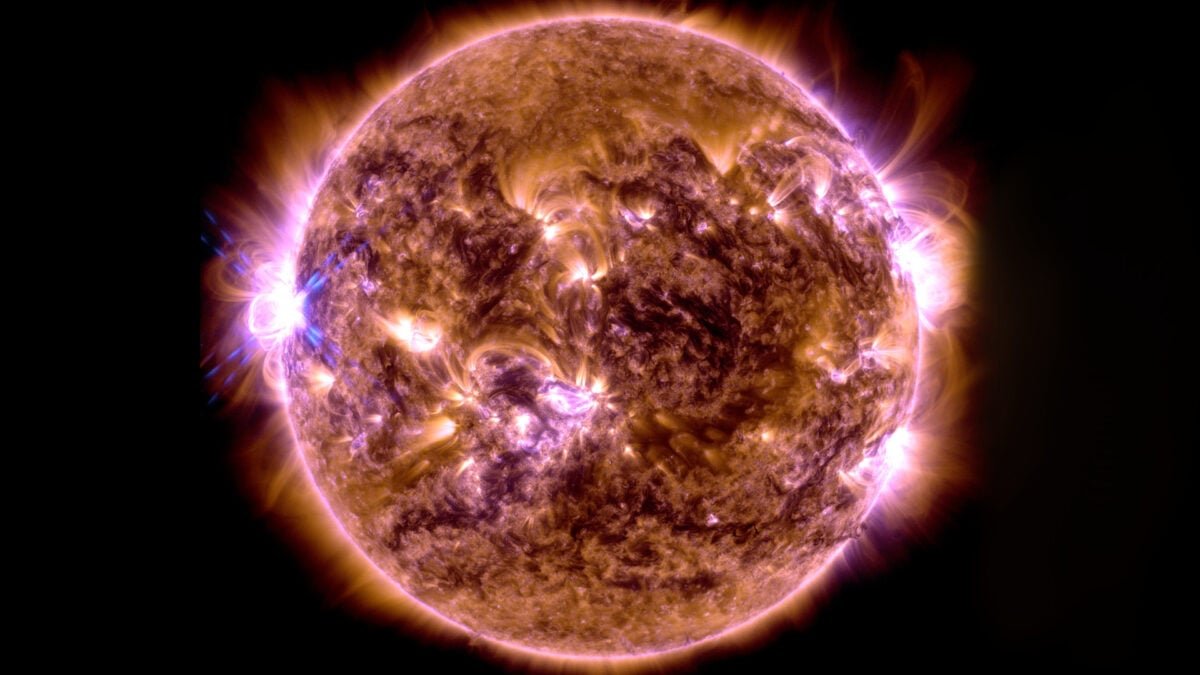
In a paper recently published in the International Journal of Plasma Environmental Science and Technology, researchers consider the possibility that solar activity is linked to earthquakes. Scientists said that when solar flares disrupt Earth’s magnetic field, they also cause slight changes in Earth’s upper atmosphere, which filters out the electrical forces that cause changes in our planet’s crust. These forces are weak but potentially serve as the straw that breaks the camel’s back.
“Let me be clear—we are not claiming that solar flares cause tectonic stress,” Ken Umeno, the study’s senior author and an applied mathematician at Kyoto University, told Gizmodo. “Our argument is about time, not energy. When a fault is already close to failure, even a small glitch can change the situation when it breaks.”
busy parts of the earth

The study’s model treats the Earth’s crust and ionosphere – a part of the Earth’s upper atmosphere filled with charged particles – as a giant electrical circuit. According to NOAA, radio and satellite communications systems depend on this particular aspect of the ionosphere.
This also means that the ionosphere is heavily affected by solar events, such as solar flares and geomagnetic storms, which alter the electromagnetic profile of the atmospheric layer.
On the other hand, the Earth’s crust has its share of increased electromagnetic activity. After all, Earth’s magnetic field itself is the product of moving hot, molten iron and nickel in Earth’s outer core. According to the U.S. Geological Survey, this constant movement of hot, lumpy material underground gives the Earth’s crust a permanent magnetism.
a waterfall of electrons
In the paper, the researchers connect the electromagnetic properties of these two layers. Given the sensitivity of the ionosphere to solar activity, powerfully charged particles within solar flares can force ionospheric electrons downwards.
This surge increases the electron density at low altitudes and disrupts the electrostatic balance in the Earth’s crust. Once the pressure increases to a certain level, it can generate enough force to move a fault in the crust. Normally, the Earth’s crust would not be much disturbed by such a fault, but for a “severely strained fault” things could be different, Umeno said.
The paper argues that the model is consistent with space weather patterns ahead of the Noto Peninsula earthquake in Japan on January 1, 2024. Even for Japan, where earthquakes are common, these events were truly devastating, causing at least 700 deaths and 204,903 damaged structures. Japan is one of the most seismically active regions in the world, with approximately 1,500 earthquakes occurring each year. A day earlier, the strongest solar flare on record for 2023 struck Earth. Similarly, an X-class flare could be followed by another earthquake in December 2025, Umeno said.
Coincidence or pattern?
This is not the first time that scientists have suggested this connection – although the question is now more a part of the US Geological Survey’s FAQ section than in academic circles. Similarly, while the new paper presents a provocative mathematical analysis, other experts have some concerns about its validity.
In an email to Gizmodo, University of Maryland geophysicist Nicholas Schmer called the study “highly speculative.” Schmer said the paper “does not present a thorough analysis or well-supported evidence that their proposed mechanism links solar flares and earthquakes.”
“Instead, they present a coincidence of a solar flare and an earthquake, which is probably just a coincidence,” he said.
Viktor Novikov, a geophysicist at the Russian Academy of Sciences, told Live Science that the model was “too simple” and did not include factors such as the electrical resistance of rock layers in the crust that could eliminate the effects proposed in the model.
Not “revolution”
In response, Umeno acknowledged the feedback, saying that the paper “does not claim to be final statistical proof.” However, he objected to “labeling the relationship that way.” [a] Coherence assumes that earthquake systems are dynamically isolated from space weather” and “in complex systems science, cross-scale interactions near instabilities are common.”
Asked about plans to further validate the model, Umeno said the team is currently planning a larger-scale analysis. And if they find “no measurable conditional effect,” that’s all — it will be rejected, he said.
“We are not claiming revolution,” Umeno said. “If the data refute this, the current framework stands. If measurable time modulation is present, seismic hazard models may need to be expanded. Either way, testing the question is scientifically valuable.”
high stakes
Strictly speaking, the paper proposes that a solar flare pushes an already stressed fault past its breaking point, causing an earthquake—No That the flames are directly linked to the earthquake. Then, it could be argued that, in the big picture of things, a million other smaller things in Earth’s various systems could act similarly to solar flares in the new model.
What I mean to say is that the study gives us a lot to think about. As Umno itself says, it will take years of intensive statistical analysis to issue a final decision.
<a href