SINGAPORE – On a lively weekend afternoon beneath the Marina Bay sands, there is no stage, no spotlights and no audience in the traditional sense. Still, familiar music fills the underground concourse.
A group of teenage girls count beats under their breath while harmonizing to “Focus” by rookie K-pop girl group Hearts2Hearts. A few meters away, another dance team is practicing choreography to TWICE’s “Feel Special,” adjusting their formation as shoppers pass by. No one seems surprised.
Such scenes now unfold regularly throughout Singapore, not only at historical sites but also near everyday malls and underground transit corridors. During a recent visit, pop-up stores dedicated to K-pop operated by major Korean labels such as SM Entertainment appeared alongside cafes, fashion and lifestyle brand stores, which witnessed steady foot traffic.
What emerges here is not a city hosting a temporary cultural event, but a city in which K-pop has settled into daily life. As this presence becomes more visible in shared urban spaces, it has also begun to shape how Singapore positions itself as a destination for live entertainment.
That shift comes into focus later this year, when K-pop juggernaut BTS brings their upcoming world tour to Singapore for four nights in December, one of the group’s longest stops in Asia.
These concerts reflect a partnership between the Singapore Tourism Board (STB) and HYBE and its affiliated labels which is effective from 2024.
“Based on the cooperation, we are pleased to host BTS’ four-day concert series in Singapore this coming December,” Seren Tan, STB’s executive director for North Asia, told The Korea Times in a written interview.
As large-scale concerts become more frequent, tourism officials in Singapore have described their role as “facilitative” rather than prescriptive.
“Our key role is to connect partners, showcase Singapore’s hosting capabilities and support the ecosystem required for major international events,” Tan said.
Blackpink performs during their “Blackpink World Tour ‘Deadline’ in Singapore” on March 30 at the Singapore National Stadium. The group is the only K-pop act to headline the venue twice. Courtesy YG Entertainment
How K-pop thrives in Singapore
The concerts come amid a widespread increase in K-pop presence across the city-state.
Singapore has seen strong growth in the K-pop concert scene post-pandemic, with STB expecting this trend to continue. Ticketmaster listings for K-pop events in Singapore are set to increase by nearly 250 per cent between 2022 and 2024, reflecting both fan demand and industry confidence.
There have also been a series of sell-out shows in recent years.
K-pop act SEVENTEEN filled the Singapore National Stadium for two nights in January 2025, while boy bands TXT and ENHYPEN sold out the Singapore Indoor Stadium in September 2024 and October 2025 respectively. BTS members have also returned in person, with Suga performing in 2023 and J-Hope in 2025.
Beyond attendance figures, industry executives are increasingly touting K-pop concerts as an economic engine. A senior executive at HYBE Labels said a single BTS concert could generate an economic impact equivalent to about 68 percent of that produced by a locally held Winter Olympics.
Singapore’s appeal lies in its ability to handle events of that scale. The city’s infrastructure, regional connectivity, safety record and range of accommodation have established it as a reliable host for extended musical events.
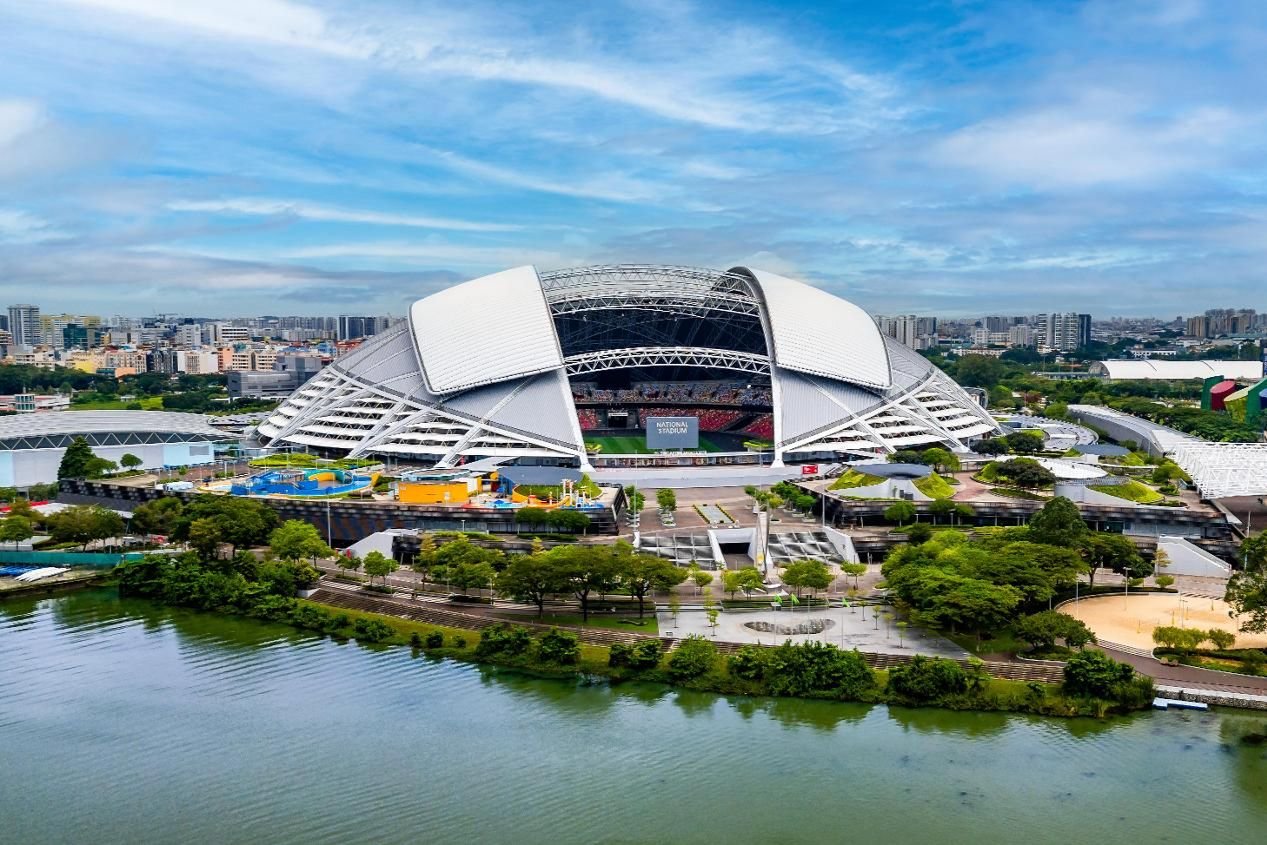
Aerial view of the Singapore National Stadium next to the Kallang Basin and Reservoir/GettyImagesBank
That physical readiness has increasingly been coupled with a change in the way the destination is presented.
“In response to consumer trends, especially the increasing consumption of digital media and entertainment, STB is leveraging branded entertainment partnerships and collaborations with global celebrities to highlight Singapore in more engaging and organic ways,” Tan said.
Those collaborations include music, film, television and digital content, which tourism marketers describe as a “set-jetting” phenomenon.
“By taking advantage of the ‘set-jetting’ trend where travelers are inspired to visit locations by their favorite artists, these projects increase consideration for travel to Singapore,” Tan said. Singapore’s presence in BTS member Jin’s recent music video “Don’t Say You Love Me” offers a recent example of that approach.
For STB, the value of K-pop is not only in scale, but also in narrative reach.
“K-pop and Korean content have tremendous global influence and provide strong storytelling,” Tan said. He said Singapore aims to collaborate with more artists on content-driven projects that inspire travel.
“This is in line with our ambitions to become the region’s leading leisure events centre.”
What gives strategy its context is that it comes with a visible, everyday culture that exists beyond programming. Dancers practicing in public plazas and fans wandering among pop-up stores and cafes point to an already ongoing cultural landscape that has not been generated by tourism campaigns.
Singapore’s initiative appears to parallel this street-level reality, rather than manufacturing demand. As K-pop continues to take over general venues as well as large-scale concerts, the emergence of the city-state as a live entertainment hub looks more like a calculated pivot than an alignment between a global industry seeking scale and a city where the culture has already taken root.
<a href=