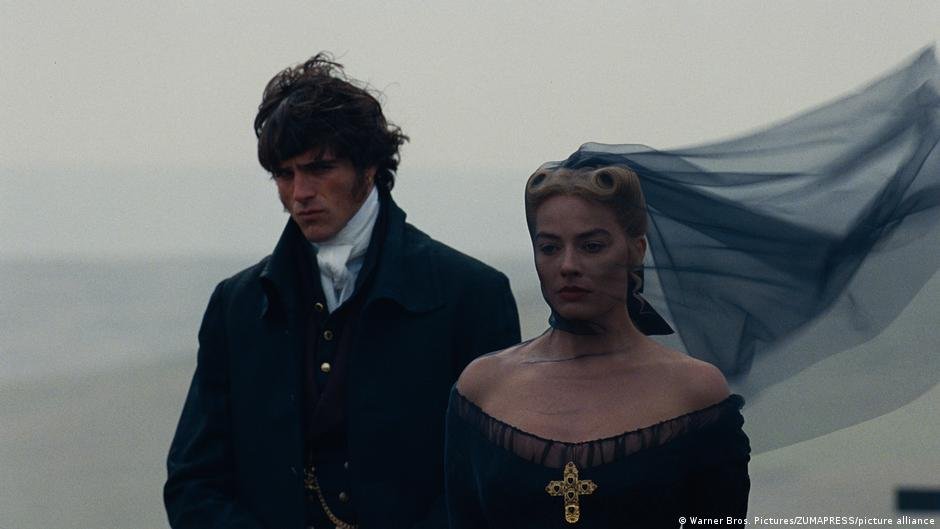
The new film features an all-star lineup, with Margot Robbie as the leading lady, Katherine, and Jacob Elordi as Heathcliff.
Directed by Emerald Fennell, the trailer released last week promises a cinematic, broody take on Emily Brontë’s 1847 Gothic novel of the same name.
Set in the moorland of West Yorkshire, the trailer hints at sensuality, as well as a sense of the rising damp of English walls and hearts tormented by doomed love, with enough anguish to inspire any sentimental child. Heavy amounts of rain, fog and pained gazes in the trailer suggest that things won’t end well for star-crossed lovers.
The trailer also includes a new song, “Chains of Love,” from pop star Charli XCX, who wrote the film’s soundtrack — her first album since her global hit “Brat.”
For anyone who hasn’t read the novel and has only the 1978 Kate Bush song “Wuthering Heights” as their main reference, the basic plot is as follows: Heathcliff is an orphan from Liverpool who is described as “a swarthy gypsy” – a term that, in the context of 19th-century Britain, connotes foreignness or racial difference. She is immediately separated from the white-skinned Earnshaw family who take her in. He forms a bond with Catherine, who eventually moves away from him by marrying the wealthy Edgar Linton to improve her social status.
Heathcliff’s love is reciprocated and their toxic bond destroys the lovers’ families for generations to come. Heathcliff displays a possessive love towards Catherine, using threats, isolation and insults to dominate everyone around him.
How did ‘Wuthering Heights’ become so popular?
Brontë died at the age of 30, shortly after the book, her only novel, was published. It received rave reviews, shocking readers and critics alike.
But after her death, the book’s reputation began to change, with writers such as Virginia Woolf contributing to establishing Brontë’s work as a masterpiece of English literature.
This story has resonated with audiences over the years. It has produced at least 14 major film adaptations, as well as TV series, theater pieces, and even a Bollywood film.
So why does this story still attract audiences today? One reason may be that voyeurism has not lost its appeal.
Caroline Koegler, professor of English literature at the Free University of Berlin, said, “It combines romance and tragic ending with a level of aggression and violence that the novel is quite explicit about and is still shocking by today’s standards. That voyeurism goes on for ages.”
Brontë finds violence “both horrifying and thrilling at the same time”, Koegler said.
The issue of racism was ignored
But there is a more problematic aspect of the novel that goes beyond the generally highlighted theme of social class. Heathcliff, whom Koegler describes as “vaguely not white”, is made a monster. This, Koegler explained, was a product of the colonial context in which the book was written and, unfortunately, was part of what made the story interesting at the time.
“In the beginning, we’re encouraged a little bit to sympathize with Heathcliff, who’s abused by his siblings, but then he’s cast aside, and for a large portion of the plot, he’s just an oppressor, an aggressor of white people.
“My reading, and many others’ reading, is also that the novel connects violence and aggression to racial themes, which is something that still holds importance today – we are still dealing with a society that is invested in other marginalized groups and portraying them as dangerous or aggressive, when in reality they are on the receiving end.”
playing on fear
Gothic novels were based on themes of fear, including fear of the “other”, whether monster (supernatural themes were common in Gothic literature) or human.
Brontë’s sister Charlotte’s famous novel, “Jane Eyre”, also features a racist character, Bertha, who is repeatedly blamed for things going wrong, reflecting typical Victorian attitudes.
When “Wuthering Heights” was published in Britain in 1847, slavery had been illegal for a little more than a decade.
Meanwhile, slavery was still legal in America and many British ones were also Still economically linked to slavery through trade, cotton and finance.
Koegler said, “Wuthering Heights brings the fear of role reversal back to haunting the white colonizing nation in a rural area.” Its purpose was to create fear that one day “the roles might reverse and someone like Heathcliff might serve as a future plantation owner who oppresses and abuses those who depend on him.”
Film adaptations, he said, are left with the struggle of how to remain faithful to the novel “without replicating the quite dubious dynamics of blaming a racial theme for everything”.
For this and other reasons, the novel has been described by directors as extremely difficult to adapt, with some filmmakers describing it as borderline unfilmable.
Even Peter Kosminsky, The director of the 1992 movie version later admitted that he regretted making it, calling it “a really terrible adaptation”.
However, Andrea Arnold’s 2011 film brought race to the forefront, casting a black actor in the role of Heathcliff and showing a more human side of him than Brontë’s novel.
fennel’s The choice of stars has already fueled debate over how faithful the 2026 film will be to the book. The mid-30s Margot Robbie is seen as too old to portray the novel’s teenage Catherine, while Jacob Elordi does not seem to epitomize Heathcliff’s ambiguous ethnicity.
Earlier this year, the filmmaker’s casting director, Kharmel Cochrane, defended the choices, Saying that there is “no need to be accurate” because the source material is “just a book”. Purists may disagree.
Edited by: Elizabeth Grenier
<a href