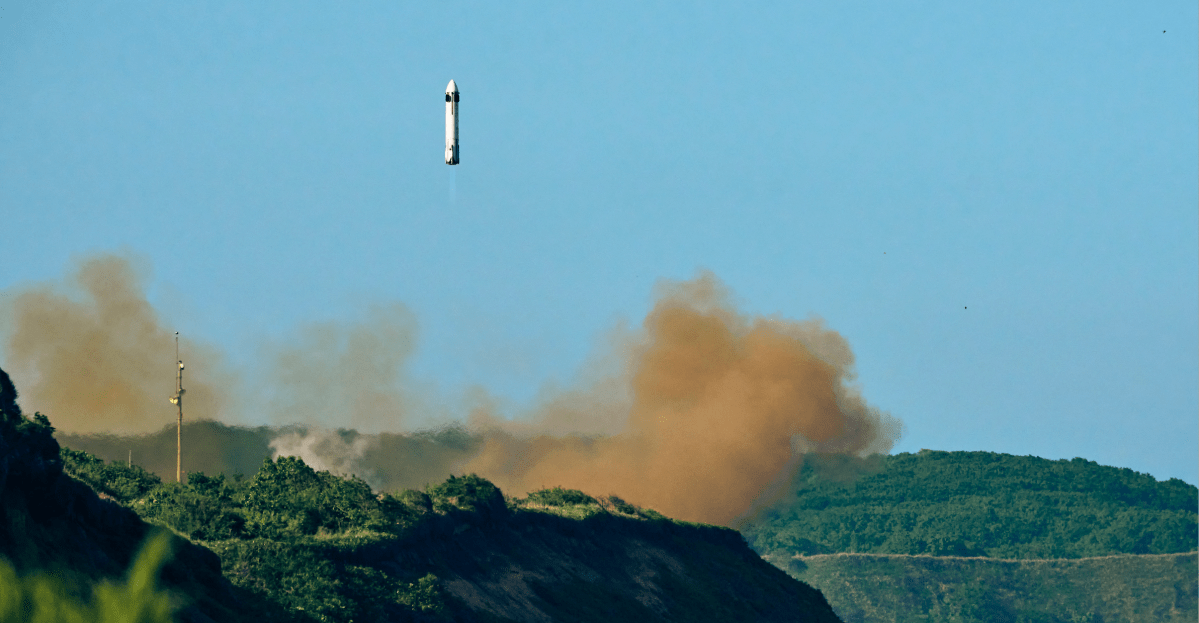
In June this year, Honda launched and landed a prototype of a 20-foot-long reusable rocket at its research facility in Hokkaido, Japan’s northernmost island.
Although the company is primarily known as an innovative and iterative carmaker, it is also a transportation conglomerate, having developed and produced motorcycles, scooters, e-bikes, ATVs, boat motors, and even jets. Its Skunkworks R&D center created the world’s first in-car navigation system, the first mass-produced automatic braking system, and the first production Level-3 autonomous driving system. Still, aiming for the stars and potentially launching a competitor to Elon Musk’s SpaceX goes beyond even Honda’s wildly diverse capabilities.
Yet according to Kazuo Sakurahara—a former director of Honda’s Formula One racing team who now runs the company’s space development strategy—it’s a logical move. “Honda’s products have already spread over land, sea and sky,” says Sakurahara in his first conversation with the American press from Honda’s R&D facility north of Tokyo. “So, it’s not surprising that space is the next area of opportunity.”
“Honda products have already spread across land, sea and sky.”
Honda’s stated goal for this initiative sounds a bit silly, even if it is altruistic: “To contribute more to people’s daily lives.” But multinational corporations also clearly see rockets as key to their core businesses. “Rockets can be used to carry satellites to support mobility, energy and communications,” Sakurahara says, referring to wide-area communications satellites, which are essential for myriad connected features embedded in advanced driver assistance software, as well as a contributing factor to plans for autonomy in all mobility products from scooters to planes. “Although we are more focused on transportation.”
Sam Abuelsamid, vice president of market research for Telemetry Consulting Group, sees the immediate utility of such a plan. He says, “Honda could potentially use such satellites for its vehicles globally. Or it could sell this capability to other manufacturers.” “I don’t want to depend on a real monopoly like SpaceX, especially from someone as volatile as Elon Musk.”
Given the uncertainty introduced into long-term global geopolitical alliances by the Trump administration and the threatening activities of Japan’s neighbors such as China and North Korea, Abouelsamid sees other motivations behind Honda’s moves toward space. “These technologies could potentially provide defensive capabilities,” he says, “and they probably realized they didn’t want to be overly dependent on the United States for that at this time.”
As it happens, the payload-carrying rocket is just the capsule tip of Honda’s bigger plans for our solar system. After developing fuel cell technology for more than 30 years, despite failing to gain traction with it in ground vehicles, Sakurahara revealed a new application: a circulating energy system aimed at supporting sustainable activities in space, such as human colonization on the Moon.
“I don’t want to depend on a real monopoly like SpaceX, especially from someone as volatile as Elon Musk.”
According to Sakurahara, a vertical solar array, built in partnership with Japanese company Astrobotic, will generate electricity during two consecutive weeks of lunar daylight, electrolyze water with a proprietary system that can produce oxygen and supply hydrogen pressurized to 10,000 psi without a compressor. Oxygen can be stored for humans to breathe, and can also be combined with stored hydrogen to power fuel cells during two consecutive weeks of lunar nights. If you’re wondering where the water would come from, Sakurahara says, there is ice frozen at the moon’s south pole.
Similarly, years after shutting down its 30+ year-long ASIMO Android program, Honda is revising that project with a view to creating human-controlled avatar robots for off-Earth use. Strong and/or dexterous, they can be used in tasks such as module construction, refueling, and even fine motor repair skills. Control may occur in proximity to the Moon, or may be transmitted from Earth via Honda satellites. “Space is a harsh environment, so if it works, it would be an incredibly useful robot for people, freeing users from the constraints of time, space, and physical ability,” Sakurahara says.
The re-application of past research and development ventures, even those that seemed like dead ends, aligns strongly with Honda’s culture of creative reuse. “Although this may seem like a turn for Honda, they’re actually building on a lot of the technologies they’re developing for ground transportation anyway – aerodynamics, fuel cells, vehicle control systems and robots,” Abuelsamid says. “So, it’s interesting how they can take some of this and put it into different endeavors that are beneficial to them and their country.”
Is Honda’s dominance in the space nascent? Probably not. Sakurahara says the company has not yet developed or tested a full-size prototype, let alone one capable of carrying relevant payloads, and is unsure whether it will commercialize the system if it does. But it’s only been six years, and Honda was able to build a concept rocket and launch, operate, and land it without crashing or blowing up. This is a good start.
“If you look at how long it took from when SpaceX started to successfully launching a rocket and returning it to the ground, it was over 15 years. So I think there’s a definite possibility that by the early 2030s, Honda could launch,” Abuelsamid says. “They’re coming to Elon in some different ways.” After colonizing our nearest celestial neighbor, will Honda try to beat Musk to Mars? “The moon is 380,000 kilometers away,” says Sakurahara. “Mars may exceed 380 million kilometers away. I think our target right now is to make sure we hit 500 kilometres.”
<a href