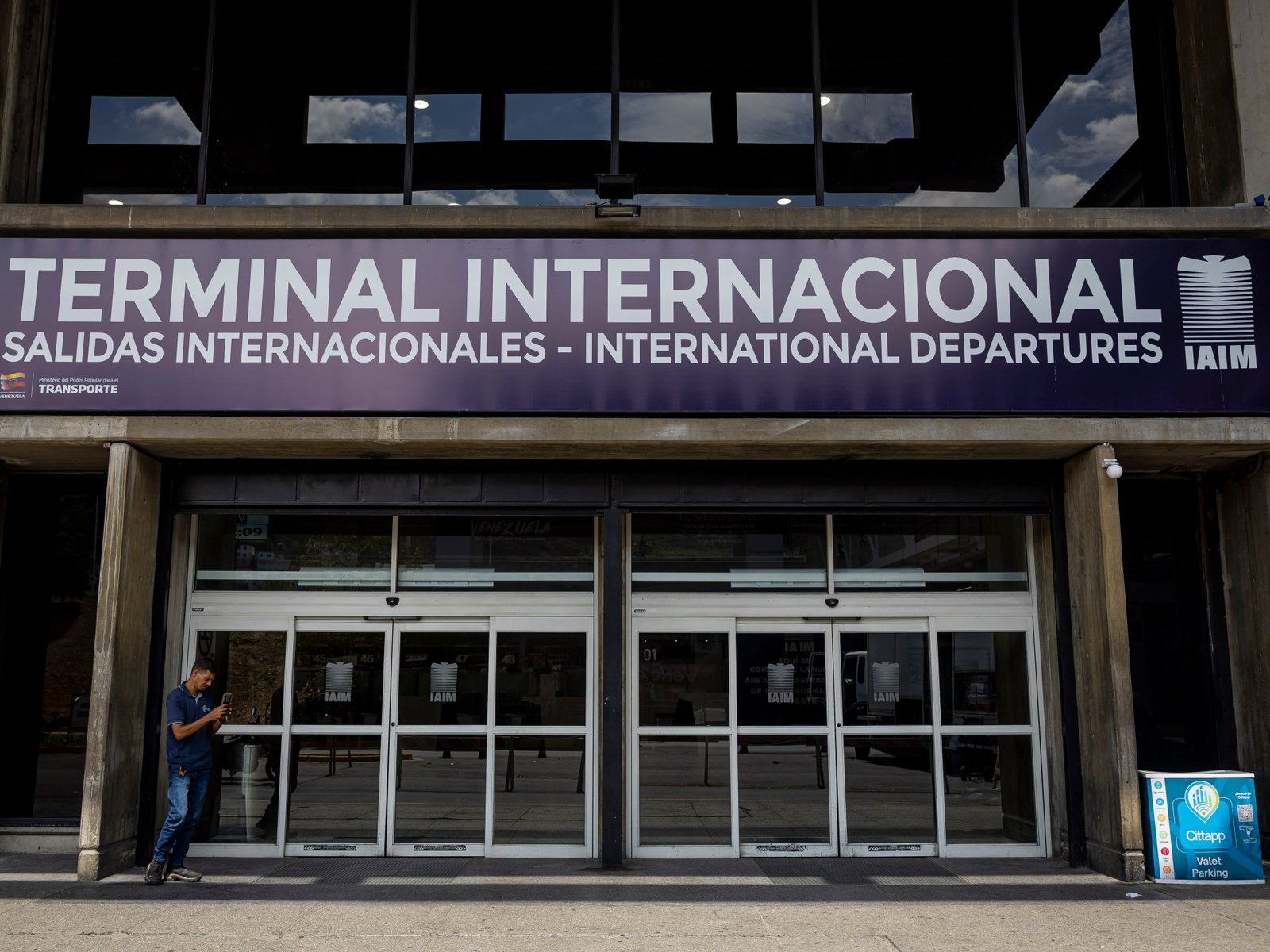
Last week, the US Federal Aviation Administration (FAA) warned of a “potentially hazardous situation” due to the “deteriorating security situation and increased military activity” in Venezuelan airspace.
Recommended Stories
4 item listend of list
While Caracas said the FAA has no jurisdiction over its airspace, Marisela de Loaiza, president of the Airlines Association in Venezuela, said the decision has caused some airlines to indefinitely suspend flights to the South American country from November 24 to 28.
This action comes amid rising tensions between the US and Venezuela over President Donald Trump’s war against ‘narco-terrorism’ in the Caribbean region.
Since September, the US has carried out at least 21 attacks on ships accused of drug trafficking, killing at least 83 people. Venezuela has said the attacks amount to murder.

Which airlines has Venezuela banned and why?
On Wednesday night, Venezuela’s civil aviation authority announced that the permits of Spain’s Iberia, Portugal’s TAP, Colombia’s Avianca, Chile and Brazil’s LATAM, Brazil’s Gol and Turkish Airlines would be revoked.
The authority said the decision was taken against the carriers for engaging in “acts of state terrorism promoted by the United States government.”
Before the cancellation, the Venezuelan government had issued a 48-hour deadline on Monday for airlines to resume their canceled flights or risk losing their permits.
Airline carrier Iberia had said it planned to resume flights to Venezuela as soon as full safety conditions were met.
At the same time, Avianca, in a statement on Wednesday, announced its intention to reschedule the canceled flights to the Venezuelan capital until December 5.
But Portuguese Foreign Minister Paulo Rangel described the decision to revoke the permits as “disproportionate”.
“We have to make the Venezuelan authorities aware through our embassy that this measure is disproportionate, we have no intention of canceling our routes to Venezuela, and we only did so for security reasons,” he said.
What about other airlines operating in Venezuela?
Spain’s Air Europa and Plus Ultra have also suspended flights to Venezuela, but their permits have not been revoked, with no reason given for the exemption.
Panama’s Copa and its low-cost airline, Wingo, continue to operate to Venezuela. Domestic airlines, including Convisa, the flag carrier that flies from Venezuela to Colombia, Panama and Cuba, are also still in operation.
What is behind the US-Venezuela tension?
Since US President Donald Trump returned to office in January, tensions have increased between his administration and the Venezuelan government.
The US has built a major military presence off the Venezuelan coast – its most significant military deployment to the Caribbean in decades – to combat what it claims is drug trafficking.
The Trump administration has repeatedly claimed that Venezuelan President Nicolas Maduro is behind the drug trade, without providing any evidence to support it.
In August, the U.S. government increased its reward for information leading to Maduro’s arrest from $25 million to $50 million.
Maduro has denied that he is involved in the drug trade.
This week, the US designated the Cartel de los Sols (Cartel of the Sons) a foreign “terrorist” organization. It has also been claimed that the group is led by Maduro and a senior figure in his government.
The Venezuelan Foreign Ministry said it “categorically, strongly and completely rejected” the designation, calling it a “new and ridiculous lie”.
Additionally, the US has long rejected Maduro’s government and described his election victory last year as “rigged”. In November 2024, the US recognized Venezuelan opposition leader Edmundo Gonzalez as the country’s rightful president.
The Venezuelan government has suggested that drug operations in the Caribbean and Eastern Pacific are a cover for the US’s real objective of removing Maduro from government – something that some observers also believe.
Since September, the US has carried out at least 21 attacks on Venezuelan ships in the Caribbean and eastern Pacific, claiming they are drug boats. More than 80 people have died, but the Trump administration has provided no evidence for its claims.
Last month, the US military conducted bomber sorties off the Venezuelan coast as part of a training exercise to simulate an attack, and sent the USS Gerald R Ford, the world’s largest aircraft carrier, to the region.
However, in recent days Trump has shown a willingness to talk directly.
On Wednesday, Trump told reporters aboard his presidential plane, Air Force One, that he could “negotiate” with Maduro, but warned that “we can do things the easy way, that’s OK, and if we have to do it the hard way, that’s OK too”.

What has Trump said about anti-drug ground operations in Venezuela?
On Thursday, Trump warned that a land operation to combat drug trafficking by land could begin “very soon.”
“You’ve probably noticed that people don’t want to make deliveries by sea, and we’re going to start stopping them by land as well,” Trump said while addressing troops deployed around the world on the US holiday of Thanksgiving.
“The ground is easy, but it’s going to start very soon.”
“We warned them to stop sending poison into our country,” he said.
<a href