
 getty images
Rachel Reeves has raised taxes again in her latest budget. Although he acknowledged that “ordinary people” will contribute more to tax in the coming years, the Chancellor has also argued that it will leave those with the “broadest shoulders” paying more.
Ms Reeves also stressed that other measures in the Budget – such as reducing rail fares in England and fuel charges across the UK and removing some costs from household electricity bills – will reduce the cost of living for many families.
And the Government estimates that the decision to end the two-child limit on benefits will reduce relative child poverty by 450,000 by the end of this Parliament and increase average incomes among affected families by £5,310 a year.
So do these claims add up?
BBC Verify examines what we know about how the Budget could affect different groups financially.
What does it mean for you?
The budget impact will depend on the individual characteristics of each household.
For example, a low-income person with no more than two children would not benefit from the two-child benefit limit being lifted. And anyone with a modest income who drives an electric vehicle will be impacted by the new mileage charges for EVs.
Similarly, someone with a higher income who gets a lot of mileage from their petrol car or uses a lot of energy at home may benefit more from measures to help those with higher living costs rather than those with lower incomes.
The Resolution Foundation think tank has created some representative families to demonstrate these different effects:
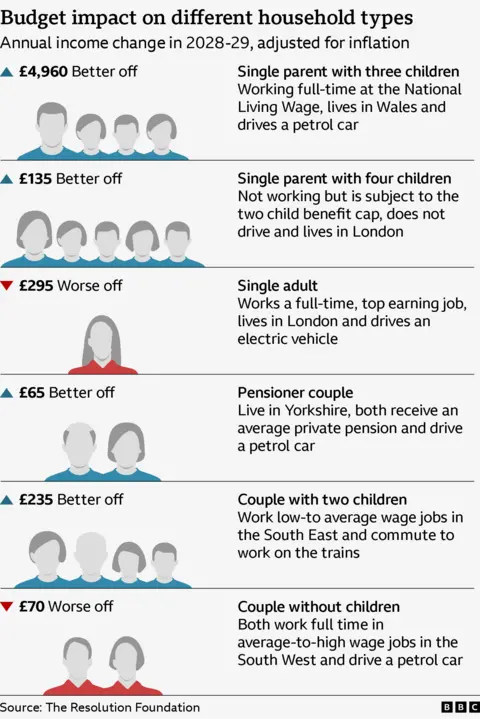
It finds that, as a result of all the tax and benefit changes since the Autumn Budget in 2024, low-income households are more likely to gain financially than lose, while the opposite is true for higher-income households.
It also found that pensioner households are more likely to benefit from Reeves’ budget measures than working-age households, with 56% benefiting, while only 33% of households with children benefited.
Does the burden of the new tax fall more on the rich?
Measures in the Budget such as the new high value council tax surcharge in England (set to raise £400 million per year in 2029–30) and increased income tax rates on property, savings and dividend income (set to raise £2.1 billion per year) will fall primarily on higher income earners because wealthier people own more assets and have more income from those sources.
The same is true of plans to impose a National Insurance charge on pension contributions made through workplace salary sacrifice schemes (set to raise £4.7 billion).
Treasury analysis shows that the tax measures in the Budget will reduce the income of the top 10% of earners in the UK population by around £2,000 by 2028-29.
In contrast, middle-income earners will see their incomes drop by about £300 and the bottom 20% of earners will see their incomes drop by about £200.
The decision to extend the moratorium on income tax thresholds by an additional three years from 2027-28 will hit the majority of earners. This forces more people – including those with relatively modest incomes – to pay more taxes as their incomes rise with inflation.
Those currently earning less than the personal allowance of £12,571 will find they will pay tax for the first time as wages rise but the threshold does not rise. The Office for Budget Responsibility (OBR) estimates that as many as 780,000 more people could be paying the tax by 2029-30.
Do other budget measures benefit the less well off?
The Treasury’s analysis also shows that while people on low incomes will benefit much more than rich people from measures such as reducing costs from electricity bills, reducing fuel duty and scrapping the two-child limit, the top 30% of earners will get little cash benefit.
The Institute for Fiscal Studies has put together some of the key measures of the budget in its analysis.
Those solutions are:
- personal tax limit withholding
- fuel duty freeze
- Removing the two-child benefit limit
- High value council tax surcharge in England
The think tank believes that by 2030-31 the net effect of these measures will be that the lowest 20% of earners will have incomes between £220 and £290 higher, while the top 10% will have incomes lower by around £700.
However, it is worth keeping in mind that these calculations only show the impact of budget measures.
Determining what actually happens to people’s total income, no matter where they are in the UK income distribution, is based on how the wider economy performs.
And the downgrade in the OBR’s latest overall UK growth forecast means that average UK real household disposable income (RHDI) per capita – the government’s chosen target measure of living standards – is now forecast to grow by an average of just 0.5 per cent per year by the end of the Parliament.
According to the Resolution Foundation, this would mean the Parliament’s average income growth would be only £740 (in 2025–26 money), making it the second-worst Parliament in terms of income growth on record.
Additional reporting by Phil Leak
<a href