

Image by Renate Koppel from Pixabay
Johnson & Johnson’s rally: drivers of growth
The surge in JNJ stock is supported by several positive factors:
- Strong Earnings and Outlook: JNJ delivered strong third-quarter 2025 results that beat sales and profit expectations and raised its full-year guidance. This indicates management’s confidence in continued growth.
- Strategic Acquisition: Key acquisitions such as Halda Therapeutics (Prostate Cancer) and Intra-Cellular Therapies (Neurology) have enhanced and strengthened JNJ’s high-growth portfolio.
- Portfolio Focus: The planned spin-off of the orthopedics business (DePuy Synthes) is viewed positively, allowing JNJ to focus on faster-growing, higher-margin areas such as cardiovascular and surgical technologies.
- Section Strength: Both the Innovative Medicines segment (driven by drugs such as Darzalex and Tremfya) and the MedTech segment (boosted by new launches and acquisitions such as Abiomed and Shockwave) showed consistent, strong operating growth.
Pfizer’s decline
The decline in Pfizer’s stock is mainly due to the following reasons:
- Falling Covid-19 demand: Compared to pandemic-era sales, declining demand for its key COVID-19 products, Comirnati and Paxlovid, has created a significant revenue gap.
- Developmental Concerns: Investor concerns remain about future growth, exacerbated by patent expirations, a complex regulatory environment (particularly around vaccines), and the recent discontinuation of a weight-loss drug.
Overall, JNJ stock shows strong revenue growth performance over key periods, better margins, and a relatively lower valuation than PFE stock, which suggests you may be better off investing in JNJ.
- JNJ’s quarterly revenue growth was 6.8%, while PFE’s was -5.9%.
- Additionally, its revenue growth over the last 12 months stood at 5.1%, which is higher than PFE’s 3.9%.
- JNJ has strong profitability in both periods, with LTM margins at 26.2% and a 3-year average of 26.4%.
See how Johnson & Johnson’s financial position compares to its competitors, including Pfizer.
These differences become even more apparent when you look at the financials side by side. The table highlights how JNJ’s fundamentals on growth, margins, momentum and valuation multiples stack up against PFE.
Evaluation and Performance Overview
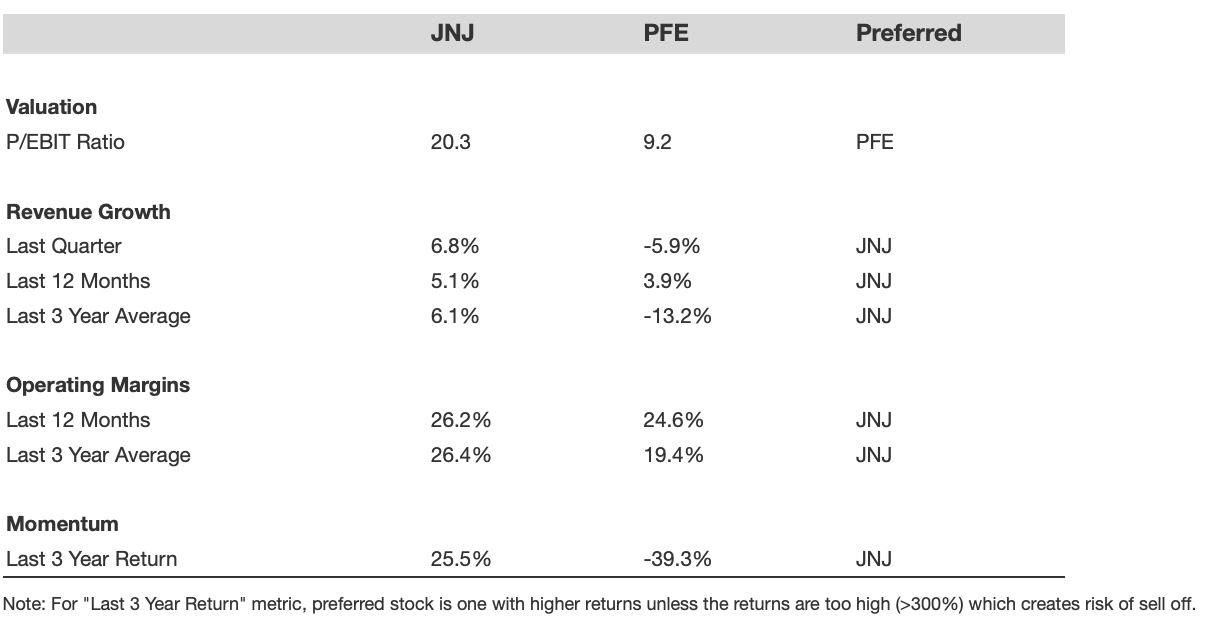
Evaluation and Performance Overview
View more revenue details:
View more margin details:
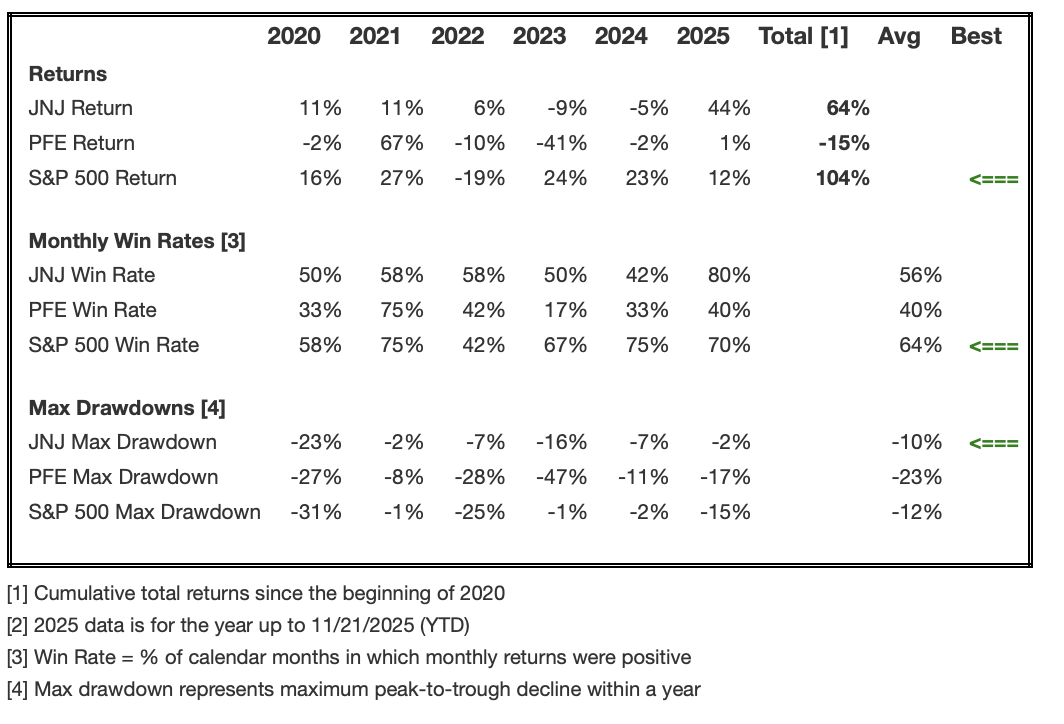
See detailed fundamentals on Buy or Sell PFE Stock and Buy or Sell JNJ Stock. Below, we compare market returns and related metrics over the years.
historical market performance
Still not sure about JNJ or PFE? Consider a portfolio approach.
The best investors think in portfolios
Personal choices may be volatile, but staying invested is what matters. A diversified portfolio helps you stay the course, gain gains, and minimize downsides. Consider the Trefis Reinforced Value (RV) Portfolio, which has outperformed its all-cap stock benchmark (a combination of the S&P 500, S&P Mid-Cap and Russell 2000 benchmark indices) to deliver strong returns for investors. Why so? The quarterly rebalanced mix of large-, mid- and small-cap RV Portfolio stocks provided a responsive way to make the most of upbeat market conditions while limiting losses when the market headed south, as explained. RV portfolio performance metrics,
invest with trefis Market Beating Portfolios
see all trefis price estimate
<a href=