Ford is also building a battery plant to make prismatic LFP cells for future EVs. The site in Marshall, Michigan, has attracted political opposition amid controversy over Ford’s decision to license intellectual property for those cells from CATL, China’s largest battery company. Ford pushed back at the criticism, arguing that the US needs LFP batteries to lower EV costs and “reinvent” the technology initially invented in the US. Meanwhile, GM says the IP in its LFP cell is entirely owned by the two Altium partners, LG and itself.
So far, Hyundai-Kia has not said whether it will offer LFP cells in any of its US EVs. The release date of its 2026 Kia EV4 compact sedan, which was expected in 2026, has now been “delayed until further notice” due to “changed market conditions.” It was believed that the EV4 would be priced in the mid-$30,000 range. None of the VW Group brands, Toyota, Nissan or other EV makers selling in the US have announced LFP plans.
make them smaller
The largest single segment in the US market is the small crossover SUV. Stephanie Brinley, principal automotive analyst at S&P Global Mobility, says future low-cost EVs will be “the same subcompact and compact segments we know today.” “The larger the vehicle, the higher the cost and the greater the battery requirement.”
New low-cost EVs can’t be much smaller than today’s small SUVs, and they will still have to remain utility vehicles. The 2026 Nissan Leaf and 2027 Chevrolet Bolt fit this mold (sort of): They’re tall hatchbacks with the “presence” and “stance” of an SUV, except with all-wheel drive.
The new Leaf S+ starts at $31,485 – including mandatory destination charge – and offers an EPA-rated range of 303 miles. The more popular mid-range SV+ is still under $36,000 for 288 miles, and Nissan promises to bring the bare-bones Leaf S under $30,000. When the 2027 Chevrolet Bolt LT arrives at dealers early next year, it will start at $29,990 – but a less-featured 1LT trim will be available later in 2026 for $28,995.
simplify them
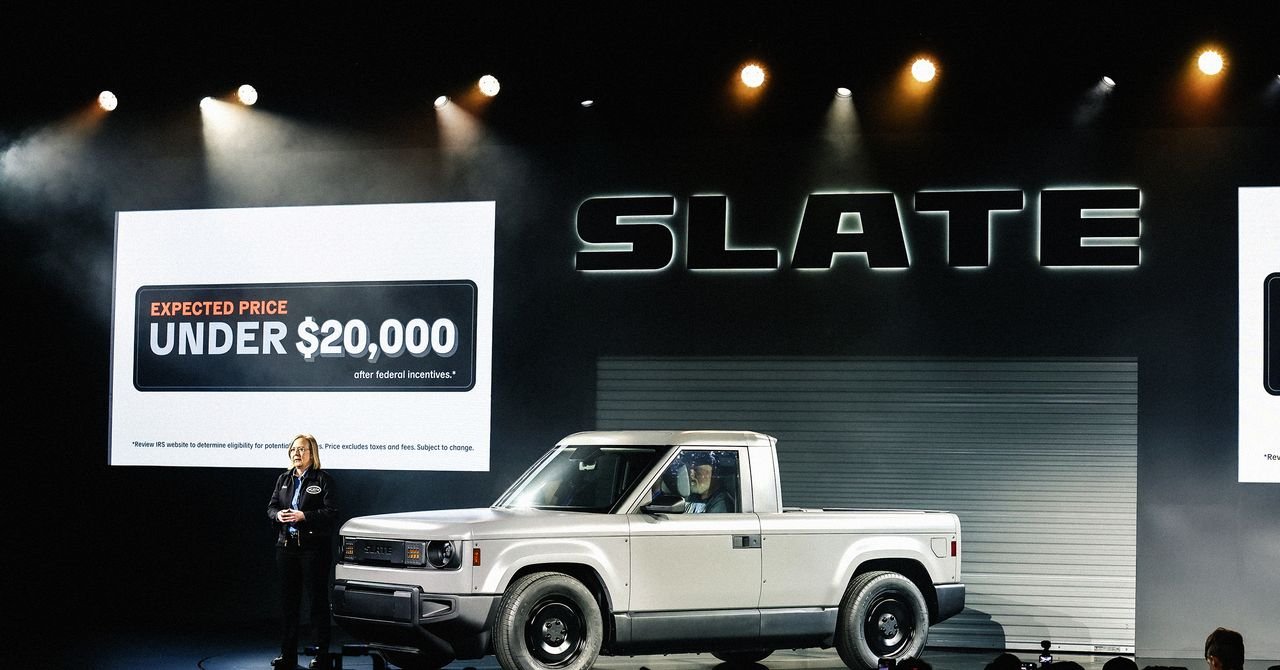
Another approach is to offer a very different vehicle at a much lower cost. Startup Slate Auto plans to offer a $25,000 compact pickup truck that radically simplifies the vehicle: no central touchscreen (drivers mount their phones on the dash), one color (wraps are optional extra), no power accessories (windows wind up manually!). The base vehicle is a two-door, two-seat, small pickup approximately the size of the gasoline and hybrid Ford Maverick. The slate may be on to something: Reportedly, Toyota is now planning its own small EV pickup model.
The $25,000 “blank slate” version will have a rated range of 150 miles. The only factory option is a larger pack, at 84.3 kWh compared to the base 52.7 kWh, which leads to an estimated 240 miles of range. Slate has not revealed the price of the larger battery. A $5,000 accessory turns the two-seat pickup into a five-seat SUV, which can be installed for a fee by the owner (from a flat pack) or by the distributor. The most popular slate could cost around $35,000 if it ships in late 2026 as planned.