
 getty images
The UK National Screening Committee recommends that only a very small group of men at high risk of prostate cancer should be screened for the disease.
There is currently no screening program for prostate cancer, the most common cancer in men.
But there have been some energetic campaigns for change by high-profile figures, including Sir Chris Hoy, who has terminal prostate cancer, and Lord David Cameron, who recently revealed he had been treated for it.
The expert advice will now be discussed for the next three months, before the screening committee delivers its final recommendations to the governments of the UK’s four countries in March.
What is screening?
Screening is when people are invited to have a test to check for the disease even if they have no symptoms.
Examples include women being invited to a mammogram to screen for breast cancer or a home bowel cancer test, posted to your door every two years for those over the age of 50.
The idea is to catch cancer before someone gets sick and when it can be treated.
What was recommended today?
Experts say there is no justification for screening large numbers of men for prostate cancer.
They looked at all the available evidence and concluded that screening was only appropriate for:
- Men at genetic risk for prostate cancer (with a confirmed BRCA gene variant)
The advice says this group should be screened every two years between the ages of 45 and 61.
This means that no screening is recommended for other high-risk groups of men such as:
- black man
- men with a family history of prostate cancer
Why did they reach that conclusion?
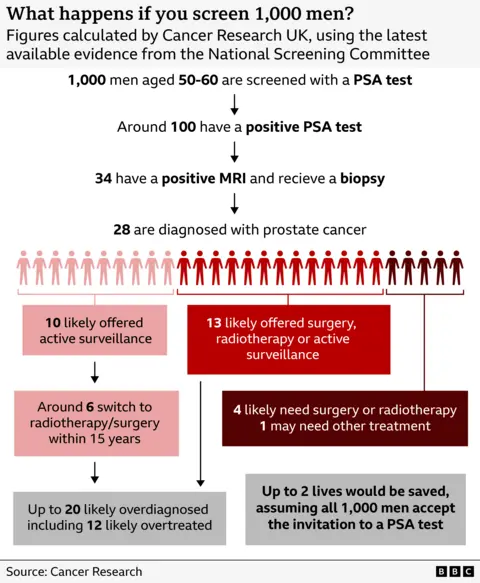
The UK National Screening Committee said that a large-scale screening program for prostate cancer was likely to cause more harm than good.
Tests for this disease are unreliable, and may lead to men being treated for a slow-growing cancer that will do them no harm. The treatment itself can cause incontinence and impotence, which can significantly impact quality of life.
Conversely, early detection and treatment of cancer can save lives. But it is difficult for doctors to figure out which cancers are aggressive and likely to spread, which means men may be treated unnecessarily.
The committee said the number of lives saved by screening does not outweigh its harmful effects on healthy men.
Why aren’t all high-risk men screened?
Many speculated that all men at high risk of the disease would likely be included in the new screening schemes.
But the committee scaled back that recommendation.
Despite black men being at twice the risk of prostate cancer, it said there should be no screening for black men due to “uncertainties” surrounding its impact and a lack of evidence from clinical trials in these men.
It also recommended no screening for men with a family history of the disease, for the same reason – many cancers will be overdiagnosed and overtreated.
But men with specific genetic mutations — called BRCA variants — develop faster-growing and aggressive cancers at younger ages, making screening appropriate for them.
Experts said treating these cancers earlier is more likely to benefit those men than men in the general population and outweighs the potential harm from unnecessary treatment.
How do you test for BRCA variants?
A genetic test is needed that looks for mutations of the BRCA 1 and 2 genes.
These gene variants can affect men and women, increasing the risk of several types of cancer, including prostate, breast, and ovarian cancer.
About three in 1,000 men have the BRCA variant, but many will be unaware unless their family members are known carriers and then confirmed by testing.
Experts say more genetic testing will be needed in the future for high-risk men to better find out how many people are affected.
How many men get prostate cancer?
Prostate cancer is the most common cancer in men.
About 55,000 men are diagnosed with the disease each year in the UK and 12,000 men die from it each year.
Is this the last word on screening?
No, a three-month consultation on the recommendations begins today.
The committee will then meet again and give its final advice to the ministers of England, Wales, Northern Ireland and Scotland.
They then have to make their own personal decision on prostate screening.
Wes Streeting, the health secretary in England, says he wants screening in place, but only if it is “supported by evidence”.
He said he would examine the evidence “thoroughly” before making his final decision in March.
<a href