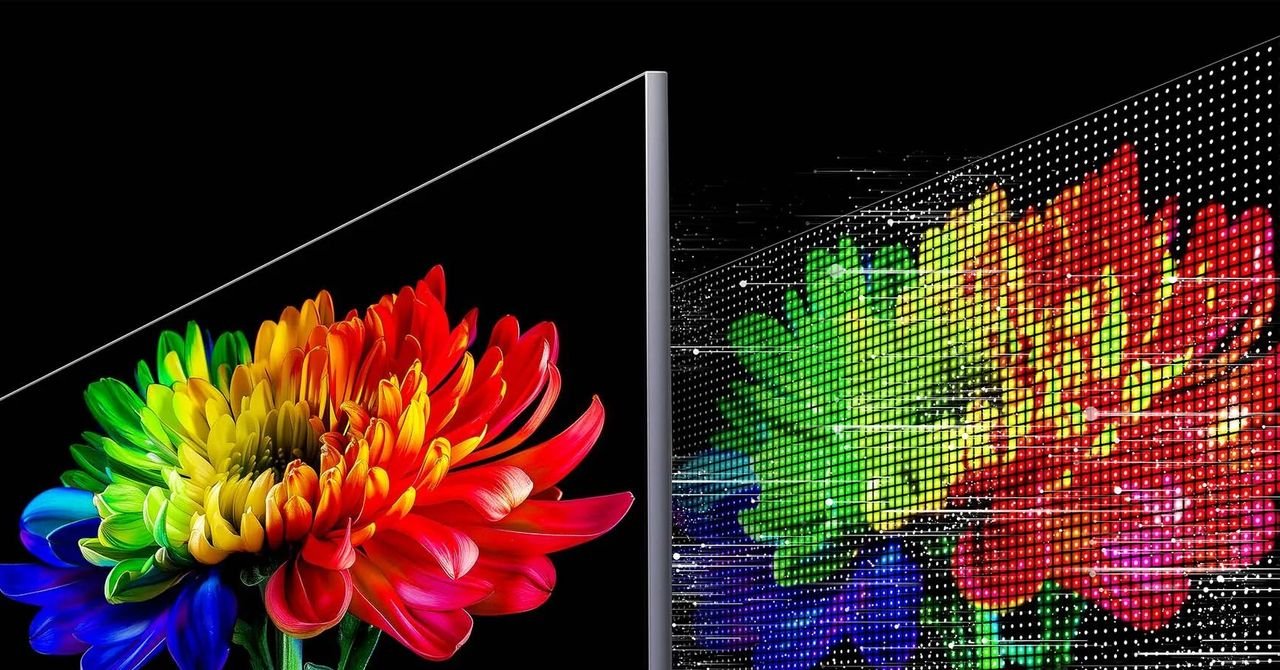
Micro RGB TVs should still offer better contrast than their Mini-LED rivals, as their smaller size can theoretically offer more dimming zones for better overall black levels. They may also provide more natural and grainy color variations more easily, although we won’t know how much better or different they are until we spend more time with each variety. Samsung’s 2025 prototype was impressive in the short time I spent with it, with great colors, clarity, and brightness. You can currently buy Samsung’s first Micro RGB TV in the 115-inch size for $30,000, but 2026 will see more accessible sizes and (possibly) pricing.
What is RGBY LED?
Just as we’re all thinking about this new era of RGB LED backlighting, Hisense once again moved the needle. After spotlighting RGB LED backlighting at CES 2025, the company used CES 2026 to showcase its new 116UXS RGB mini-LED TV, which adds a new color substructure to RGB’s red, green, and blue modules with the introduction of cyan. (This is not to be confused with Hisense’s new emissive Micro LED TV Too Uses cyan in its color architecture.)
Hisense said in its press release, “Cyan sits in the part of the spectrum where human vision is most sensitive to subtle changes and additionally allows the 116UXS to render gradients, tones and transitions with a level of nuance that feels more natural and lifelike.” The TV is claimed to go above and beyond current RGB LED technology with a stunning 110 percent coverage of the BT.2020 color spec, as well as audio extras like a Deviant Opera de Paris 6.2.2-channel audio system. We don’t know much about it or its backlight technology yet, but expect it to cost a lot when it becomes available.
What about SQD LEDs?
TCL was one of the few major panel makers that did not showcase an RGB LED TV at CES 2026. Instead, the company promoted another new display technology that underpins many of today’s quantum-dot-enabled (or QLED) displays, called Super Quantum Dot Mini-LED. Debuting with TCL’s new 85-inch
The TV offers the same amazing features as top RGB LED TVs, including a claimed 10,000 nits maximum brightness and 100 percent of the BT.2020 color spectrum – though the brand also notes that the latter is based on “specific performance of units tested” and “actual results may vary.” TCL says its new display technology reduces color artifacts compared to RGB LED TVs, and the X11L’s WHVA 2.0 panel is designed to provide better contrast for a “wide color viewing angle” and deeper black levels to better compete against OLED displays.
Although I haven’t seen the X11L in person yet, it made a big splash at the show and promises to be an exciting new competitor to RGB LEDs in this rapidly growing market. The X11L SQD TV is now available in 75-, 85- and 98-inch sizes starting at $7,000.
The RGB TVs you can buy in 2026

Courtesy of Hisense
One of the most exciting things about RGB LED is that it’s already here. In fact, Hisense begins selling its first model, the UX Series RGB Mini-LED TVs, in 2025, albeit in giant sizes with the same huge price tags. That’s changing this year, with many RGB LED TV models available in more modest sizes, hopefully with more attainable price tags. That’s why we’ve declared 2026 the year of RGB LED TVs. Here are the RGB LED TV models we know about so far:
RGB LED TVs are now available
Samsung’s original Micro RGB Backlit TV claims to offer a backlight system that is “the smallest available in any RGB LED TV” and is powered by 100 percent BT.2020 color spectrum, Samsung’s glare-free coating, and Samsung’s Micro RGB AI Engine. The little time I spent with a prototype of this TV produced impressive viewing, with surprisingly bright colors. At CES 2026, Samsung also launched a 130-inch RGB LED TV in a unique form factor that the brand calls “the pinnacle of our picture quality innovation,” but it’s unclear when or if this TV will be commercially available.
Hisense’s Mini-LED RGB TV was equally spectacular at CES 2025. It reaches 95 percent of the BT.2020 color gamut from more than 20,000″ color control units, and boasts a blasting brightness of up to 8,000 nits.
RGB LED TVs are coming soon
Samsung’s latest Micro RGB TV lineup will include 55-, 65-, 75-, 85-, 100- and 115-inch model sizes, which should mean more attainable pricing. Along with more accessible screen sizes, highlights include Samsung’s next-generation Micro RGB AI Engine Pro chipset and an advanced Micro RGB light source with “Advanced” RGB color dimming for improved precision. All TVs will include Samsung’s glare-free matte screen technology.
Billed as the “most advanced LCD TV ever”, LG’s Micro RGB Evo will include an advanced processor and is claimed to achieve BT.2020, the more widely used DCI-P3 and 100 percent coverage of the Adobe RGB color gamut.
Aimed at making RGB LED backlighting technology available to “more homes, more screen sizes and more price points”, the UR9 and UR8 models will likely be the most accessible RGB LED TVs seen to date. Describing the new models as a testament to “what’s scalable”, we’re expecting these TVs to fall somewhere in the premium range of current OLED and QLED technology, although pricing is still up in the air. Although specifications are limited so far, Hisense says these models will “deliver a dramatically expanded color range with richer saturation and more accurate tonal reproduction than standard premium TVs on the market.” I can’t wait to see if they deliver.
It’s still early days for RGB displays, and it’s too early to count out other new display technologies, or OLED, which is evolving further than we expect. We’ll find out much more this year, but it’s clear that the future of TV is brighter, cheaper and better looking than ever.
<a href