For a long time, the fear of failure was my staunch enemy. Looking back on my life, I can think of countless occasions when I decided not to do something, not because I didn’t want to, but because I was worried about what might go wrong. I was worried that I might make a fool of myself or waste my time in a futile endeavor.
Thankfully, as I get older, I worry less about what others think and am more inclined to do things in my own best interests. But that fear of failure has not gone away. Not completely. And nowhere does this fear manifest itself more than in resistance to acts of creativity.
Sometimes, such fear is justified – even useful. After all, what is it other than self-doubt that motivates us to perform better or think more carefully? But the result can also be suffocating. In some cases they even cripple them. Anyone who has ever suffered from writer’s block will know what I mean.
When these obstacles arise, we are often told that it can be helpful to have inspiration at hand. But inspiration is a funny thing.
Often, I find that the things that inspire me, like award-winning works of literature, museum exhibitions, and grand works of art, only sap my enthusiasm. Ultimately, these grand accomplishments make my artistic endeavors feel quite small, insignificant, and futile.
Maybe I am guilty. Maybe I need grander aspirations and less skepticism (and, dare I say, less jealousy?). Regardless, when I’m at my lowest creatively, genius doesn’t inspire me to pick myself up from the dustbin of defeat. Instead, it just rubs my nose.
I can’t help but gaze at a masterpiece during these low points. Instead, I need something more practical to bring the joy back into the creative process. I need something that, frankly, will force me to get over myself.
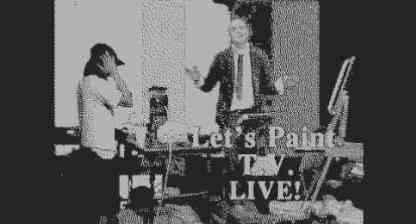
With that in mind, I’d like to introduce you to the show that has inspired me to take more chances on myself than any Picasso painting: Let’s Paint TV.

Let’s Paint TV is a television show hosted by artist and serial multitasker John Kilduff. And as you might have guessed from the name, this show is all about painting. Well, something like this. Things are a little more complicated than that.
For starters, Kilduff tries her painting while exercising (usually on a bike or treadmill) and attempting other variable tasks, like mixing drinks, playing chess, or cooking. He also takes audience calls and interviews guests. And he does all this while wearing his trademark paint-smeared suit.
Kilduff is no multitasking genius. Instead, things go as you expect. The paintings look as if they were painted by a child, the food and drinks appear inedible, and John often becomes so distraught and distraught that he can barely talk.
And then there are the callers.
For several years, Let’s Paint TV was broadcast live on Los Angeles public access television. And if you’ve ever watched any public access broadcast, you’ll already know the types of calls Kilduff received.
I’m not exaggerating when I say that 90% of the calls Kilduff received in the early days of Let’s Paint TV were horror. They mostly consisted of people shouting the most offensive things they could think of, accusing Kilduff, or making nonsense. That or the line will be absolutely dead.
Throw in cheap green screen and editing effects, the bizarre array of guests convinced to appear on the show, and the general unscripted and unfiltered nature of the program, and you have a hot mess of televised broadcasts.
Here’s the thing about Let’s Play TV. By most metrics, it’s a disaster. Not only is the material itself anarchic, but it has been largely ignored by the mainstream to date. And honestly, it’s not hard to see why.
Still, to dismiss the show as a failure would be to ignore the entire issue.

In 2007, John Kilduff arguably got his first exposure to mainstream television when he appeared on America’s Got Talent. He used his 30 seconds of airtime fame to paint a portrait of David Hasselhoff running on a treadmill and mixing drinks.
In true Let’s Paint TV fashion, everything went wrong. The judges kicked him out, the crowd jeered him, his canvas fell to the floor, and Piers Morgan told him he was “disturbing”.
In fairness to Kilduff, the variety show stage environment did him no favors. Plus, I think a lot of people will take Piers Morgan calling him irritable as the ultimate compliment. Still, the appearance tells you everything you need to know about John’s chances of bringing his performance to the masses.
Regardless of its cult following, Let’s Paint TV has always been a doomed show. Not only is each painting almost guaranteed to look terrible, but the very premise of the show practically ensures that it can never “succeed.” And yet Kilduff, a trained comedian and genuinely talented performer, persists.
More than twenty years after he first climbed onto his treadmill with a paintbrush in hand and came up with the public access station that first broadcast Let’s Paint TV, Kilduff is no more than a distant memory, Kilduff is still multitasking in front of his elite audiences on YouTube and in galleries across America. And that’s a long time to commit to what many will see as ironic performance art or some Bob Ross parody.
But the fail-to-disastrous nature of Let’s Paint TV is what makes it so endearing. And that’s what makes it so tempting for those willing to take a deeper look.
As Kilduff said in an interview with Vice, failure is the heart of the program. Because it is failure – and the ability to face it – that really motivates us:
“It’s not my job to create a masterpiece and succeed. It’s my job to hang in there, persevere, experiment and fail and keep moving forward.” […] Honestly, when you see someone who teaches you how to make a perfect painting, how does that inspire you? This may dissuade you from learning to paint, because you see how impossible it all is.
Kilduff tries it all and fails so we can feel more comfortable trying things. He reminds us that despite our cultural obsession with results, awards shows, and self-importance, it’s the process, not the art, that counts. After all, this is where the real joy of art and life lies.
In other words, this show reminds us that we need to be seriously serious about our creative endeavors. Sure, we may fail, but what does it matter? If Kilduff can get on his treadmill, make an ass of himself, and persevere, why do we need to worry? No big deal.
On the other hand, if we cannot accept failure wholeheartedly, we have already lost. Not only do we deprive ourselves of the possibility of succeeding (and what is success in art but the chance to enjoy ourselves and connect with people?), but of experiencing the process and all that it teaches us. We have to adopt all this or adopt nothing.
The multitasking madness of Let’s Paint TV is a testament to maintaining patience even in the face of defeat. And it’s a message that goes beyond questions of creativity and speaks to the challenge of life. As Kilduff puts it in his own words:
,[In life]We’re trying to put everything together to see if we can do it. My job is kind of like a test of our stamina to see if we can survive these days.
While watching Let’s Paint TV, it’s hard not to feel like we can do this.