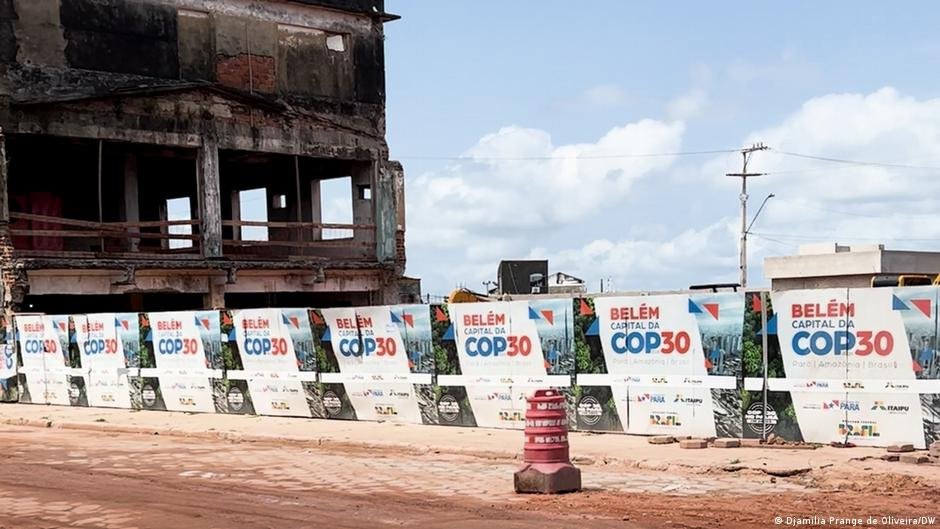
Construction work is going on a few meters away from his house.
It’s not just the noise and smell of the site that makes him angry. Soon, a pumping station will begin operating on the site, which will pump waste water from the surrounding affluent neighborhoods directly into Vila da Barca, from where it will be pumped to Belém’s first large-scale waste water treatment facility. However, waste water from Vila da Barca will continue to flow directly into the estuary. “We got nothing out of it,” says a disappointed Power.
Wastewater for the poor, parks for the rich
“COP30” is printed on every billboard protecting the construction site. The pumping station and large-scale treatment facility are part of a multi-million dollar investment that was built with the climate conference in mind.
The water treatment facility was opened in October. Until that time, Belém and its approximately 1.4 million inhabitants had practically no sewer system. According to Trata Brazil, an organization that systematically tracks water and wastewater data, less than 4% of all sewage is treated here, and only 20% of residents are connected to the municipal sewerage network.
“It’s a huge accomplishment for our city that Belém is now getting a sewer system,” says Power, “but now we’ll have to shovel dirt out of Doka.”
The Nova Doca Canal, a straight, palm-lined promenade that today runs through the affluent neighborhoods of Raduto and Umrizal, was until recently a stinking, open sewer. In October, Brazilian President Luiz Inácio Lula da Silva personally reopened the renovated canal as well as an adjacent park that was created as part of the project.
There were a lot of positive reactions to the many investments made in Belém in the run-up to COP30. “Belem got some makeup!” says an Uber driver.
“People have discovered Belém, sales have increased,” says juice seller Nazaré Barros. “COP30 has brought a lot of progress for us – it’s a jump of at least 10 years.” Many are also excited that the world will now know about Pará’s rich culture – its Afro-indigenous cuisine, the many fruits of the Amazon and the Carimbo dance.
Just promised to get running water with sanitation next year
In Vila da Barca, some people still feel neglected. Until recently, many people in the neighborhood did not even have running water. Sueli Constante, a housewife and nurse, lives in the oldest part of Vila da Barca; Right on the water, where houses built on stilts jut out over the river.
“When I talk about the past, I cry because I think of how my mother used to carry water containers,” she says. In this case, past means only up to a few weeks ago. There has been only running water since residents protested against the water treatment plant, and as COP30 approached, journalists became aware of the condition of Vila da Barca.
By that time, very few homes had running water, and what came out of the tap was yellow. Ultimately, in the wake of numerous media reports highlighting the issue, Mayor Helder Barbalho was forced to take action.
In August, he personally came to the neighborhood to promise residents water within 45 days and sanitation connections in the city by April 2026. Barbalho used this trip as an opportunity to create an effective Instagram Reel, wearing a construction helmet and a Belém T-shirt.
On the roof of the Sueli Constanta, she proudly shows off the water pressure. She views COP30 with both optimism and pessimism. “COP30 has been good for the city,” she says, “not for us here in the community.”
Climate change is felt every day
Nonetheless, Power Martins believes COP30 is good for Belém. He says that the world should come and feel how hot it is here. According to a study conducted by the Federal University of Pará (UFPA), Belém is on track to become the second hottest city in the world by 2050. It’s already so hot here that you see more and more people with umbrellas, not against the rain – although that too – but against the hot sun that burns the asphalt streets of the city.
An Uber driver says it no longer rains at the same time every day like it used to. Now it comes in floods or rarely. “It’s unbearable,” says Power, “and when you’re poor, you have no right to an air conditioner.”
The fact that Belém is dealing with the effects of climate change was certainly one reason President Lula insisted the world gather there – controversy be damned: forests were cleared to make way for roads, housing prices went through the roof, delegations had to be put up on cruise ships and in sex motels due to a lack of enough beds.
In the end, people were thrown out of their homes because landlords wanted to rent their apartments to conference attendees for big money. The homeless were “removed” from the city. Just days before COP30 began, Brazil’s Institute for the Environment and Renewable Natural Resources (IBAMA) – with the express blessing of President Lula – gave the green light to oil drilling in the Amazon basin.
But when Lula opened the conference, he promised heads of state and government that “COP30 will be the COP of truth.” The issue of the meeting should be for action, not for discussion. Despite the contradictions, expectations remain high regarding Brazil, as previous installments have been held in autocratic oil states – without indigenous peoples, traditional communities and activists.
It is also the first climate change conference to be held at the center of the crisis. Attendees will have the opportunity to see and experience the rainforest they have previously discussed in detail in Bonn, Dubai and Paris, and to speak to the people who are fighting to protect it.
Power Martins and residents of Villa da Barca will also be there. “We are also ready to talk with big corporations, to make them understand that climate change is happening now. We have to do something now – otherwise it will get worse.”
This report was written on a press trip with the German Catholic aid organization Miserer; It was translated from the original German by John Shelton.
<a href