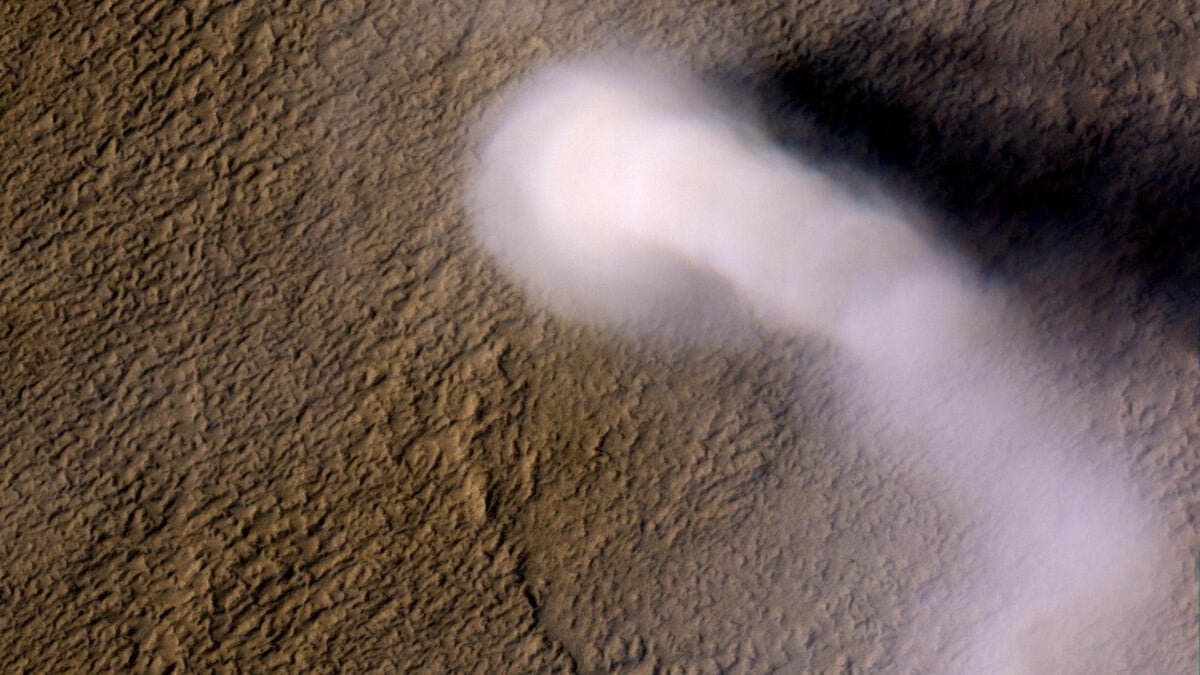

Planetary scientists have detected new evidence of lightning strikes on Mars in sounds and electrical signals captured by the Perseverance rover, suggesting that the Red Planet’s dusty surface causes electrification. Astronomers have long theorized that lightning exists on Mars, but have failed to find direct evidence until now. The new study, published Wednesday in the journal Nature, The study deepens our understanding of Mars’ atmosphere and may have implications for future human-led missions to the neighboring planet.
lightning doesn’t strike twice
NASA’s Perseverance rover landed on Mars in February 2021, and it is equipped with a microphone to capture the sounds of the planet. The team of researchers behind the new study analyzed 28 hours of recordings captured by the rover’s SuperCam microphone.
By listening to the sounds of Mars, the team identified interference in the recordings and acoustic signals that are characteristic of lightning. A total of 55 events were detected over a period of two Martian years (about four years on Earth). Most of the time when lightning was detected, it was associated with high winds, dust devils, and dust storms on Mars. Studies show that wind plays an important role in lightning.
Unlike Earth, Mars’ atmosphere is too thin to withstand tornadoes. Instead, as the air near the planet’s surface warms and rises to meet cooler, denser air, it begins to rotate. As more air joins the column, it speeds up along with the dust, creating a swirling dust devil. NASA’s Viking mission was the first to observe devils on Mars in the 1970s, and the dusty phenomenon was later captured by the Curiosity and Perseverance rovers.
On Earth, lightning usually occurs during thunderstorms. However, dust devils on Earth also produce similar friction that sometimes generates electrical charges, in which dust particles rub against each other instead of water and ice inside thunderstorm clouds. That friction creates a charge, and the increasing buildup can be released as electricity.
For this reason, scientists have theorized that lightning, or electrical discharges within the atmosphere, occur on Mars. A 2009 study found signs of electrical discharges during dust storms on the Red Planet, suggesting evidence of dry lightning. However, follow-up research failed to detect radio evidence of so-called dry lightning.
The new study proposes unprecedented direct detection of lightning on Mars based on the acoustics generated by electric discharges. The scientists behind the study, an international team of researchers led by Baptiste Chaide of the Research Institute in Astrophysics and Planetology in France, note that electrostatic discharge could pose a threat to rotating rovers as well as future astronaut missions to the Red Planet.
“A better understanding of these discharges will help protect future explorers (robots or astronauts) from their effects,” the researchers wrote.
<a href