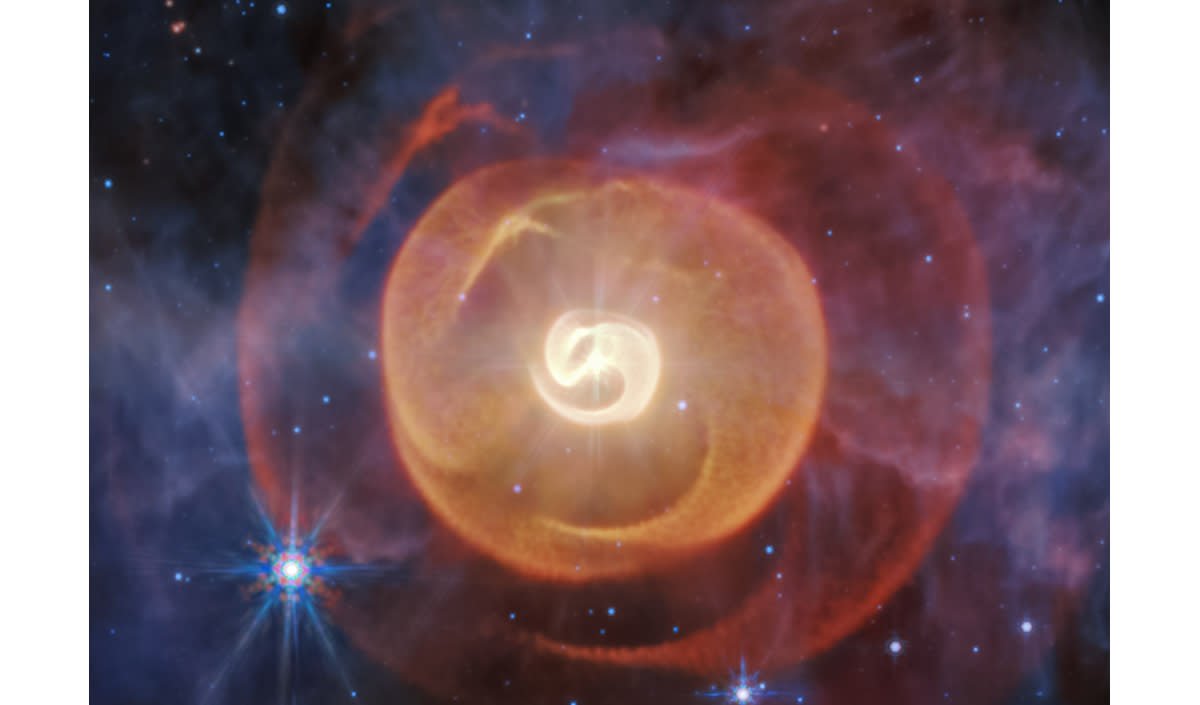
NASA’s James Webb Space Telescope has shown us images of space we would never have seen otherwise, and one of the latest surprises it has captured is an unusual star system in our galaxy that the agency describes as “four serpentine spirals of dust.” Previous observations of the Apep system, named after the Egyptian god of chaos and located about 8,000 light-years away from Eth, had shown only a shell. But as you can see in the mid-infrared image captured by Webb above, it actually has four spheres, the outermost of which is at the very edges of the image. These spheres are composed of dense carbon dust ejected by the system’s two Wolf-Rayet stars over the past 700 years.
Wolf-Rayets are massive stars nearing the end of their lives. They are very rare, and scientists believe there are only a thousand in our galaxy. Appe has two of them. Yinuo Han from Caltech and Ryan White from Macquarie University in Sydney, Australia have recently published their own papers about the system. They combined Webb’s observations of measurements with years of data from the European Southern Observatory’s Very Large Telescope (VLT) in Chile to determine that the two stars “swing by each other” once every 190 years. The stars then pass close to each other for up to 25 years, causing their strong stellar winds to collide and expel huge amounts of carbon-rich dust within that time frame.
Thanks to observations from the Webb telescope, they were also able to confirm the presence of a third star in the system that is gravitationally bound to the two Wolf-Rayets. The third star is a massive supergiant 40 to 50 times larger than our Sun, and it has created a cavity in the sphere, which looks like a funnel. You can see the cavities in the shells in the video below.
The Wolf-Rayet stars of Apep used to be larger than supergiants, but they have since lost most of their mass and are now only 10 to 20 times the mass of our Sun. Over time, both stars will explode in a supernova and possibly turn into a black hole.