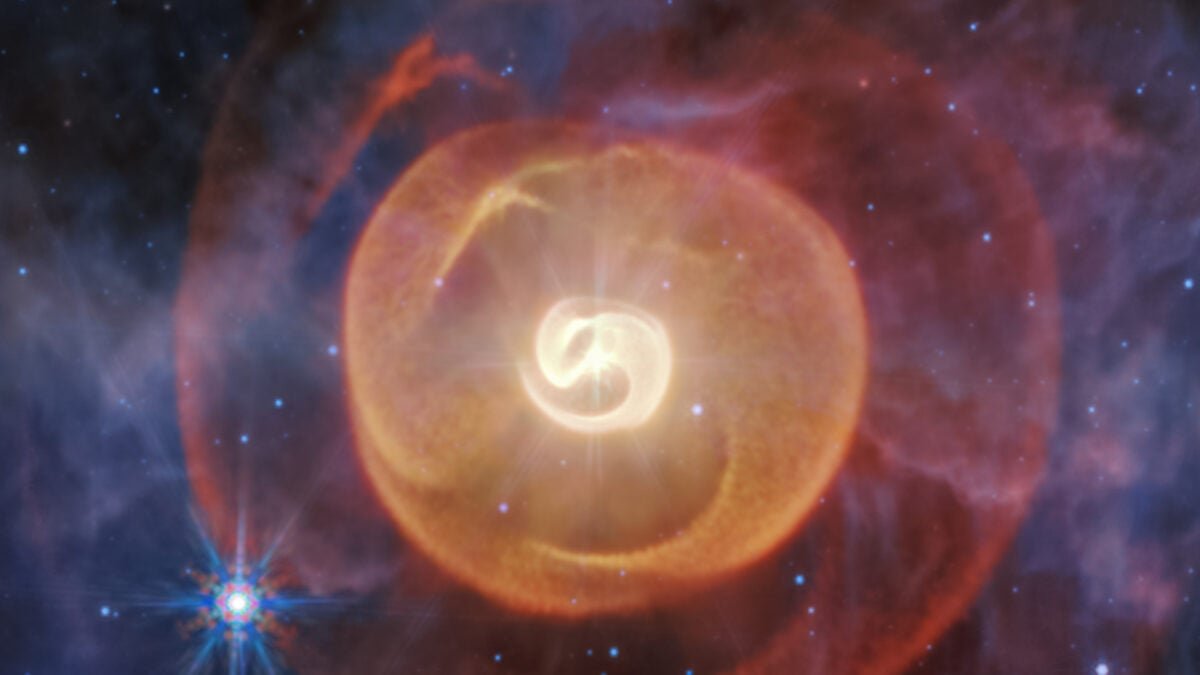

The Webb Telescope has uncovered a mystery in an alien star system located about 8,000 light years from Earth. Using its mid-infrared observing capabilities, the space telescope captured the first image of four swirling spirals of dust that surround two aging stars locked together in an orbital dance.
NASA released the image Wednesday, confirming the existence of layered shells of dust around two Wolf-Rayet stars in the Apep system. Previous observations had detected only one dust spiral, whereas Webb was able to not only see all four, but also narrow down how long it takes the binary stars to orbit each other.
“Seeing Webb’s new observations was like walking into a dark room and switching on the light — everything came into view,” Yinuo Han, a researcher at Caltech in Pasadena, California, and lead author of a new study published in the Astrophysical Journal, said in a statement. “There is dust everywhere in Webb’s image, and the telescope shows that much of it was laid out in repetitive, predictable structures.”
one of a kind
Wolf–Rayet stars are extremely rare, with only a thousand of them believed to exist in the Milky Way. They are massive, bright stars in the final stages of their stellar evolution. Stars this big don’t last very long; Wolf-Rayet burns their fuel rapidly, expelling their mass into space via high-pressure winds.
The pair of stars in Apep, named after the Egyptian god of chaos, have been shedding their outer layers for the past 700 years. The two Wolf-Rayet stars are gravitationally bound to each other, as well as their third companion, a massive supergiant that pokes holes in the dust clouds from its sweeping orbit.
Most Wolf–Rayet stars orbit each other within two to 10 years, with the longest recorded orbital period being 30 years. However, the Apep stars swing closer to each other every 190 years. The team of researchers behind the new study were able to trace the stars’ orbits by combining measurements of the location of the rings from Webb’s image with observations taken by the European Southern Observatory’s Very Large Telescope in Chile over a period of eight years.
With each longer orbit, the two stars remain closer for up to 25 years, creating extended dust balls. As the stars approach and pass each other, their stellar winds collide and mix, creating dust spirals for periods lasting up to a quarter century. Dust from other star systems persists for a few months at a time.
Although the web image may inspire peace, there is nothing good about the Apep stars. Both stars are spewing dust at speeds of 1,200 to 2,000 miles per second (2,000 to 3,000 kilometers per second) as they move through the universe.
The Wolf–Rayet stars were initially more massive than their third companion, but over the years they have lost most of their mass. Scientists estimate that both stars are 10 to 20 times the mass of the Sun, while the supergiant stars are 40 or 50 times the mass of our host star.
Although scientists know of a third star in the Apep system, Webb’s observations confirm that it is gravitationally bound to the system, appearing to cut through the dust cloud. “Webb gives us a ‘smoking gun’ to prove that the third star is gravitationally bound to this system,” Ryan White, a PhD student at Macquarie University in Sydney, Australia, and author of another paper published in the Astrophysical Journal, said in a statement.
Two massive stars are on their way to destruction and will eventually explode as supernovae. It is possible that any star could emit a gamma ray burst before becoming a black hole.