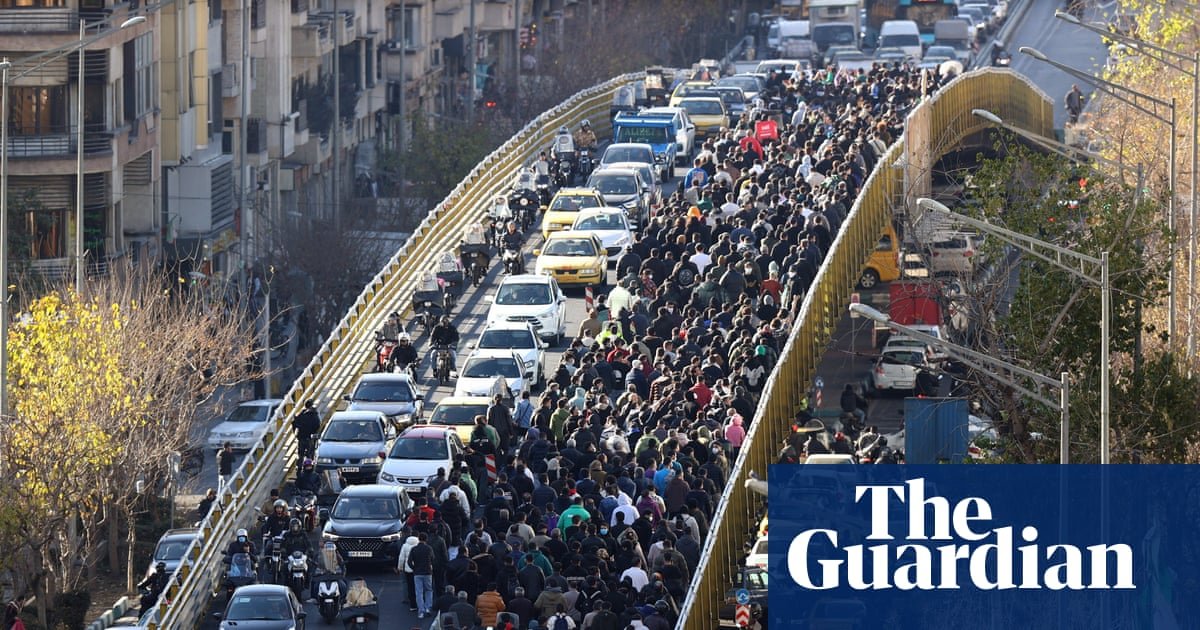
ALorbz, a textile merchant from the central Iranian city of Isfahan, decided he could no longer sit on the sidelines. They closed their shops and took to the streets, and were joined by businessmen across Iran who closed their shops and students occupied their premises in protest of deteriorating economic conditions.
The sudden loss of purchasing power pushed Alborz and thousands of other Iranians into the streets, where protests are now entering their fourth day. Students have paralyzed university campuses, traders have closed their shops and protesters have blocked roads in defiance of police. Protests have spread from the capital Tehran to cities across Iran.
Despite the risk of jail for his political activism, the father of four had run out of options. On Sunday, the national currency fell to historic lows, putting further pressure on Alborz, who was already struggling to feed his family.
“What will my children eat? Do we have to bring suitcases of cash to buy bread? Does this seem normal to you?” Alborz told the Guardian over the phone, speaking under a pseudonym out of fear of security reprisals.
The unprecedented depreciation of the national currency on Sunday – when the Iranian rial fell to 1.42 million against the US dollar, a more than 56% loss in value in six months – was a breaking point for an already struggling economy and population. The falling currency has led to increased inflation, with food prices rising an average of 72% compared to the same period last year.
Iran is also under some of the world’s most intense sanctions, which have fueled inflation as the country struggles to access funds and foreign currency frozen abroad, compounded by a growing reliance on imports.
It is the largest protest in Iran since 2022, when Iranians erupted in anger over the death of 22-year-old Mahsa Amini, who died in police custody after being arrested for not wearing her hijab properly. Those protests were violently quelled and eventually ended.
Social media in Iran is filled with videos of protesters chanting anti-government slogans and throwing stones at security forces. In a video from Tehran, a lone man is seen blocking the way for security services on motorbikes as a crowd of protesters flees from teargas.
Although the protests began as a demonstration against deteriorating living conditions, they have grown to express grievances over the way Iran is governed. Women’s rights activists, shopkeepers and students have begun chanting “Death to the dictator” and “Women, life, freedom” – slogans that can land people in jail.
Alborz said: “For many years now, we have slowly but surely made significant changes to our lifestyle because of this corrupt government. This was the last nail in the coffin. We wanted this regime gone and now there is no way this regime can continue.”
The government, still shaken by the brutal 12-day war with Israel in June that shook the foundations of the Iranian regime, has called for talks with protest leaders. Iranian President Massoud Pezeshkian said the government should listen to the “legitimate demands” of the protesters.
But they are wary of the proposal, believing it is an attempt to co-opt their demands and sap the rare protest movement’s momentum.
“You have to be naive to think that Iranians trust this government or regime,” said Farhad, a 19-year-old university student active in the protest movement who spoke under a pseudonym.
He and other students described how security services confiscated students’ IDs and beat and arrested some protesters. A protester in Tehran sent the Guardian a photo of a metal bullet he said security forces had fired at him. The Guardian could not independently verify the protester’s claim.
Farhad said, “If the administration wanted to talk, they would not have tear gassed, shot at the protesters, and if they wanted talks, they would not have killed the protesters in 2023. None of us have any desire to talk to them, we want the mullahs to go and we want democracy.”
As the Iranian government was dealing with protests domestically, it was also facing threats from abroad.
On Monday, the US President, Donald Trump, considered striking Iran again, suggesting there could be renewed nuclear activity in Iran – telling reporters that if that happened, “we will take them down”. Iran has rejected claims of uranium enrichment and says its nuclear program is peaceful.
On Monday, the Iranian Revolutionary Guards Corps (IRGC) said in a statement that it would confront any “treason, unrest” or security threats.
The IRGC said: “The enemy is trying to sow the seeds of treason within Iranian society through cognitive warfare, psychological operations, false stories, spreading fear, and encouragement of surrender.”
Despite threats from authorities, protesters said they were not afraid. He hoped that the trade unions would soon join the traders in strike.
“Yesterday, we blocked the roads and stopped the security forces from advancing. People sat on the streets and started shouting slogans that they can kill us, but we will not let them. We are not going to open shops until the regime is further weakened,” Alborz said.
<a href