
My father grew up on a subsistence farm, raising chickens and raising enough chickens to make ends meet. Farmers were the original hackers. You can’t wait for the right equipment or the right expert. You fixed what was broken with what you had, because the alternative was even worse.
As a child he taught himself rocket chemistry. Not from any kit. From whatever he could source locally. He was trying to make things hotter and blow farther, adjusting the mixture through trial and error, before there were terms like specific impulse or oxidizer ratio for what he was doing.
The materials were not foreign. Potassium nitrate is sold as a stump remover. Sulfur and coal. Mix them correctly and you have black powder, the same oxidizer-fuel logic underlying every solid rocket motor ever built. More ambitious builders mixed potassium perchlorate with aluminum powder or sugar from chemical suppliers to control burning rate and energy density. All this over the counter. It’s all accessible to anyone who is willing to read carefully and try things until they work.
He was not following any plan. He was exactly that kind of person.
Most people have forgotten that the Air Force had its own space program before NASA existed. NASA was created separately from NACA in 1958, but the Air Force had been running a parallel effort since the mid-1950s. That generation was raised on science fiction and wanted to see it happen. When Sputnik launched in October 1957 the country went into a low-level panic about whether or not it understood physics well enough to survive, and suddenly the kids who had been dreaming about space since they could read had to go somewhere with it. What happened next was one of those rare moments in American history when technical ability was a real class elevator. The government needed people who understood this stuff well enough to find them wherever they were.
He enlisted in his early twenties, aerospace degree in hand. The Air Force’s space program was his target. He ended up working on attitude control thrusters for reconnaissance satellites that could resolve fine surface details on Earth from hundreds of miles above. Attitude control was not a secondary problem for that mission. It was central. A camera that can’t remain steady is useless. Thrusters are what made intelligence gathering possible. The underlying engineering was the same problem he was teaching himself: oxidizer, fuel, combustion geometry, now controlled to tolerances with no margin left.
I remember watching satellite reenters on cable news when I was younger. I don’t know which one or exactly which year. What I remember is that he cried. Later he told me that there was a plate on that satellite with his name engraved on it. The work he did, the hardware he touched, was in the classroom for years and now it’s gone. The sadness of not having enough viewers, because the context was secret and those who could understand were scattered among programs that did not officially exist.
Years later my father was excited to watch the launch of Motorola’s commercial satellite constellation, Iridium, first launched in 1997. The same fundamental technology, now accessible to anyone with a phone. Their generation had figured out how to do it, quietly, under classification, and here it was finally out in the open. Knowledge had been disseminated. Just not through the channels it should have taken.
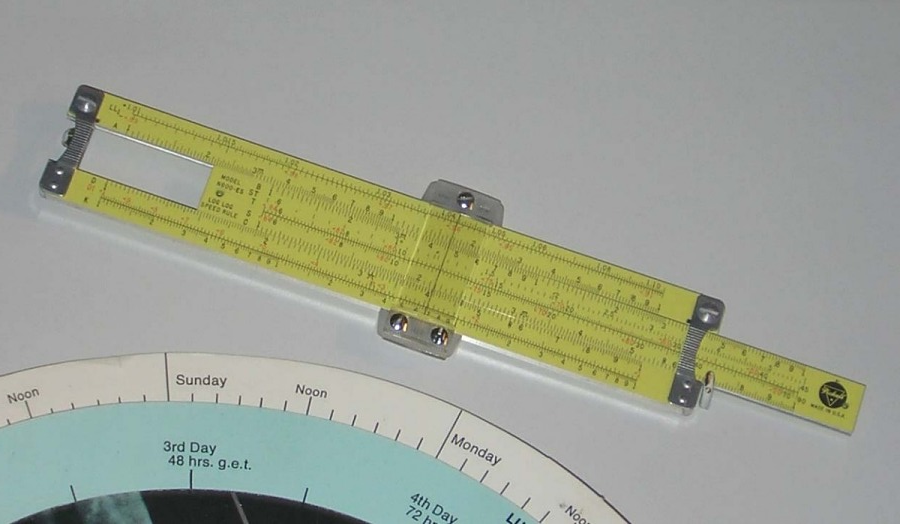
He had a green chalkboard in the garage. He’ll get out his slide rule and work with me. Orbital decay, thrust, specific impulse, delta-v, the rocket equation and why it makes everything harder than it looks. He had a concern that he came back to again and again – that society had forgotten how to get to the Moon. The knowledge existed among aging engineers and in partially classified documents and was not being disseminated. The chalkboard was all he could do about.
Last year Destin Sandlin, an aerospace engineer who describes himself as a freshman from Alabama, walked into a room full of the most senior people in American space policy and did something worth an hour of your time for you to watch. They asked questions that people inside the institutional food chain had stopped asking. Start with the most basic: How many rockets does it take to refuel the Artemis lunar lander?
The room became quiet. Nervous laughter. ePublic’s estimates vary, but all point to a large number of launch and on-orbit refueling operations before the landing attempt based on assumptions about boil-off and reuse, and no one in the room had a convincing answer.
These are not uninformed people. A core operational parameter of their own mission architecture was not common knowledge among the people running it.
Destin then asked the room a simple question.
“Is this the simplest solution?”
silence.
Destin pointed them to NASA SP-287, a document written by Apollo engineers and left behind specifically so that the next generation would not have to invent everything from scratch. The title is “What Made Apollo a Success.” It’s been sitting there in public for decades. Most of the people in that room had not read it.
The principle at the heart of that document is clear:
“Simplify it and then double up as many components or systems as possible so that if one fails, the other one takes over.”
Simple first. Then again nonsense. Complicated and not promising.
Simplicity is not just an aesthetic preference. The simple thing is how you keep the system inside your mind. The simple thing is how do you create processes all the way up to the bolt cutters and still know what happens next. When a system becomes so complex that a room full of its leaders cannot answer a basic operational question about it, it has truly exceeded the limits of their understanding. They are hiring for capability as well as complexity.
This is literally what the Apollo engineers meant. When designing the ascent stage separation, the mechanism that takes astronauts away from the lunar surface, they did not stop at one or two solutions. They built redundancy on top of redundancy. Flip the switch. If that fails, go outside and trip the manual release. If that fails, depressurize, suit up, get under the spacecraft with bolt cutters, and cut the straps holding the stages together. Harrison Schmidt said there was another process after the bolt cutters. No one will say what it was.
That’s not talent. It’s a chicken farmer’s epistemology applied to the hardest engineering problem ever tackled by humans. You don’t wait for perfect circumstances or perfect knowledge. You start simple, you make every fallback you can think of, and then you think of another fallback.
Destin argues that Artemis did not follow that logic. The NRHO/Gateway architecture was publicly justified on the grounds of communications, surface access, sustainability, and operations, but Destin argues that it also reflects deeper architectural constraints that have accumulated into a more complex solution. Destin’s read, and he makes a detailed case for it, is that it is an architectural constraint devised as a design choice, complexity that has accumulated because the actual constraints cannot be publicly named. A room full of program leaders who couldn’t tell you about the basic parameters of the systems they were running.
This is what happens when you lose the thread.
Destin also interviewed an engineer who worked on the Lunar Landing Training Vehicle, the machine that taught Apollo astronauts to land in one-sixth gravity, by literally putting them in a vehicle where their lives depended on getting it right. Destin asked whether Apollo engineers were smarter than today’s engineers. The answer was no. What he had was not superior intelligence. There was a bias towards functionality, towards simplicity, towards keeping the system inside the human brain, rather than infusing it with complexity that they could not fully reason about.
NASA SP-287 exists because those engineers realized something important. Capacity does not survive on its own. Knowledge does not spread automatically. You have to codify it intentionally otherwise it will end up with people who have it. This ownership has been made clear. This is what we understood. Here’s why it worked. Here is the playbook so that the next generation does not have to reinvent it at the cost of lives.
The Space Race created a machine for converting practical knowledge into national capability. Wherever they were, they found people like my father because they wanted what he had already taught themselves. It was on-ramp, powerful work that drew interest at important events and gave it a chance to take off. The same forcing function that produced SP-287, the discipline of writing it, the institutional pressure to disseminate it. When the race was over the machine stopped. On-ramp closed. The knowledge did not disappear immediately. Program by program, engineer by engineer, panel by panel, it became old. All that was left was the credibility and institutional memory of once knowing how, which is an entirely different thing from knowing how.
We took that gift and built a lunar return architecture that, at least in its public form, often looks more operationally complex than the Apollo playbook. More complex architecture. It is estimated that eight to fifteen or more rockets will be used to fuel the lander. A room full of leaders who had not read the playbook.
“Is this the simplest solution?”
silence.
This is not an aerospace problem. This is the pattern. The problem of knowledge transmission is older than aerospace. I’ve been writing about it for some time, starting here and in other contexts.
My father spent my childhood pointing it out from a chalkboard in a garage. I did not become an astronaut. That was his hope, not my way. The chalkboard worked anyway. Knowledge is gone. The Iridium launch proved it. The knowledge that his generation developed under classification eventually became the infrastructure that anyone could carry in their pocket. You can’t completely control where it will land. Only you can decide whether to try or not.
Now AI is doing for software what the end of the space race did for aerospace. It is eliminating early career tasks that served as scaffolding for decision making. The debugging, the boilerplate, the regular iteration that taught you the tradeoffs and edge cases before anyone trusted you on hard problems. The visible work disappears first. Tacit knowledge becomes inaccessible the moment it becomes most important. On-ramp stops. And at some point a room full of senior people goes silent when someone asks a basic operational question, not because they don’t know, but because the complexity was explained before understanding was achieved.
This is a cautionary tale. It is not that AI is bad. Before you even realize this, outsourced capability leaves you renting out decisions you don’t control, while maintaining results you can’t shift. The room becomes quiet. And ultimately no one even thinks to ask if this is the simplest solution.
My father saw it coming. That’s what the chalkboard was for.
The question isn’t whether you work in aerospace or software. The point is whether you have stopped to ask basic questions about the system you are running. Has it crossed the limits of what you really understand. Even if you are renting out capability as well as complexity and calling it progress.
You don’t wait for perfect knowledge. You read every playbook you can find. You build redundancy all the way up to the bolt cutters. And then you think of another thing.
The chemicals are still on the shelves. SP-287 is still public. Destin Talks is worth an hour and every minute of your time.
Read the playbook.
<a href