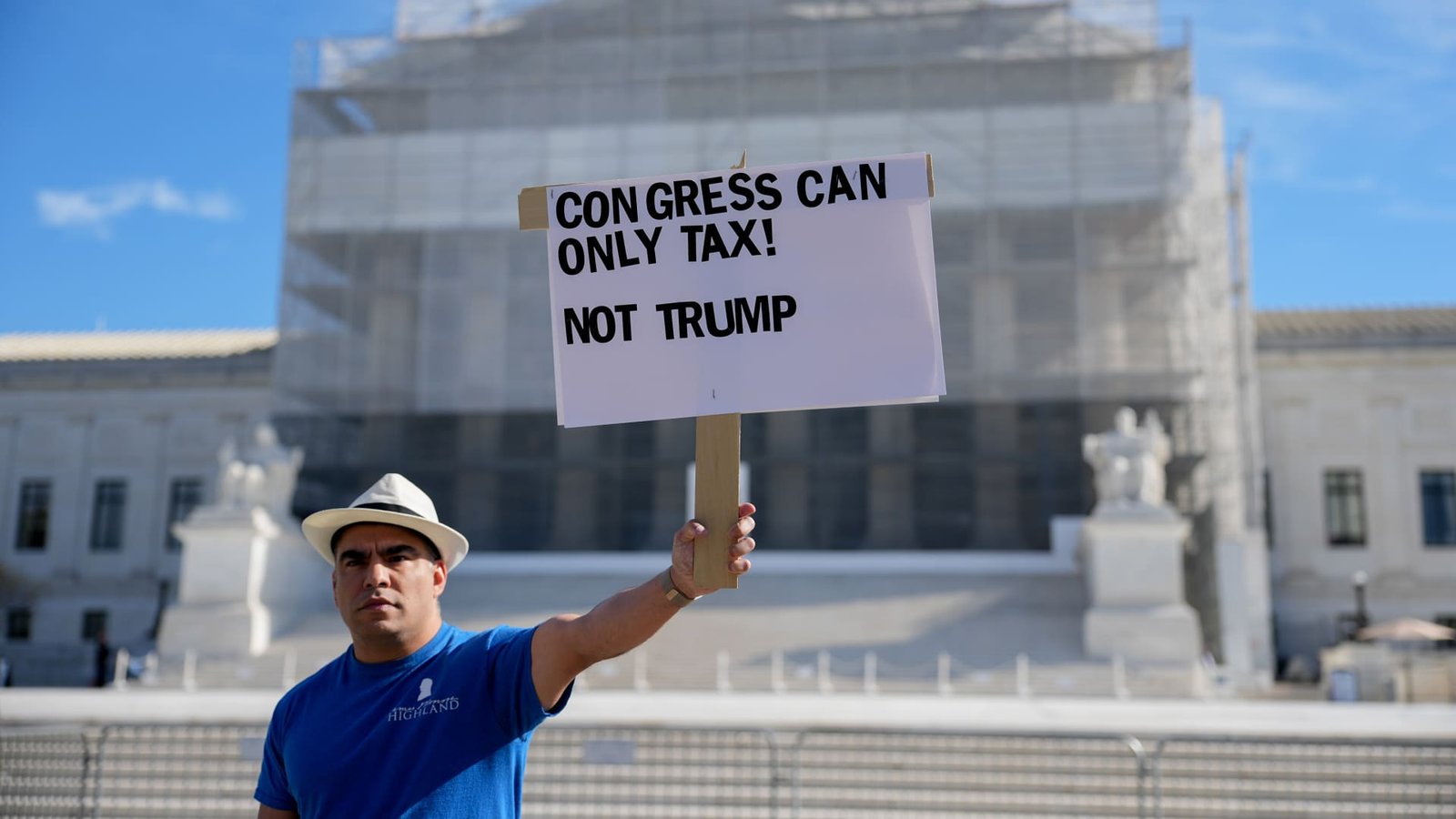
Eric Lee | Bloomberg | getty images
The freight industry in the US is in a recession due to lower container volumes after companies frontloaded products to mitigate the impact of tariffs. The move forward to 2025 marked a shift in the traditional peak season for shipping container movements.
If the tariffs imposed under the International Emergency Economic Powers Act are ruled illegal by the Supreme Court, imports into the US could surge as companies feel more confident about their cash positions and demand the Trump administration open up buffer inventories ahead of any revised tariff plan, with officials saying they would be willing to meet their existing trade targets.
“If IEPPA tariffs are removed from all imported goods, there will certainly be an increase in imports,” said Paul Brashear, vice president of global supply chain for ITS Logistics. “Especially for goods being imported from high tariff countries recently,” he said.
The Supreme Court’s decision could be released Wednesday at 10 a.m. ET.
While Trump’s trade war has not slowed Chinese trade with other countries – it has reported a record $1.2 trillion trade surplus – global ocean container volumes in the US tracked by sonar have seen a 14% decline year over year. Higher tariffs forced some businesses to operate with less inventory, with the decline in sugar trade being the most severe. Project44’s January tariff report estimates that US imports from China fell 28 percent year-on-year, while exports to China fell 38 percent in 2025. “This is one of the sharpest bilateral trade contractions in recent history,” Project44 said in its report.
The Supreme Court’s decision comes at a critical time of year for supply chain management decisions within companies as factories in China close for a month in February for the Lunar New Year. Orders for spring and summer merchandise delivery need to be placed early to ensure products reach the US from the factories on time. The deadline for companies to place manufacturing orders for the Lunar New Year is usually late December or early January, to avoid a slowdown in the production of their imports. According to SEEKO Logistics, the slowdown in production begins three to four weeks before the Lunar New Year, as workers begin to leave factories to go home.
This year, the Lunar New Year falls between February 17 and March 3.
“If the Supreme Court invalidates the tariffs, it will absolutely impact orders with increased demand for bookings for three reasons,” said Brian Bourke, chief commercial officer at SEOK Logistics. “First, the timing of the Lunar New Year holidays. Second, we fully expect other tariff provisions to be used, but there are limitations and implementation timelines that will encourage companies to ‘strike the clock’ again, and third, the expected infusion of cash in the future to finance these purchases.”
If the tariffs are ruled illegal, the Court of International Trade has the legal authority to pay refunds to U.S. importers and retain jurisdiction over refund claims for a two-year statute of limitations. Additionally, the Trump administration has said it already has plans in place to impose tariffs using other legal provisions if the Supreme Court rules against it.
Smaller companies will be expected to act first. “Small and medium-sized businesses should start placing orders sooner than larger businesses due to their planning and smaller staff,” said Eitan Buchman, CMO of Freightos. “The tariffs are sucking the life out of them because of the lack of stability in their supply chain planning. There’s too much uncertainty.”
Based on its analysis covering five years of Lunar New Year order data, Freightos expects orders from small and medium-sized businesses to increase very soon if a ruling against Trump’s tariffs is issued.
“Typically, we see a huge increase in importer activity three to four weeks before Chinese New Year,” Buchman said. “This means U.S. small and medium-sized businesses have until January 20 to plan their shipments.”
A recent survey by Freightos indicates that small and medium-sized businesses will not necessarily source resources from China. Respondents said that if the tariffs were invalidated by the Supreme Court, they would expand their global sourcing base and evaluate high-quality, low-cost suppliers in new areas without tariff-related cost penalties. Others mentioned that they would move production back to China.

A recent CNBC supply chain survey showed there was no surge in additional orders from China in November or December after a trade ceasefire between the two countries was announced on October 30, despite logistics managers’ expectations that new orders could increase. The current situation of low inventories within the US supply chain can be clearly seen in the trade data after the holidays. Warehouse inventory, tracked on the Logistics Managers Index, saw a strong decline of 17.4% month-on-month.
“Right now, there is somewhat of a sense of defeat because they feel worse than they did a year ago. They want to be able to plan their supply chain,” Buchman said.
But not all players in the supply chain agree that the court’s decision will be a major swing factor in trade volumes in the US. IMC Logistics told CNBC it is seeing strong volumes from Asia to the West Coast and does not expect volumes to decline as retailers, manufacturers and wholesalers are actively stocking up after a strong holiday season. “Import volumes continue to demonstrate strength through the end of the year and into January 2026,” said Brian Kobza, IMC chief commercial officer.
Due to the time it takes to place orders and then travel across the ocean, any impact on higher container volumes will not be seen for about 45 days, Kobza said. “We do not believe this decision will impact total import volumes in any way based on trade response in 2025,” he said.
“If the Supreme Court overturns the tariffs, there could be a slight increase, but we don’t see any dramatic changes,” said Alan Baer, CEO of OL USA.

<a href=