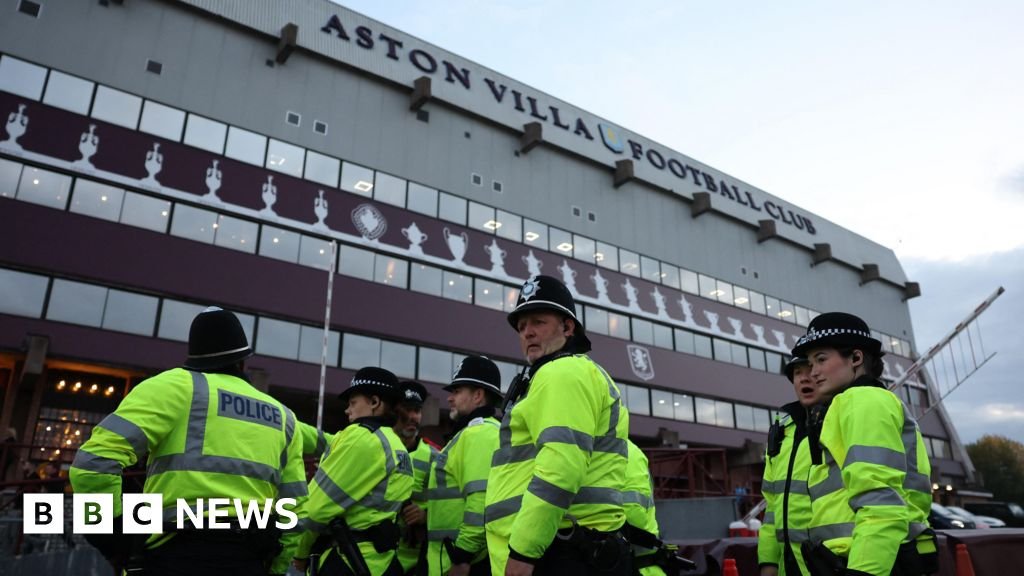

 reuters
Evidence cited by police to impose a controversial ban on Maccabi Tel Aviv fans from a match against Aston Villa was based on facts changed to suit a decision, a group of MPs has heard.
Lord Mann, the government’s independent adviser on anti-Semitism, told the Home Affairs Committee that he had “struggled” with some of the “inaccurate” descriptions given by the West Midlands force.
Some evidence had “mixed up” different things regarding the match against Ajax in Amsterdam, he said, giving an example of a street fight that did not occur on the day of the match.
Chief Constable Craig Guildford told the committee that the decision to ban fans was “not taken lightly”.
“We have taken a cautious approach,” he told lawmakers. He added, “We haven’t created anything suitable.”
Maccabi Tel Aviv fans were banned from attending the 6 November game at Birmingham’s Villa Park, a decision later reviewed.
MPs heard that the police assessment was based mainly on information given to the force by Dutch police commanders before the game.
But Lord Mann argued that separating the fans would have been a “simpler, better” solution.
He said the police report cited Maccabi fans in the Netherlands “pulling down the Palestinian flag” on the day of the match, despite it being a flag the night before the game.
The report also mentions several incidents against taxi drivers, he said, when one incident took place.
One MP asked him, “I think what you’re saying is the facts have been slightly changed to suit the decision.”
“Right. Right. Yes,” replied Lord Mann.
‘The best way to reduce risk’
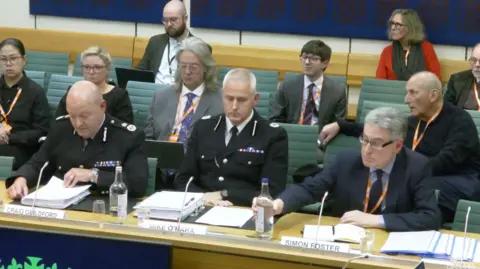
Assistant Chief Constable Mike O’Hara and West Midlands Police and Crime Commissioner Simon Foster were also questioned about their decision-making.
Following a decision on the ban by the City’s Security Advisory Group (SAG), a panel which includes Birmingham City Council as well as the police, the match, monitored by over 700 officers, took place without any serious disorder and only a handful of arrests were made.
That said, Lord Mann also highlighted an error in the West Midlands Police intelligence report, which referred to a match between Maccabi Tel Aviv and West Ham that never took place.
The chief constable admitted that the report was concluded “because of a social media post”.
Mr O’Hara said the restrictions were the “best way to minimize the risk” to the local community, players and fans.
“If we had allowed fans and it had gone wrong I think I would have been sitting here again anyway.”
 House of Commons
In the wake of the ban, the Prime Minister criticized the move, saying “We will not tolerate anti-Semitism on our streets” and that the role of the police is “to ensure that all football fans can enjoy the game without fear of violence or intimidation”.
Asked by MPs whether he thought it was appropriate for the government to comment on operational decisions, the chief constable said politicians “should be allowed to express their views freely.
“But from an operational policing perspective, sometimes when views are expressed quite publicly, particularly where views are given, let’s say, without all the facts being explained in detail, sometimes… reporting it can escalate tensions and it can increase the level of threat and risk.”
But, he added, “on the contrary it may also serve to reduce reporting and reduce the level of threat and risk”.
“We operate in an environment where we operate online 24/7 and we police in the same way, we have to be able to respond accordingly.”
<a href