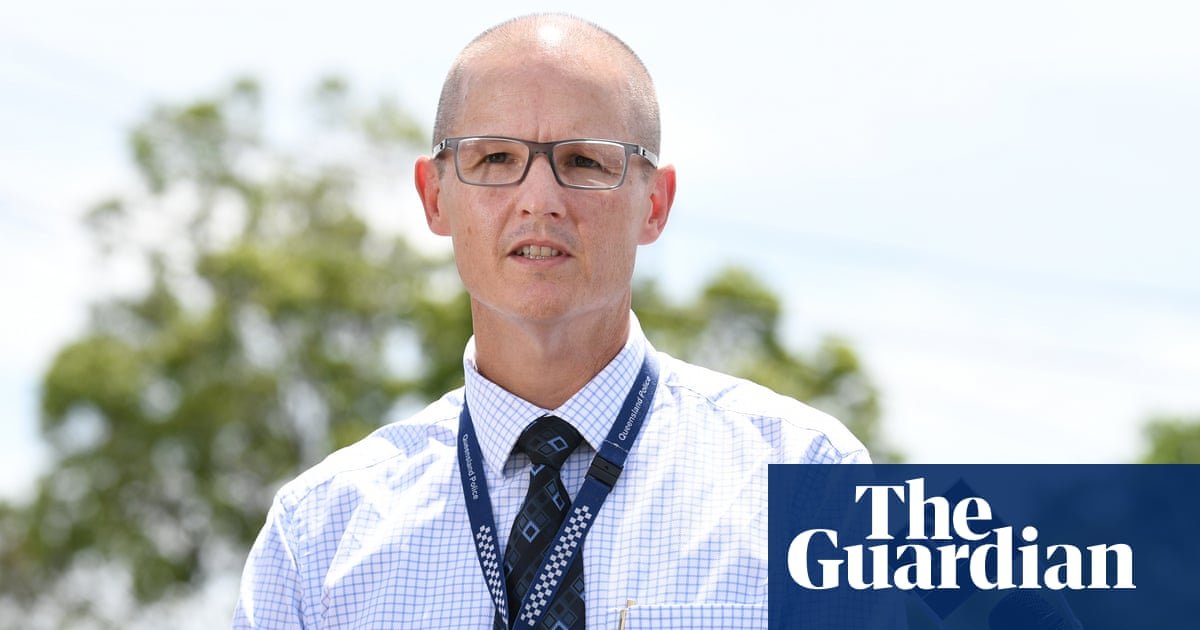
Senior Queensland police officials gave a presentation suggesting controversial comments made by a detective in the wake of the Hannah Clark murders were part of a police “media strategy” that “went wrong”, documents obtained by Guardian Australia reveal.
Det Inspector Mark Thompson said at a press conference in February 2020 in the days following the murders that police were keeping an “open mind” about the case in which Clarke’s estranged husband, Rowan Baxter, was seen pouring petrol on the family car and setting it on fire, killing Clarke, her three children and himself.
“We need to look at every piece of information,” Thompson said. “And, to be clear, there are probably people in the community who are deciding which side to take in this investigation.
“Is this a case of a woman suffering severe domestic violence and her and her children ending up at the hands of her husband? Or is this an example of a husband taken too far?”
The comments were heavily criticized and condemned by domestic violence campaigners as “victim blaming” and Thompson was removed from the case by former Police Commissioner Katrina Carroll.
This year Thompson – after being promoted to Superintendent – and Assistant Commissioner Brian Swann ran a seminar about the Clark murder investigation at the prestigious Serious Crime Management Program run by the Australian Federal Police.
Guardian Australia was not present at the seminar, but a copy of the slides and speaking notes for the presentation released to the Guardian by the Queensland Police Service shows that Swann disagreed with Carroll’s decision to stand Thompson down.
Swann notes that Thompson “had the right intentions” when he made the controversial comment: “Mark should have stayed.”
“My gut feeling was that it was a wrong decision,” the notes said. “Was I firm enough with (the commissioner)? Probably not – but it was too late – the decision was taken without me.
“We missed an opportunity to control the narrative and maintain control over the message.”
The speaking notes reveal that Thompson’s comments were part of a deliberate “media strategy” that was planned with the regional crime coordinator. It was designed to encourage people who had previously supported or believed in Baxter to come forward, but it “went wrong” after widespread community backlash, according to the notes.
Guardian Australia’s Broken Trust investigation reveals what happened next.
Sign up: AU Breaking News Email
Two witnesses supporting Baxter came forward and testified that Clark had fabricated allegations of domestic violence. Detectives investigating her brutal murder questioned the “truth and motive” of her revelations in the months before she and her children were murdered.
Broken trust revealed that police made potentially serious errors in the months before Clark’s death, as well as raising concerns about the subsequent investigation.
quick guide
Contact us about this story
show

If you have something to share on this topic, you can contact us confidentially using the following methods.
Secure messaging in the Guardian app
The Guardian app has a tool for sending suggestions about stories. Messages are end-to-end encrypted and hidden in the routine activity performed by each Guardian mobile app. This prevents the observer from knowing that you are communicating with us at all, let alone what is being said.
If you don’t already have the Guardian app, download it (iOS/Android) and go to the menu. Select ‘Secure Messaging’.
SecureDrop, instant messenger, email, telephone and post
If you can safely use the Tor network without being observed or monitored, you can send messages and documents to the Guardian through our SecureDrop platform.
Finally, our guide on theguardian.com/tips lists several ways to contact us securely, and discusses the advantages and disadvantages of each.
The speaking notes stated that Baxter had recruited associates and used false stories and that police were “trying to take out the narrative and make it negative”.
Kate Posina, a former senior detective with significant experience reviewing domestic violence murders, said the comments – regardless of intent – were “problematic and dangerous”.
He said the idea that the case required a “media strategy” was “nonsense”.
“This was a constitutional inquiry, not a criminal inquiry,” he said. “There was no person of interest. It doesn’t make sense that any covert strategy was required.”
After newsletter promotion
“The initial comment was extremely problematic and dangerous, regardless of its intent. A victim is never responsible for the violence they experience and even their own death.”
At a press conference announcing that Thompson had been removed from office, Carroll said that police would investigate his dealings with Clark. He said, “We will go back, like all other agencies, and go to the coroner to see exactly what happened (and when).”
“Could we have intervened earlier? Could we have prevented it? What do we learn from this? That’s a conversation we always need to have, because we’re always getting better at it.”
Guardian Australia revealed that Queensland Police did not carry out a mandatory “contact audit” to check all transactions between officers and family violence victims. Nor did the force conduct an internal review of its own actions leading up to the inquiry.
According to the speaking notes, Thompson felt he was ostracized from sports and community groups due to the public reaction to his comments.
“The negative allegations made about me had the positive effect of focusing attention on the need to ensure positive cultural change among the men (and in the organization),” the notes read.
The Queensland Police Service did not respond to questions sent by Guardian Australia, including whether it endorsed the presentation or approved the content.
The QPS cited previous responses regarding its handling of the Clark case.
In an interview with the Guardian for the Broken Trust investigation, then-Deputy Commissioner Cameron Horsley was asked about Thompson’s comments and said he believed attitudes towards domestic and family violence among the police were beginning to change.
Swann is the officer who led a 100-day review of police operations this year, which argued that domestic violence case management was not “core business”. It found that the “perceived preponderance” of family violence means it involves a large amount of police workload.
Critics say the findings are evidence that police attitudes towards domestic and family violence remain problematic.
<a href