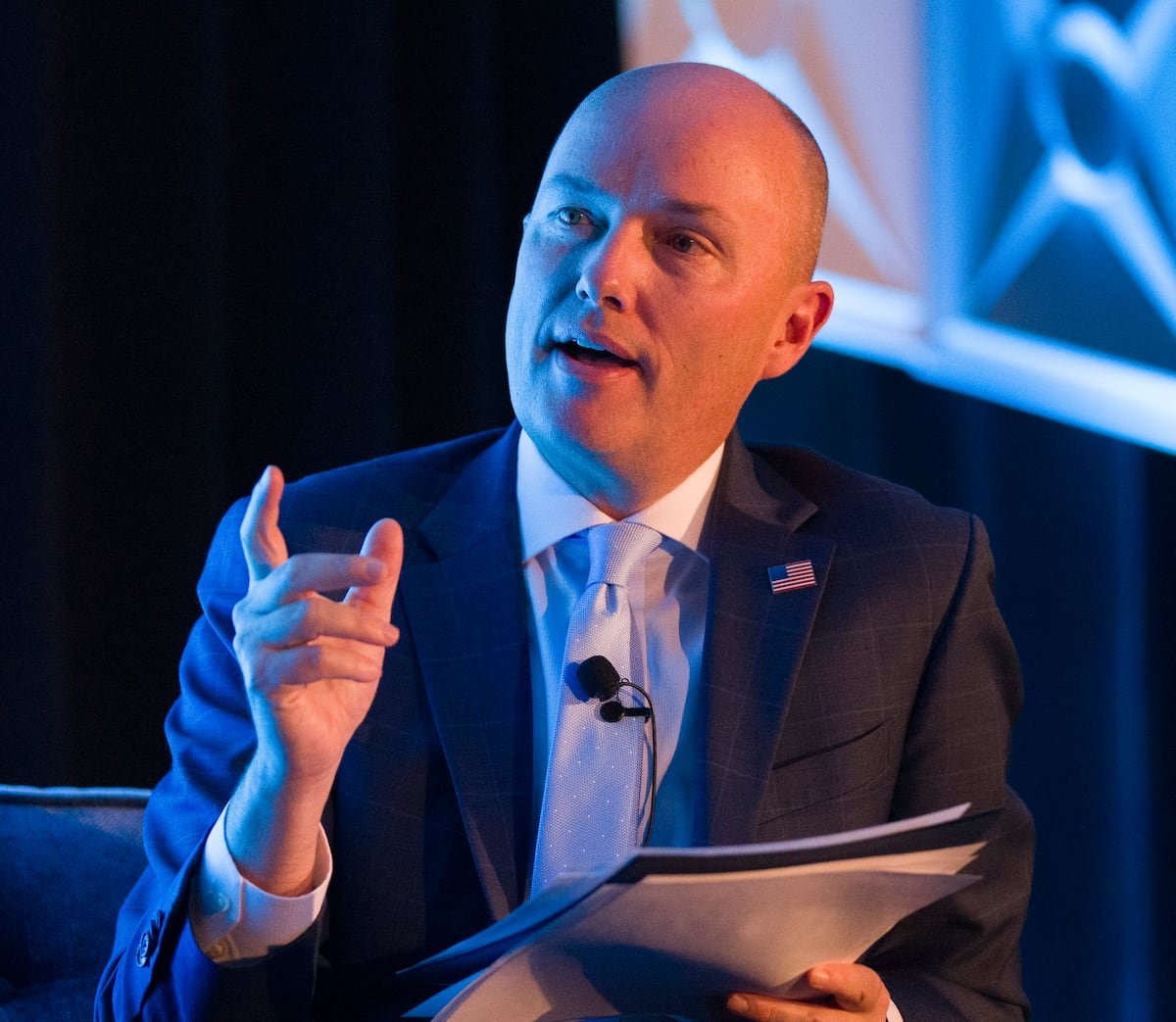
Cox said during a technology summit Tuesday that the state will invest $10 million in curriculum to ensure Utah’s workforce is “AI-ready.”
(Bethany Baker | The Salt Lake Tribune) Gov. Spencer Cox speaks during a panel during the 2025 AI Summit at the Salt Palace in Salt Lake City on Tuesday, Dec. 2, 2025.
Gov. Spencer Cox told a gathering of policymakers and technology leaders Tuesday morning that as artificial intelligence increasingly permeates daily life, “we have to apply Utah values to this new technology.”
His administration therefore plans to launch what the governor has called a “human-supportive AI” initiative in an effort to shape the future of AI development and use in the state.
The move comes nearly two years after lawmakers voted to create the Office of Artificial Intelligence Policy, which Cox helped organize at the Utah AI Summit in downtown Salt Lake City, where Cox made the announcement.
“We’ve used human ingenuity to build machines and connect them together and, again, take all human knowledge and employ it the way we want, the way we decide,” Cox said. “But the point is: We have to make a decision.”
“I don’t think the government should be telling companies how to develop technologies,” Utah’s second-term Republican governor said.
But the government must take action to protect data privacy and children, Cox said. And Utah is taking action, he added, because Congress hasn’t taken responsibility.
His comments come as a group of federal lawmakers backed by President Donald Trump seeks a way to impose restrictions on state AI regulations. Two attempts to add such a massive spending bill — most recently an annual defense budget bill making its way through Congress — have failed amid opposition, including from Utah officials.
The White House is reportedly considering an executive order to weaken state AI laws through lawsuits and withholding federal funds.
“The government shouldn’t be regulating the development of AI, but the moment you decide to use those tools to give my child an erotic chatbot, that’s my business, and that’s the government’s business,” Cox said, “and Congress shouldn’t prevent us from being able to do that.”
Cox told the audience, “I would very much prefer that we have a Congress that can actually pass a bill, that can actually do something, that can work the way it was designed to work. But if it’s not going to work, then the states must take action, and we must have the ability to do that, and we will fight for the ability to do that.”
Utah’s initiative will span six areas: workforce, industry, state government, education, public policy and education, Cox said.
According to Cox, the state plans to launch a “human-supporting AI academic consortium” to “achieve breakthroughs in human-centered innovation and launch moonshot challenges that advance human flourishing.”
It will also invest $10 million in developing curriculum to focus on energy and so-called “deep tech” areas to ensure Utah’s workforce is “AI-ready.” The latter include the production of semiconductors, quantum computing and other technologies based on AI.
“The goal here is to ensure that every Utah student and worker can adapt, upskill and succeed as AI transforms the workplace,” Cox said.
And the governor is expanding the use of AI throughout state government.
In the upcoming legislative session starting in January, Cox said lawmakers will consider regulations to mitigate the negative impacts of AI chatbots, require more transparency around AI-generated deepfakes and prohibit the use of AI in health care.
Earlier this year, the governor signed legislation prohibiting mental health chatbots from selling Utahns’ personal health data or using it to target users with ads.
Cox has devoted much of her five years in office to enforcing guardrails for social media companies — some of which have developed their own AI platforms aimed at reducing the harm they cause children. Parts of those efforts have been blocked in court.
Many of the potential downsides of expected AI regulation reflect criticism of laws affecting children’s social media use. Opponents are concerned about the limits such laws would place on young people’s free expression, and whether content deemed harmful by the Republican state would include useful information for vulnerable groups such as LGBTQ+ youth.
Note to readers, December 2, 4:15 pm • This story has been updated to reflect developments in discussions over a federal ban on state AI regulations.
<a href=