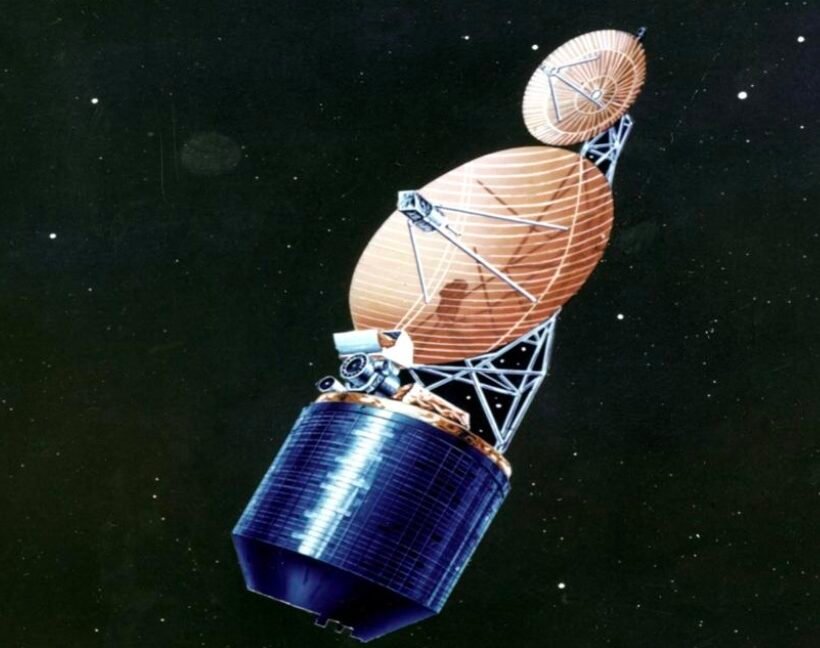
The National Reconnaissance Office, the agency that oversees the US government’s fleet of spy satellites, has made public a decades-old program used to monitor the Soviet Union’s military communications signals.
The program’s codename was JumpSeat, and its existence was already public knowledge through leaks and contemporaneous media reports. What is new is the NRO’s description of the program’s purpose, development, and photographs of the satellites themselves.
In a statement, the NRO called Jumpseat “the United States’ first-generation, highly elliptical orbit (HEO) signal-collection satellite.”
studying signals
Eight Jumpseat satellites were launched from 1971 to 1987, when the US government considered the existence of the National Reconnaissance Office a state secret. The Jumpseat satellites operated until 2006, the NRO said. Their main mission was to “monitor adversary offensive and defensive weapon system development”. “The jumpseat collected electronic emissions and signals, communications intelligence, as well as foreign device intelligence.”
The NRO said data intercepted by JumpSeat satellites was sent to the Defense Department, the National Security Agency and “other national security elements.”
The primary target of Jumpseat intelligence collection was the Soviet Union. The satellites flew in highly elliptical orbits ranging from a few hundred miles to 24,000 miles (39,000 kilometers) above Earth. The satellites’ flight paths were angled such that they reached apogee, the highest point of their orbits, in the far northern hemisphere. Satellites travel slowest at their peak, so the JumpSeat spacecraft spent most of the 12 hours it took to complete one orbit around Earth, hovering over the Arctic, Russia, Canada and Greenland.
This trajectory provided the Jumpseat satellites with continuous coverage over the Arctic and Soviet Union, realizing the utility of such an orbit for the first time. The Soviet government had begun launching communications and early-warning satellites into the same type of orbit a few years before the first Jumpseat mission, launched in 1971. The Soviets called the orbit Molniya, the Russian word for lightning.
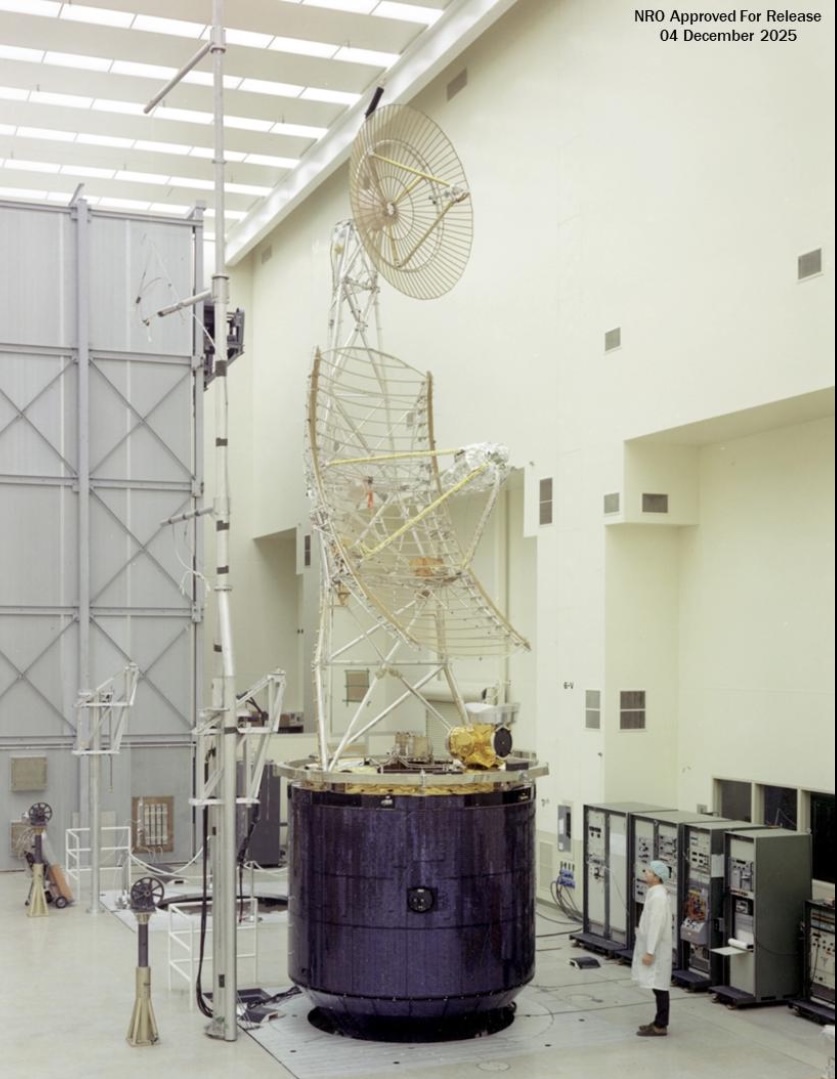
A jumpseat satellite before launch.
Credit: National Reconnaissance Office
A jumpseat satellite before launch.
Credit: National Reconnaissance Office
The name Jumpseat first appeared in a 1986 book by investigative journalist Seymour Hersh about the 1983 downing of Korean Air Lines Flight 007 by the Soviet Union. Hersh wrote that Jumpseat satellites could “intercept all forms of communication”, including voice messages, between Soviet ground personnel and pilots.
<a href