Speaking on the sidelines of the G20 summit in South Africa, Lula said the deal would represent “probably the largest agreement” in global trade, citing the two blocs’ combined population of approximately 722 million and combined gross domestic product (GDP) of $22 trillion.
But while the EU trade representative considers the Mercosur agreement a done deal, France and Hungary are seeking last-minute changes, citing risks to their agricultural sectors.
And while the long-expected agreement remains uncertain, the US is stepping up efforts to sign trade deals of its own with several countries in the region.
America intensified Trump’s trade strategy
In recent weeks, Washington has announced or negotiated framework agreements with Argentina, Guatemala, El Salvador and Ecuador as part of the Trump administration’s effort to shift the trade balance and curb China’s growing influence.
“At the geopolitical level, these agreements strengthen the US presence amid growing competition with China in infrastructure, technology and critical minerals,” Vladimir Ruvinsky, a political scientist at ICESI University in Cali, Colombia, told DW.
Ruvinsky said closer trade ties with Washington would give Latin American countries “more room for maneuver, access to technological cooperation, and opportunities to diversify production.”
He believes these deals can integrate Latin America into America’s changing economic priorities and provide the region with a strong footing in the broader global restructuring.
China ahead in Argentina
A recent report states that China is currently outpacing rivals the US and the EU in the race for geopolitical influence in Latin America. By the German Foreign Trade and Investment Agency (GTAI).
For example, in Argentina, after China recently replaced Brazil as the country’s largest trading partner, Chinese imports of Argentinian goods – particularly soybeans and beef – have increased rapidly, while Argentina’s imports from China have also increased.
Over the same period, the US slipped to fourth place behind Brazil and the EU, helping to explain Washington’s new interest in closer ties with Buenos Aires.
Additionally, according to the Economic Commission for Latin America and the Caribbean (ECLAC), Latin America’s exports to China increased by 7% overall, driven mainly by higher shipments of meat and soybeans and rising copper prices.
According to the latest annual report of ECLAC On international trade, most countries in Latin America and the Caribbean face lower tariffs on their U.S. trade than many of Washington’s main trading partners, especially those from Asia.
“This situation creates opportunities for trade diversion in favor of the region’s exports in sectors such as clothing, medical devices and agro-industry,” ECLAC wrote.
America wants strategic allies in Latin America
Diana Luna of the liberal-leaning Friedrich Ebert Foundation in Germany told DW that the Trump administration is resorting to a familiar approach, particularly the “classic ‘carrot and stick’ method” to strengthen its trade position in Latin America.
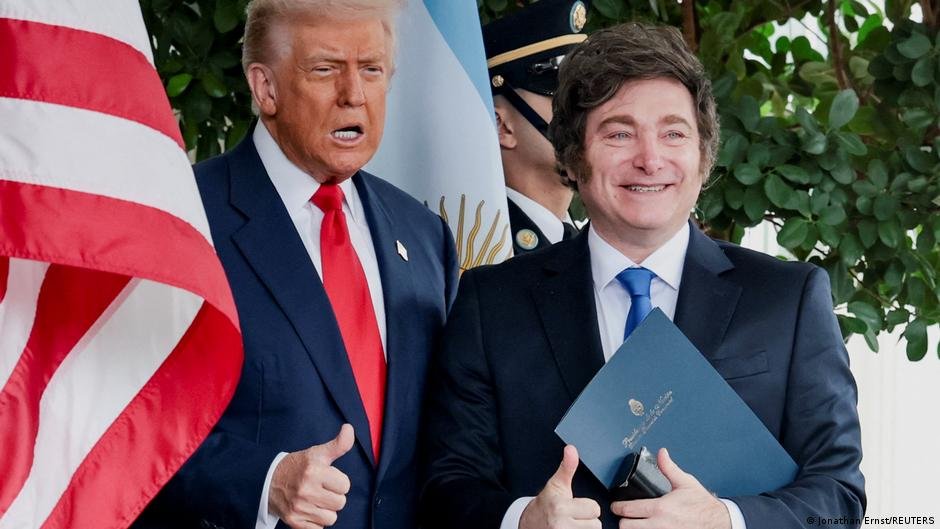
Countries considered allies on migration and security – such as Guatemala, El Salvador and Ecuador – or politically aligned states such as Argentina are being treated favourably, Luna said, adding that the new deals strengthen these countries as strategic partners and signal a push against China.
“In Argentina, they (the agreements) represent the first concrete steps following the Trump administration’s financial involvement. They encourage investment, particularly in the pharmaceutical sector, and send a clear message to markets: Argentina is worth investing in – an important signal to leaders like (Argentine President Javier) Miley, who rely on foreign capital to fuel growth.”
However, Argentina’s libertarian leader Javier Meili now has to walk a narrow path. The new US trade framework may not be fully compatible with Mercosur rules, raising the possibility that the country may have to choose between the US approach and Mercosur commitments.
Luna warned that such an option “could have a significant impact on trade in Brazil and the (Mercosur) bloc.”
Marcela Franzoni, an international relations expert at Ibmec University in Rio de Janeiro, agreed, telling Brazil’s leading economic daily, Valor, that an immediate impact could be the erosion of Brazil’s market share in Argentina, as low-cost American goods gain access.
Meanwhile, Europe is stuck waiting — partly of its own making, Luna said, adding that EU negotiators still have an “extensive list of demands” while bilateral US deals offer “quicker and more concrete results.”
This article was originally written in German.
<a href