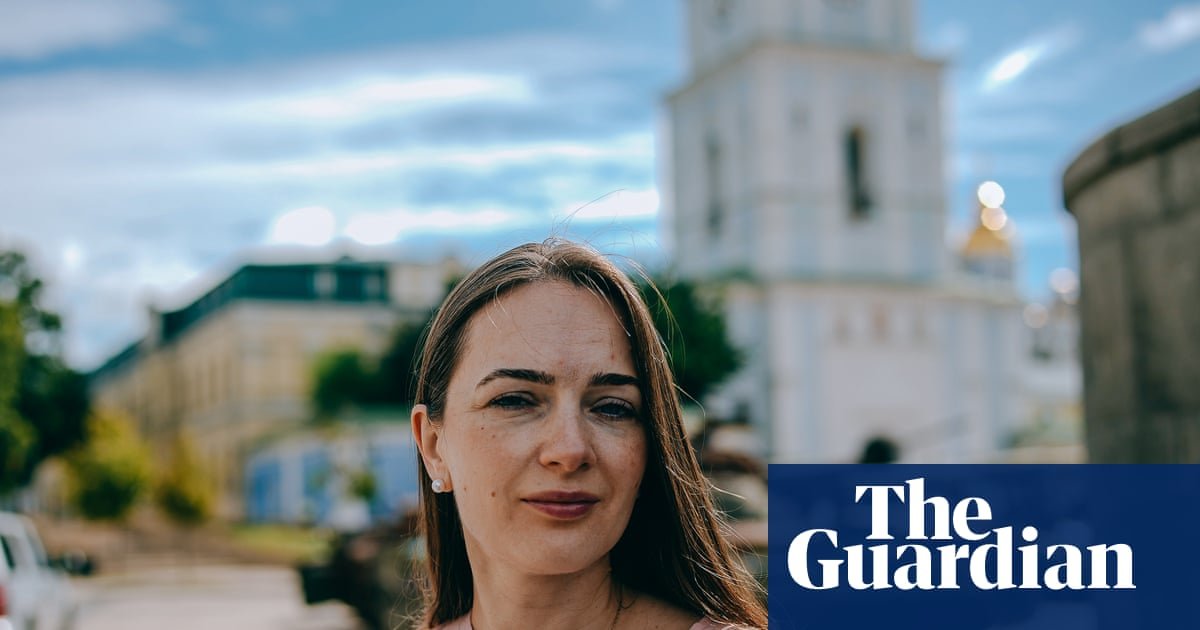
Ukraine’s only Nobel Peace Prize laureate has warned that any peace deal between Russia and Ukraine that includes amnesty for war crimes could encourage other authoritarian leaders to attack their neighbours.
Oleksandr Matveychuk said the leaked 28-point US-Russia plan does not include a “humanitarian dimension” and supported President Volodymyr Zelensky’s efforts to rewrite it in talks with the White House.
“We need peace, but not a pause that would give Russia a chance to retreat and regroup,” said the Kiev-based human rights lawyer. He said a durable agreement should include NATO-like guarantees for Ukraine.
Matviychuk heads the Ukrainian Center for Civil Liberties, which was jointly awarded the Nobel Peace Prize in 2022, and has been influential in arguing that Russia has developed a “genocidal character” because the international community has not adequately controlled it.
Comments like his reflect widespread sentiment in Ukraine. Even after nearly four years of attritional fighting, with frequent power outages following Russian attacks, there is little willingness to accept territorial concessions, and few Ukrainians believe that without an effective security framework there could be a permanent end to the war.
The human rights lawyer argued that clause 26 of the initial US-Russia resolution, which stated: “All parties to this conflict shall receive full amnesty for their actions during the war and agree not to make any claims or entertain any complaints in the future,” was particularly problematic.
“It would subvert international law and the UN Charter (which urges refraining from attacks on neighbors) by setting a precedent that would encourage other authoritarian leaders, that you can invade a country, kill people and erase their identity, and you will be rewarded with new territories.”
It has been omitted from the Ukraine-US 19-point counter-proposal, but talks will continue next week, when Donald Trump’s special envoy Steve Witkoff visits Moscow for talks with Russian leaders. Kremlin officials have insisted there will be no changes, raising fears the US could try to impose Russian conditions on Ukraine.
As Russia demanded in its 28 points, accepting the 30% of Kramatorsk, Sloviansk and eastern Donetsk region still under Ukrainian control would not provide a stable basis for peace, Matviychuk argued, because “Putin did not start this war for land”.
The Russian president’s goal, he said, was to subdue Ukraine. “It’s foolish to think that Putin lost hundreds of thousands of troops to small Ukrainian towns that most Russians couldn’t find on a map.” A peace plan will only succeed if it is “impossible for it to achieve its goal”.
He argued that Ukraine, “deserves to be part of NATO”, is able to make a strong contribution to the alliance with its applied military experience. If this were not politically possible, only “a complex set of measures that would have the same force as NATO’s Article 5” would prevent Russia from attacking Ukraine again.
Matviychuk said the peace deal should also protect the rights of the estimated 6 million Ukrainians living in Russian-occupied territories, including 1.5 million children. He said, “Russian occupation means torture, rape, internment camps and mass graves, yet there are zero words about these people.”
Leaked copies of the initial US-Russian text make only a vague reference to Ukrainians living under occupation. It said both countries should “end all discriminatory measures and guarantee the rights of Ukrainian and Russian media and education”.
After newsletter promotion
The CCL has helped document 92,178 “potential war crimes” by Russian actors in Ukraine since 2014, when Moscow ordered the invasion of Crimea and separatists took control of parts of the eastern Donetsk and Luhansk regions. Full-scale fighting broke out with the Russian invasion in February 2022.
Although Ukraine is under pressure militarily, with Russian forces advancing on points in the east and south, its forces have not been defeated and there is a widespread belief that they can continue to inflict heavy losses on the invaders and eventually force rearmament, despite the human cost.
Inna Sovsun, an opposition lawmaker from the liberal Holos party, said that giving up the rest of Donetsk without a fight was “one of the most unacceptable positions in the current discussions” and that Ukraine had to change it in its diplomatic talks with the US.
He said, “For Russia to capture Donetsk militarily, it would require about a year of extremely intense fighting”, and that there would be many casualties in the process. “Russia currently lacks the ability to take these areas, and conceding them would only create a new platform for future attacks.”
After 15 months of fighting, Russia is close to taking control of Pokrovsk, a once militarily important coal-mining town in Donetsk. Britain estimates its forces have suffered about 1,000 casualties a day on all fronts since June, although the most intense fighting has taken place in the region.
Elena Yanchenko, a former independent MP from the president’s Servant of the People party, said “Ukrainians want peace more than anyone” but “after 11 years of war, we know what peace looks like on Russia’s terms”.
He said that the President, politicians like him and the country had no option but to engage with America. “We are all working together to clarify our position, counter Russian lobbying and disinformation, and ensure that the United States does not acquiesce to Russian demands. Because that would undo years of diplomatic efforts.”
<a href