That woman was Natalia Khodymchuk, the widow of Valery Khodymchuk, who died when reactor No. 4 at the Chernobyl nuclear power plant exploded on April 26, 1986, starting the chain of events that led to the worst nuclear disaster in history.
Having heroically remained at his workplace until the bitter end, Khodymchuk remains inside the reactor today, as his remains were never recovered from the radioactive fire that incinerated them. Khodymchuk, posthumously awarded both Soviet and Ukrainian honors after independence, was officially recognized as Chernobyl’s first victim.
After the events of April 1986, Natalia Khodymchuk was evacuated from the exclusion zone with her son and daughter, and later moved to a new, 18-storey block of flats on the outskirts of Kiev, where, ironically, there was almost nothing except another power station.
At the time, cynics said that “Chernobyl veterans” were deliberately kept together and their children sent to their own schools and kindergartens on the outskirts of the city to ensure that they could not transmit their radiation sickness to the rest of Kiev’s population.
Abandoned city of Pripyat in the Kyiv region of Ukraine. Photo: Lesha53
But that skepticism soon faded, especially when it emerged that radioactive fallout from Chernobyl had spread into Kiev as well, and people were advised not to take their children to that year’s May Day parade in the city center. Yet the message from Moscow was always the same: the accident was local, there was no danger, and Soviet citizens should not listen to enemy propaganda.
In 1996, to commemorate the 10th anniversary of his death, Khodymchuk was symbolically buried at Moscow’s Mitinskoe Cemetery along with 30 other firefighters and power plant staff members, all of whom had been buried there over the decades.
Unlike Khodymchuk, those already buried at the scene died in Moscow’s Hospital Number Six within a few months of the disaster. Hospital Six was the only medical facility in the USSR capable of diagnosing patients with “radiation sickness”. Indeed, all Chernobyl “victims” were buried in zinc coffins and their graves were filled with concrete to create their own mini-sarcophagi.
The story of Valery and Natalia’s meeting at the Chernobyl nuclear power plant is as simple as any Soviet film about love on a production line.
Natalia placed her prized possession, the shirt that Khodymchuk had worn before leaving for his last shift, in her husband’s imaginary coffin. “I didn’t wash it. I could smell Valery on the shirt for a long time,” Natalia said almost 40 years later.
Natalia’s friends and family from the Chernobyl Veterans Organization came to visit her in the burn unit, following serious injuries sustained earlier this month. Nevertheless, she was eager to talk about her late husband, and appeared concerned that people would forget some details of his life or otherwise misunderstand the facts of his tragic death.
The story of Valery and Natalia’s meeting at the Chernobyl nuclear power plant is as simple as any Soviet film about love on a production line. She was a canteen worker in the city of Pripyat, he was a young nuclear technician who went there for lunch. They would go dancing in her village, Kopachi, on the weekends, after which Valerie would go hiking back home.
Natalia Khodymchuk in the exclusion zone, 2024. Photo: Ukrainian Agency for Exclusion Zone Management
Natalia recalls in her memoirs, “Once, Valera came unexpectedly in the middle of the week. I was weaving a rug with flowers on my loom.” “I was embarrassed that he saw how bad my home life was and what kind of clothes I wore at home. But he came to propose.”
Initially, the newlyweds lived in a mobile home until they found an apartment in Pripyat, the city where Chernobyl workers lived, which has now been deserted for nearly four decades.
Every year, Natalia Khodymchuk regularly visited Moscow’s Mitinskoye cemetery for two decades, until the war in Donbass made travel too difficult, when Ukrainians became unwelcome guests in Russia. After that, Khodymchuk decided to leave his flowers every year either at the memorial plaque or at Chernobyl’s chapel.
Natalia and Valery Khodymchuk, 1980s, Chernobyl. Photo: Ukrainian Agency for Exclusion Zone Management
However, once a full-scale Russian invasion of Ukraine began in 2022, even the route to Chernobyl was closed, and the exclusion zone was rapidly occupied by Russian forces. In the same year, Natalia became a grandmother, and her granddaughter was named Valeria after her grandfather, whose photos still hang on the walls of the family home.
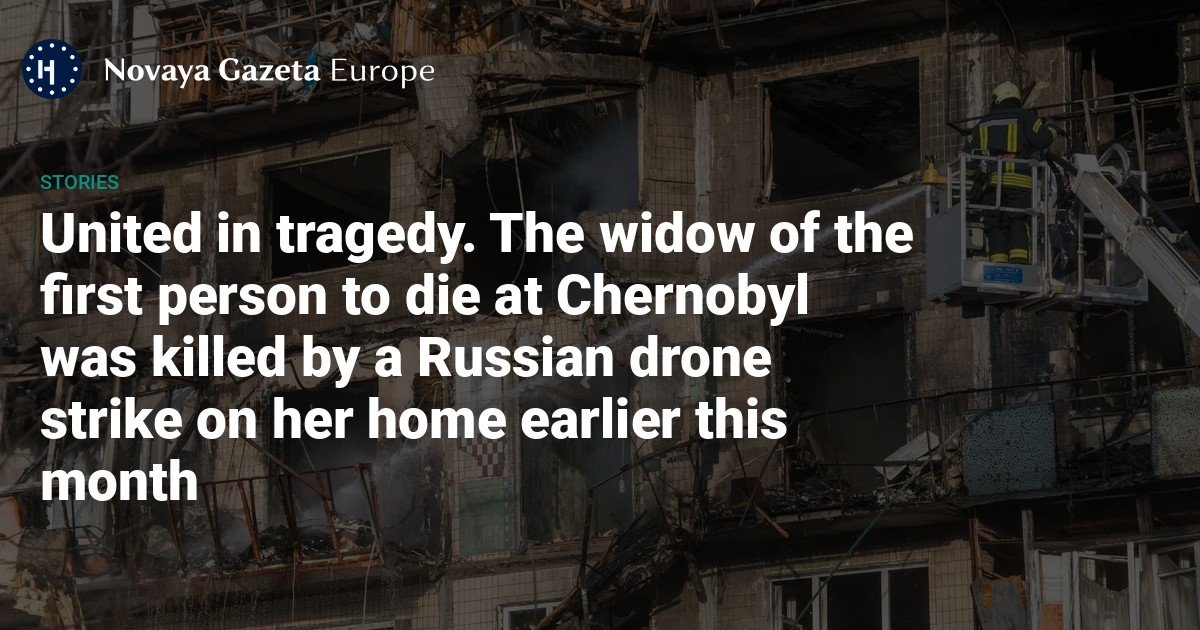
In the early hours of 14 November, a martyr attacked a Kiev building where several Chernobyl survivors – pensioners suffering from chronic diseases – were living. Where could they run to and hide every night? His possessions consisted of little more than the awards he received for his brave work and a few family photo albums, which he was able to take with him when he fled Pripyat 40 years ago.
Among the residents was the Hero of Ukraine, Oleksiy Ananenko, a former mechanical engineer at Chernobyl and one of three volunteers who, risking their lives, managed to prevent a second explosion at the power plant. If this had happened, the consequences for the rest of Europe could have been disastrous.
A coffin now covers the disaster site, and a poem on a memorial plaque dedicated to Khodymchuk’s sacrifice reads: You did not leave your post, you stood like men in battle. There should be a memory of you in every heart.
<a href=