Daniel Sandford,uk correspondent

 EPA-EFE/REX/Shutterstock
Provisional data shows that net migration to the UK has fallen by two-thirds in the year ending June 2025 compared to the previous 12 months.
The Office for National Statistics (ONS) said the gap between the number of people coming into the country and those leaving was 204,000, down from 649,000, with the decline mainly due to fewer arrivals for work and study reasons.
It comes as Home Office figures show the number of people claiming asylum by September 2025 reached a record high of 110,051.
The data also shows that the number of asylum seekers staying in hotels in the year to September increased by 2% compared to the same period last year.
The figures are part of two separate releases published on Thursday – an ONS release on net migration for the year ending June 2025, and Home Office figures on the immigration system for the year ending September 2025.
Home Office figures show that initial decisions on asylum claims have increased over the year to 133,502 people who have received an initial decision – almost half (45%) of whom were granted permission.
“Decision-making has reached historically high levels and the number of cases awaiting a preliminary decision has fallen by 36% between September 2024 and September 2025, despite a record high number of asylum claims over this period,” the release said.
The backlog of those awaiting a first decision has been steadily decreasing throughout the year, but the backlog of appeals is increasing.
The Government is committed to ending the use of asylum hotels by the end of this Parliament.
Thursday’s data showed more than 36,000 people were being temporarily housed in hotels in September.
That’s up 13% over the past three months, but volatility over the past year has led to a smaller increase of 2% through September 2024.
This is down from a peak of 56,018 people in hotels at the end of September 2023.
It follows a legal battle with Epping Forest District Council over the use of hotels, after he said earlier this week he would appeal a High Court decision which rejected his case to close Epping’s Bell Hotel to asylum seekers.
Responding to Thursday’s figures, a Home Office spokesman said fewer than 200 hotels were in use as he vowed to “close every single one”.
“We are outraged at the level of illegal immigrants and asylum hotels.
“The relocation of illegal immigrants to military bases is well underway to ease pressure on communities across the country.”
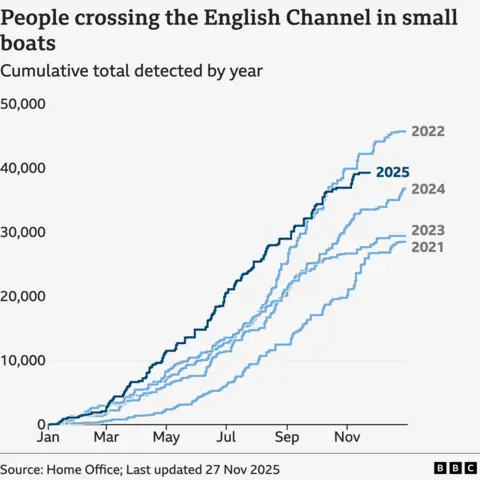
Small boat arrivals saw a 53% increase compared to the previous year, with 45,659 people arriving via this route in the 12 months to September 2025. The Home Office release shows the figure is close to the 2022 peak which was 45,774.
“The increase in arrivals in 2025 is accompanied by an increase in the average number of arrivals per small boat,” it said.
In this time period approximately 5,151 children (under 18) crossed the Channel in small boats and claimed asylum – of whom 2,700 were unaccompanied children.
Separately, 153 migrants have been sent from Britain to France under the pilot One in One Out scheme.
The return flight today included the person who was evacuated on 16 October and returned to the UK via small boat on 8 November (he has not been counted twice).
A total of 134 people have been brought to the UK through this scheme.
Figures released by the ONS on net migration take into account people who are claiming asylum in the UK after entering through both regular and irregular routes, as well as other forms of immigration. They relate to people who have changed their place of residence for a period of 12 months or more.
The overall figure saw a dramatic decline by June 2025, and arrivals of non-EU+ citizens on work and study dependent visas fell by almost 70%. (EU+ refers to the European Union countries, plus those of Norway, Iceland, Liechtenstein, and Switzerland.)
Responding to the net migration figures, Home Secretary Shabana Mahmood said the government was “moving forward” as she referenced the pressure of migration on local communities.
“Net migration is at its lowest level in half a decade and has fallen by more than two-thirds under this government,” he said in a statement.
“Last week, I announced reforms to our immigration system to ensure that people who come here contribute and invest more than those who leave.”
Earlier this month, Mahmoud introduced proposals to reform the legal immigration system, including changing how long it can take for some immigrants to obtain permanent status.
This followed a series of measures to combat illegal migration such as changing how the right to family life under Article 8 of the European Convention on Human Rights (ECHR) is applied in migration court cases.
Migration experts have indicated that the net migration numbers – which cover the year ending June 2025 – could reflect measures brought in by the Conservatives such as an increase in the wage ceiling that was introduced in June 2024.
Peter Walsh, senior researcher at the Migration Observatory at the University of Oxford, told BBC Radio 4’s Today programme: “For the most complete and accurate picture, it takes at least a year for policy changes to show up in the data.
“This is the definition of a long-term international migrant (someone who changes his or her usual country of residence for at least one year).”
Additional reporting by Robert Cuffe, head of statistics
<a href