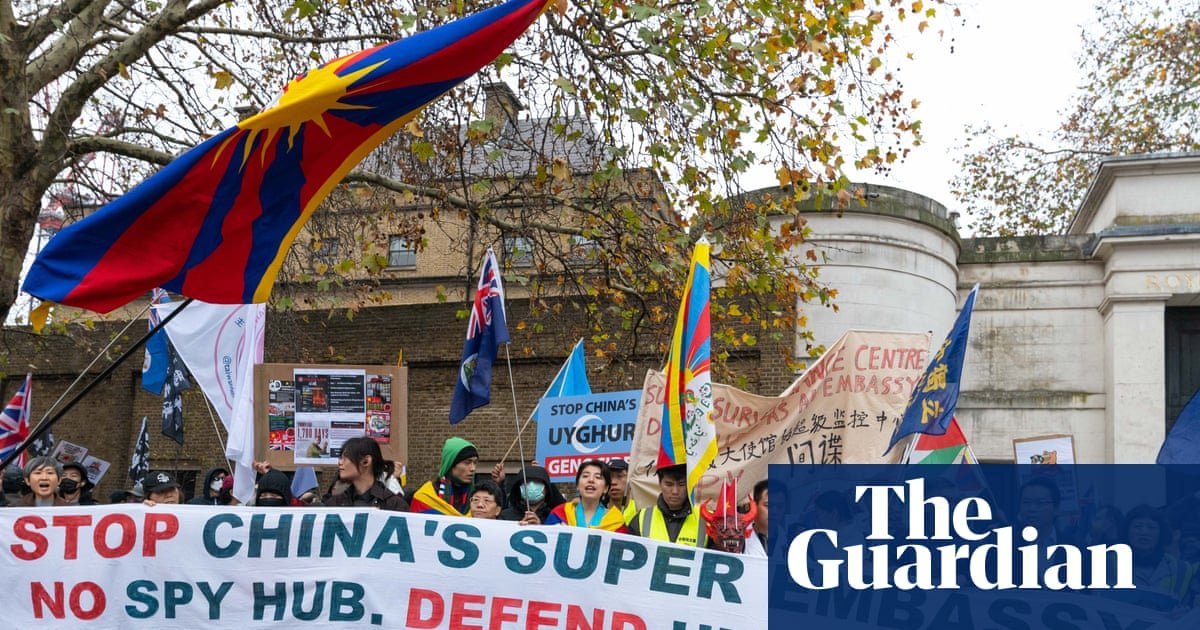
The government has postponed its decision on whether to approve a Chinese super-embassy in London until January, when Keir Starmer is expected to visit Beijing.
Ministers are expected to give the green light to the controversial plans after formal submissions by the Home Office and Foreign Office raised no objections on security grounds.
The Guardian reported last month that security services had indicated to ministers that they could handle the security risks of the embassy, which would be China’s largest diplomatic post in the world. Consolidating China’s seven existing diplomatic posts in London into a single embassy “obtains obvious security benefits”, a government spokesman said on Tuesday.
The Chinese government has agreed to combine all its diplomatic premises in London into the Royal Mint Court site, spread over 20,000 square meters near Tower Bridge in London.
A final decision on granting planning permission has been delayed until January 20, around the time the Prime Minister plans to visit China for bilateral talks. This is the third time that ministers have postponed the decision.
Starmer will be the first prime minister to visit Beijing since Theresa May in 2018. In a speech on Monday night, he argued that the government cannot continue to blow “hot and cold” on China and needs to strike a balance.
“We had a golden age, which then turned into an ice age. We reject that binary choice,” he said, describing China as “a country of vast scale, ambition and ingenuity” and “a decisive force in technology, trade and global governance.”
Starmer said, “Our response will neither be driven by fear, nor softened by confusion. It will be based on strength, clarity and sober realism.”
In a letter sent to relevant parties and released by the Inter-Parliamentary Coalition on China, the Home Secretary, Shabana Mahmood, and the Foreign Secretary, Yvette Cooper, said their departments had “carefully considered the breadth of views” related to the proposed embassy.
He said he worked with police and others to ensure that national security issues were addressed and to recognize “the importance of countries having diplomatic premises operating in each other’s capitals, while maintaining the vital need to maintain and protect our national security.”
The plan has faced intense opposition from some local residents and campaigners who are concerned about Beijing’s human rights record in Hong Kong and the Xinjiang region. Several protests have taken place near the site in recent months.
A government spokesperson said: “An independent planning decision will be taken by the Secretary of State for Housing, Communities and Local Government in due course.”
“The Home Office and Foreign Office provided views on the particular security implications of this build in January and it was clear that no decisions should be made until we had confirmed that those views had been met or resolved, which we have now done.
“Should the planning decision for a new embassy in the London area of Tower Hamlets be approved, the new embassy would replace seven separate sites that currently comprise China’s diplomatic footprint in London which clearly brings security benefits.”
A Chinese Embassy spokesperson said: “We strongly condemn the UK side’s repeated postponement of the decision on the planning application for the new Chinese Embassy project.”
The spokesperson called on the UK to quickly approve the planning application “to avoid further undermining the mutual trust and cooperation between the two parties”.
China bought the Royal Mint Court site for £255m in 2018, but its plans to build an embassy there stalled after Tower Hamlets Council refused planning permission in 2022.
The Conservative government declined to intervene but Labor took the matter out of its hands by calling on the council soon after taking power last summer.
<a href