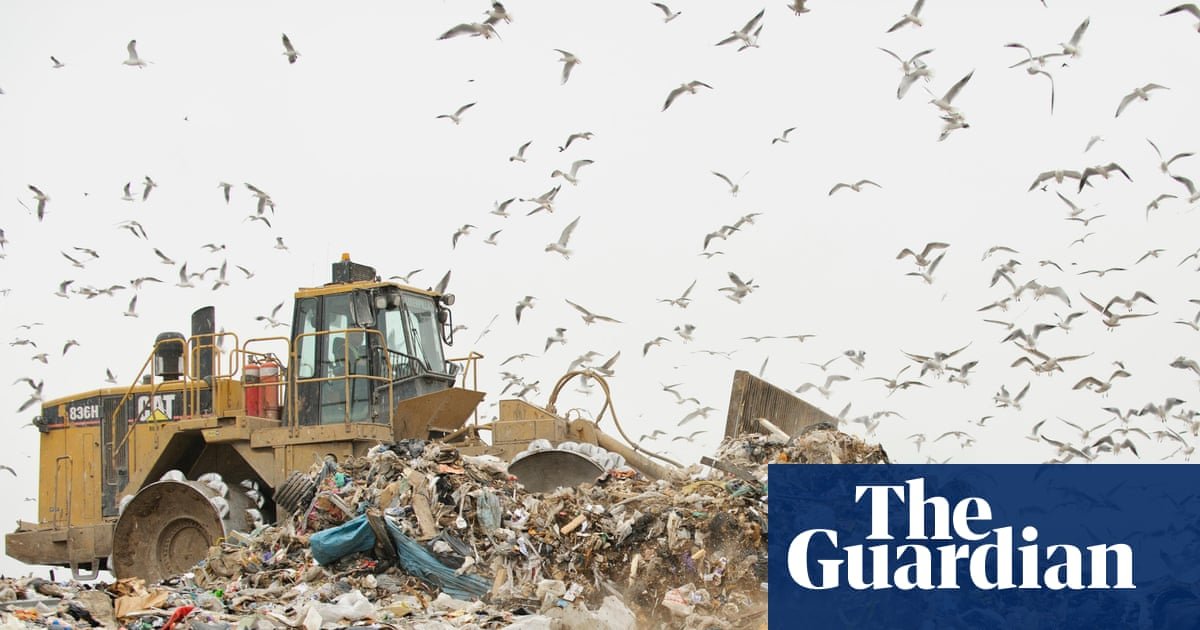
Thousands of landfills across the UK and Europe sit in floodplains, posing a potential threat to drinking water and conservation areas if toxic waste is released into rivers, soils and ecosystems.
The findings are the result of the first continent-wide mapping of landfills, carried out by Guardian, Watershed Investigations and Investigate Europe.
Patrick Byrne, from Liverpool John Moores University, said: “With climate change increasing the frequency and magnitude of floods and erosion, the risk of these wastes getting into our environment increases.
“This includes physical waste such as plastics and construction materials, but also toxic metals and chemicals such as PFAS (‘forever chemicals’) and PCBs (polychlorinated biphenyls).”
Kate Spencer, professor of environmental geochemistry at Queen Mary University, said: “We have identified a wide range of waste in the collapsing coastal landfill (at Tilbury), including waste that looks like a hospital blood bag, and we are talking about thousands of sites which, if not lined up, are at risk of flooding, with multiple ways for it to enter groundwater, surface water and the food chain.”
There are estimated to be up to 500,000 landfills across the EU. About 90% of them, including 22,000 UK sites, predate pollution control regulations such as landfill lining to prevent leaching. Modern landfills that are well managed are likely to pose less risk.
More than 61,000 landfills have been identified across Europe, 28% of which are located in areas vulnerable to flooding. Modeling suggests the actual number of flood-risk sites could be as high as 140,000. This mapping effort, based on requests for landfill data from 10 countries and complemented with open-source information, highlights a deeper issue: EU institutions lack centralized landfill records, while data from individual member states remains fragmented, inconsistent and often inaccessible.
“We have inadequate records, there are differences in the way these sites are classified and that makes it really difficult to deal with,” Spencer said.
“This is the worst possible scenario. Most landfills will be fine, but you only need a few sites that contain very toxic chemicals for there to be a problem. We don’t know which ones.”
More than half of the mapped landfills are in areas where groundwater fails to meet chemical quality standards, suggesting that in some cases landfills have contributed to pollution.
The EU Landfill Directive, adopted in 1999, banned unlined landfills and created strict waste acceptance criteria. But before this, there were very few or no pollution prevention measures.
“There can be many other sources of pollution, such as farming and industry, but one of the main ways chemicals migrate from landfills is through groundwater,” Byrne said.
Byrne found leachate from the historic landfill of Newgate Nature Reserve in Wilmslow, Cheshire, seeping into a small stream. Their tests found toxic PFAS “forever chemicals” at levels 20 times higher than acceptable levels for drinking water. In Greece, tests found levels of PFAS several times higher than drinking water standards, as well as mercury and cadmium leaching into the Nedontas River from the former Maratholaka landfill site in the Taygetos mountains, visited by thousands of hikers each year. The local mayor of Kalamata states that the site ceases to operate by June 2023 and that “there is currently no evidence or data to prove any environmental impact from the operation of the site”.
Some of these may be sources of drinking water and the analysis found approximately 10,000 landfills in drinking water areas in France, Britain, Spain, Germany, the Netherlands and Italy. Over 4,000 of these are historic landfills in England and Wales and therefore not subject to pollution control. It was not possible to confirm whether this predates landfill regulations in Europe.
“Until you can identify where all the landfills are, what’s in them, whether they’re leaching and what treatment processes are filtering them, we don’t know and won’t know what the threat to human health and our drinking water is there,” Byrne said.
A spokesperson for the European Commission said that “Under the Drinking Water Directive the quality of water ‘on tap’ has to be ensured throughout the EU. The Directive covers a number of parameters to be monitored and the corresponding limit values have to be complied with. In case of exceeding these limit values, Member States have to ensure that the necessary remedial actions are taken.”
In the UK, water companies carry out risk assessments and monitoring of their public water discharges under regulatory guidelines.
The landfills most at risk of exposure are those along the coast. The analysis found 335 landfills in coastal erosion areas in England, Wales and France, and 258 landfills within 200 meters of the coast across Europe, which could be at risk of or exposed to erosion due to storms.
“This is the tip of the iceberg,” said Spencer, who is helping the Department for Environment, Food and Rural Affairs (Defra) to rank the most at-risk landfills out of 1,200 identified priority sites in England and Wales. She examined two decaying landfills on the coast and found that Lynemouth in the north-east released high concentrations of arsenic, and Lyme Regis in the south-west released high levels of lead, both of which could cause ecological harm.
“We now need to understand the potential threats of climate change and related pollution emissions to all of our historic landfill sites, not just coastal ones,” he said. He said money would be needed to deal with these sites.
After newsletter promotion
“Essentially we are all living on a heap of rubbish,” said Spencer, who pointed out that around 80% of the British population live within 2km of known landfill sites and in the most deprived parts of the country.
A report by the UK Health Protection Agency last year concluded that living close to a well-managed municipal active or closed landfill site does not pose a significant risk to human health, although the picture for historic sites is less clear due to a lack of data.
Wildlife may also be at risk, as more than 2,000 European landfills are in protected conservation areas.
“We know that plastic is accumulating in wildlife, humans and the environment, and evidence of its negative health effects is emerging,” Byrne said.
“An important thing with chemical pollution is where the chemical leachate goes. We have significant wetlands around these areas, so if leachate goes there it can accumulate in wildlife.”
Illegal waste dumping is also a significant problem, identified by Europol as one of the fastest growing areas of organized crime in Europe. In February, Croatian authorities arrested 13 people suspected of illegally dumping at least 35,000 tonnes of waste from Italy, Slovenia and Germany in Croatia, resulting in a profit of at least €4m for the criminals.
In England, Environment Agency data shows 137 open investigations into illegal dumps, involving more than 1 million cubic meters of material.
In the Campania region of southern Italy, illegal toxic waste dumping by the Mafia has been blamed for increased death and disease rates in the area.
In England and Wales, at the current pace of use our remaining landfill capacity could be exhausted in around 2050. New sites often face environmental concerns and public opposition.
A spokesperson for the Environment Agency said: “Our job is to protect people and the environment, and we are working closely with the landfill industry, water companies and government to better understand the impacts of PFAS chemicals in landfills.
“Environment Agency teams are running a multi-year program to improve the evidence about the sources of PFAS pollution in England. At the same time, we are also running further studies to investigate the potential contribution of PFAS in landfill leachate at a limited number of sewage works.”
A Defra spokesperson said: “We want to prevent waste from happening in the first place, but where waste does occur, we need to manage it in the most appropriate way.
“We are committed to reducing the amount of waste sent to landfill, supported through our collection and packaging improvements. As well as this, the upcoming Circular Economy Development Plan will outline measures to promote greater re-use and recycling, protect the value of our resources and stop the country’s waste from going to landfill.”
-
Disclaimer: There may be duplicate records in this dataset. Duplicates may arise from multiple data sources, repeated entries, or variations in data collection processes. Although efforts have been made to identify and reduce duplication, some records may still survive.
<a href