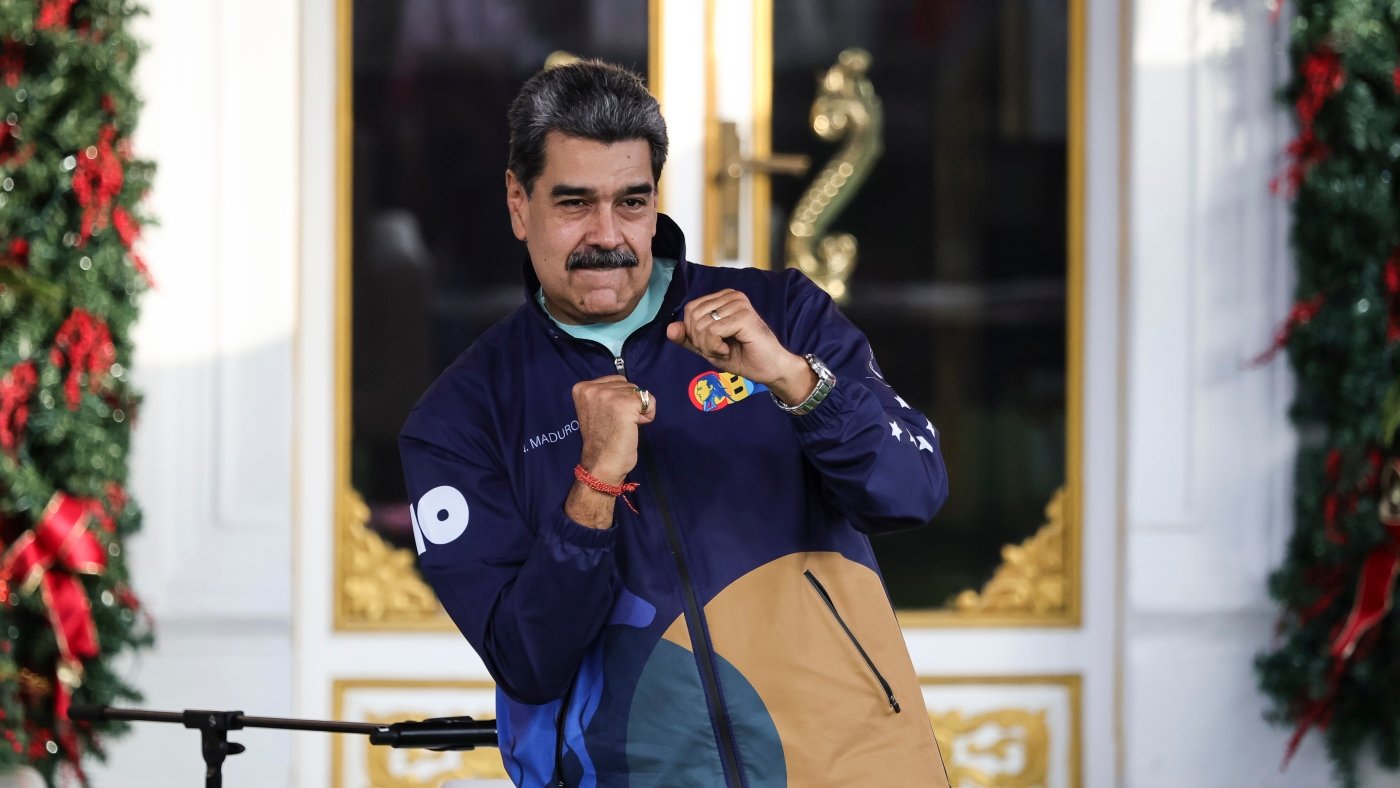

Venezuelan President Nicolas Maduro dances during a march as part of “Venezuelan Students’ Day” in Miraflores, Caracas, Venezuela, on November 21.
Jesus Vargas/Getty Images
hide caption
toggle caption
Jesus Vargas/Getty Images
BOGOTA, Colombia – The U.S. military buildup in the southern Caribbean Sea near Venezuela is raising expectations of an armed attack against that country, but also fears it could create a South American quagmire.
Tensions are rising as the Trump administration amasses warships and thousands of troops in the Caribbean. On Monday, it designated the Venezuelan government led by President Nicolas Maduro as a foreign terrorist organization. And in saying on Tuesday that he is ready to talk with Maduro, President Trump has also signaled that the authoritarian leader’s days are numbered.
But US military intervention, which is strongly supported by many Venezuelans, including opposition leader and Nobel Peace Prize recipient María Corina Machado, would be unpopular domestically and extremely risky.
“This comforting idea that somehow Maduro falls and the next day Maria Corina Machado walks into the presidential palace and everyone lives happily ever after is imaginary,” said Phil Gunson, who works in Caracas for the International Crisis Group. “This will not happen.”
Since his first term in office, President Trump has pressed to remove Maduro, who has crushed Venezuelan democracy and plunged the country into an economic crisis that has forced nearly 8 million Venezuelans to flee the country. Trump has long encouraged Venezuelan military officials to overthrow Maduro and in 2019 recognized opposition lawmaker Juan Guaidó as the country’s legitimate president.
But Maduro is clinging to power, prompting Trump to consider military options in his second term.

The most extreme would be a full-scale US invasion along the lines of the US occupation of the small isthmus of Panama in 1989, involving 27,000 US troops and the arrest of that country’s dictator, Manuel Noriega.
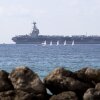
But even if Trump has sent the largest US naval fleet to the Caribbean since the Cuban missile crisis, experts say the 15,000 US troops aboard those warships will not be enough to take control of Venezuela. The South American country is larger than Texas and is home to rugged mountains and the Amazon jungle.
Should the United States field a stronger attack force, it could quickly overwhelm Venezuela’s military. Indeed, many of its poorly paid rank-and-file soldiers may defect. But unconventional forces will be significantly pushed back, says Jeremy McDermott, co-director of InSight Crime, which analyzes organized crime in Latin America.
“Any serious land invasion of Venezuela would be extremely complex,” McDermott said. “You have boots on the ground almost everywhere in Venezuela, especially in Caracas and the border areas, and you will face armed resistance.”
That resistance, he said, would include pro-Maduro militias known as “colectivos,” as well as at least 1,000 battle-hardened Colombian guerrillas who are based inside Venezuela, are sympathetic to Maduro, and would act as a pro-regime paramilitary force in the event of a U.S. invasion. Additionally, the Maduro government is handing out weapons to civilians and training them to fire.
“This is a people’s war to defend our country,” a military instructor told Venezuelan state TV.
Yet most Venezuelans hate Maduro and voted against him in last year’s presidential election, which many, including the US government, believe was stolen by his regime. A Venezuelan analyst, who asked to remain anonymous for his safety, said he had seen polling, which has not yet been made public, that shows a majority of Venezuelans would support U.S. military action to remove Maduro.

“There is no other way,” said Zair Mundare, a former Venezuelan government prosecutor who lives in exile in Florida.
Last week, opposition leader Machado issued a “freedom manifesto” demanding human rights, free markets, free speech, clean elections and the return of Venezuelan exiles for a post-Maduro future. He declared: “We stand on the edge of a new era.”
Meanwhile, anti-government influencers in Venezuela are promoting AI-generated videos imagining US intervention. One shows Maduro in the custody of US authorities in an orange prison jumpsuit, saying: “All Venezuelans want this as our Christmas gift.”
This is in stark contrast to a new CBS News and YouGov poll that found 70% of Americans opposed US military action in Venezuela. In the same survey, only 13% considered Venezuela a “major threat” to the United States.
As a result, a limited attack against Maduro, such as the capture-and-kill campaign against Osama bin Laden, who was responsible for the September 11, 2001 terrorist attacks, seems doubtful, says Venezuelan opposition congressman Henrique Capriles. Unlike Bin Laden, “Do Americans Really Care About Maduro?”. Capriles said. “no way.”
Trump could be betting that his military buildup will create a pressure cooker in Caracas that will provoke a palace coup by military officials. But that is a long way off as Maduro has surrounded himself with loyalists and Cuban bodyguards.
Caracas radio show host Vladimir Villegas says the effect of the US pressure campaign so far has been to create more solidarity within the ranks of the Maduro regime, as well as greater harassment and repression of the political opposition.
Capriles says that even if Maduro is toppled, there is no guarantee that the new leader will form a stable, democratic government. He points out that Maduro controls all branches of government while members of his United Socialist Party have taken over almost every city hall and state house across the country.
What’s more, demand for US reconstruction aid may be increasing after the US-backed overthrow of Maduro, but Trump, famously, is not a fan of nation-building.
“What about the day after the coup?” Capriles says. “Is the US ready to spend $100 billion to help stabilize Venezuela?”.
Officially, what is being called “Operation Southern Spear” is an anti-narcotics mission in which US forces are blowing up alleged drug boats in the Caribbean. But Venezuelan political analyst Benigno Alarcon says that’s not much to show for such a large military gathering.
“I don’t think they can call this operation a success if they just sink 10 boats and kill 80 drug smugglers,” he says.
InsightCrime’s McDermott calls the standoff “a giant game of chicken.”
He says, “Maduro knows that if he can hold out, President Trump cannot keep 11% or more of the US fleet off the Venezuelan coast indefinitely.” “So unless Maduro blinks, time is on his side.”
<a href