These two masses, known as large low-shear-velocity provinces (LLSVPs), are part of a list of the planet’s most massive and mysterious objects. Current estimates suggest each is about the size of the African continent, although they lie buried at a depth of 2,900 kilometres.
Lower surface vertical velocity (LLVV) regions form irregular regions of the Earth’s mantle, not defined blocks of rock or metal, as one might imagine. Within them, mantle material is hotter, denser, and chemically different from the surrounding material. They are also notable because they have a “ring” of cooler material around them, where seismic waves travel faster.
Geologists suspected that these anomalies existed since the late 1970s and two decades later they were able to confirm them. After another 10 years of research, they now directly point to them as structures capable of modulating the Earth’s magnetic field.
LLSVPs alter the behavior of the nucleus
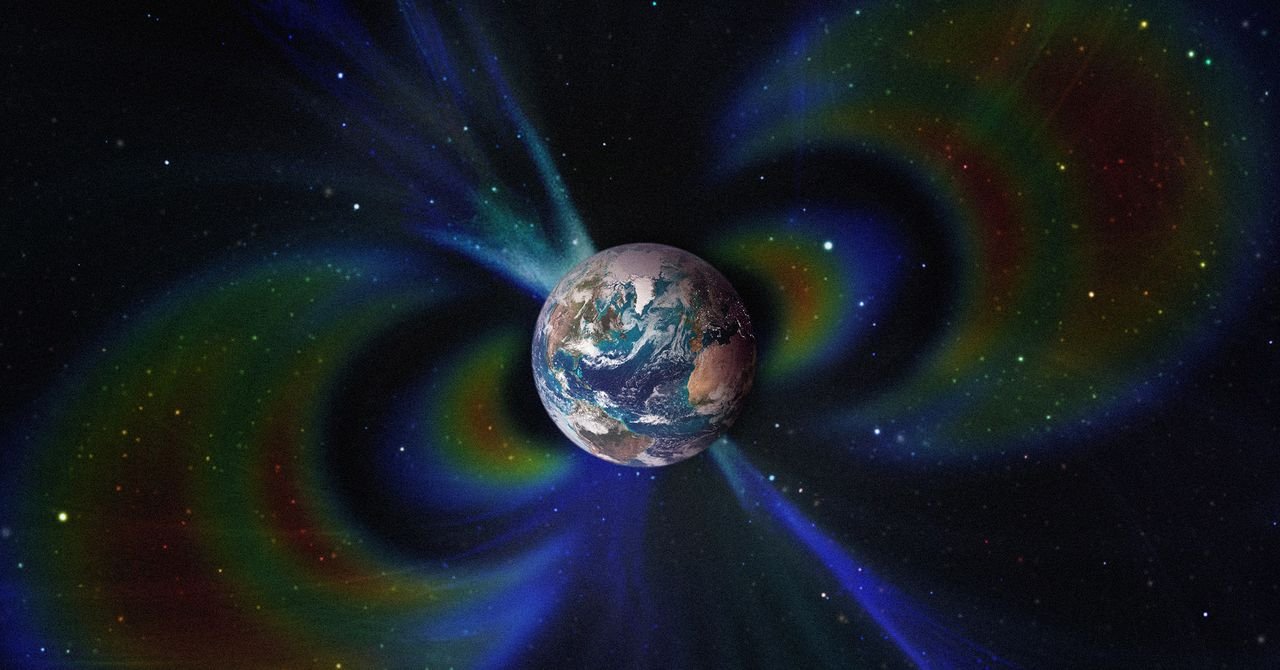
The temperature difference between the LLSVP and the surrounding mantle material changes the way liquid iron flows in the core, according to a study published this week in Nature Geoscience and led by researchers at the University of Liverpool. This movement of iron is responsible for generating the Earth’s magnetic field.
Overall, cold and extremely hot regions of the mantle speed up or slow down the flow of liquid iron depending on the region, creating an asymmetry. This unevenness contributes to the magnetic field taking the irregular shape that we see today.
The team analyzed the available mental evidence and ran simulations on a supercomputer. They compared what the magnetic field should look like if the mantle was uniform, versus how it behaved when it contained these anomalous fields with structures. They then compared both scenarios with real magnetic field data. Models incorporating only the LLSVP reproduced the same irregularities, inclinations, and patterns currently observed.
Geodynamo simulations also revealed that some parts of the magnetic field have remained relatively stable for hundreds of millions of years, while others have changed significantly.
“These findings also have important implications for questions related to ancient continental configuration – such as the formation and breakup of Pangea – and may help resolve long-standing uncertainties in ancient climates, paleontology and the formation of natural resources,” Andy Biggin, first author of the study and professor of geomagnetism at the University of Liverpool, said in a press release.
“These fields assumed that Earth’s magnetic field, when averaged over long periods of time, behaves as an ideal bar magnet aligned with the planet’s rotation axis. Our findings are that this may not be true at all,“ He added.
This story originally appeared in WIRED en Español and is translated from Spanish.
<a href