Point Piper in Sydney’s eastern suburbs has one of the best bathrooms in the world, according to the annual Dezeen Awards, a global design award.
Its dark, moody and luxurious interiors were partly inspired by Bram Stoker’s Dracula.
Jillian Dinkel, principal and creative director of the eponymous studio, said she was “deeply honored to be recognized on an international stage” for the transformation of Kilmory House, one of the city’s most affluent areas.
Dezeen, a trade design and architecture publication, honored two Australian projects at its ceremony in London on 25 November: Jillian Dinkel was honored for bathroom interior of the year and Melbourne’s Studio Bright for home of the year (urban).
“My clients were really willing to be quite adventurous in creating spaces that felt very dramatic,” Dinkel said. Dracula “was the starting point for our color scheme for the entire house”.
Kilmorey House is a conversion of the former stables of the historic property built for surgeon Sir Alexander McCormick in about 1913. Dinkel found photographs of McCormick’s original house with its dark wood paneling, which also informed the design.
The three-bedroom property is a second home for its current owners, who commissioned Dinkel to create multiple spaces for entertaining guests—including a Pilates studio, playroom, and commercial-grade kitchen.
Dezeen judges praised the project for its craftsmanship and mix of materials in the upstairs bathroom, next to the in-home wellness centre. “We used stainless steel, marble and Venetian plaster on the walls, so there are a lot of tactile materials matching each other in that space,” Dinkel said.
Dinkel also designed a powder room with solid wood paneling, a marble and brass custom basin, and hand-painted wallpaper. Also a children’s bathroom with deep burgundy tones and light blue.
Dinkel worked as a fashion editor at Condé Nast in New York before opening her own studio in Sydney in 2016, specializing in heritage houses.
“We’re really trying to preserve as much of the original architecture as possible and we’re trying to match that level of quality and craftsmanship that can feel like a lost art these days,” she said.
“It’s wonderful to be recognized against some of our heroes in the architectural industry around the world,” said Melissa Bright, director of Studio Bright, in Melbourne.
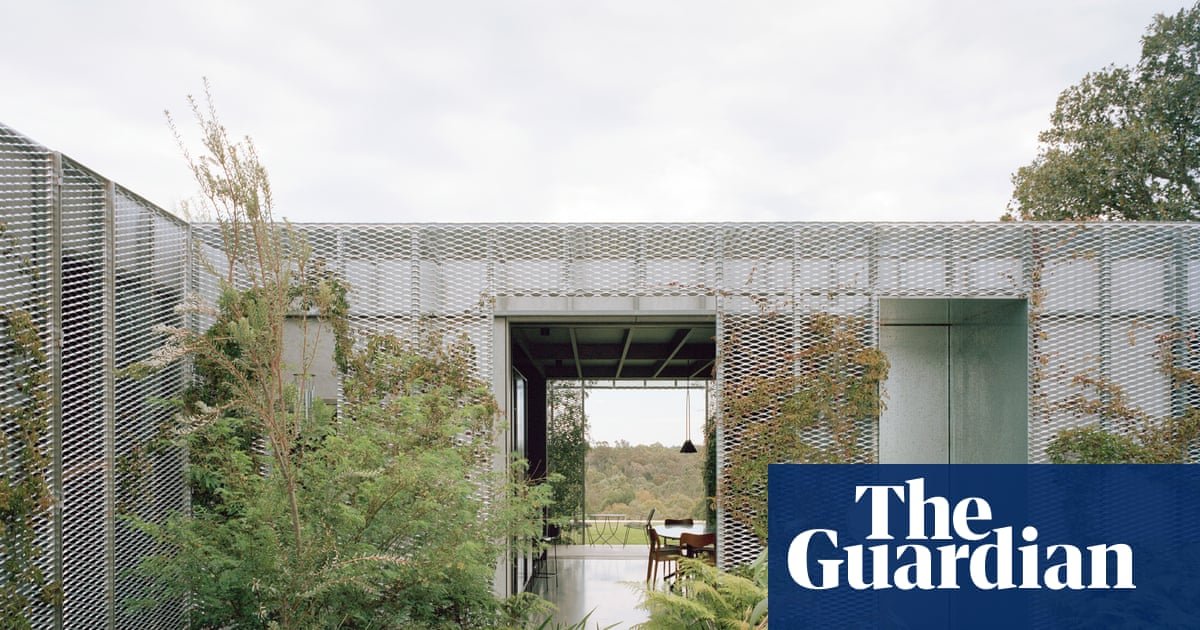
Hedge and Arbor House, a new four-bedroom family home, was named House of the Year (Urban), just weeks after winning the Robin Boyd Prize for Residential Architecture at the 2025 National Architecture Awards of Australia and, before that, winning the Harold Desbrow Annier Prize at the 2025 Victorian Architecture Awards in June.
Dezeen judges praised the property’s “clever and interesting” design. “The architects have made the best use of the site and used visually interesting mesh to balance the need for privacy, light and air,” he said.
Although the house was slated to be built in 2024, the project began in 2016. “It was not without its obstacles,” Bright said. “The fact that the design is being recognized today means that it is hopefully timeless.”
The house is wrapped in a galvanized steel mesh arbor, which serves as a structure for plants to grow.
“It’s an appropriately modest house on an incredible site, and one of the important things from the beginning was to capture that incredible landscape, both the hedges as well as the approach to the native parkland.”
“Experiencing the landscape was a fundamental tenet of the project from day one,” said Bright.
The design used modest materials, including raw cement sheets. “Our client was not afraid of these extremely hazardous raw materials,” Bright said, allowing his team to create “life-sustainable rooms for the entire family.”
Bright said his client appreciates the changes the home undergoes throughout the years. “It’s in a dense suburban area and somehow this house completely changes your perception. You see the house changing with the seasons without you doing anything yourself.”
Dezeen’s Architect of the Year went to architecture practice MAD, based in Beijing, Los Angeles and Rome.
London-based Studio Toogood won Designer of the Year and Interior Designer of the Year went to Italy’s Dimore Studio.
<a href