
Most modern tracking systems rely on satellites to determine location, supported by accelerometers that measure small movements between GPS updates. This works quite well above the ground, but those accelerometers tend to slip slowly, which is why they require frequent satellite corrections.
However, in tunnels or urban areas surrounded by tall buildings where GPS signals do not reach, that safety net disappears.
So researchers are turning to something more exotic: quantum accelerometers.
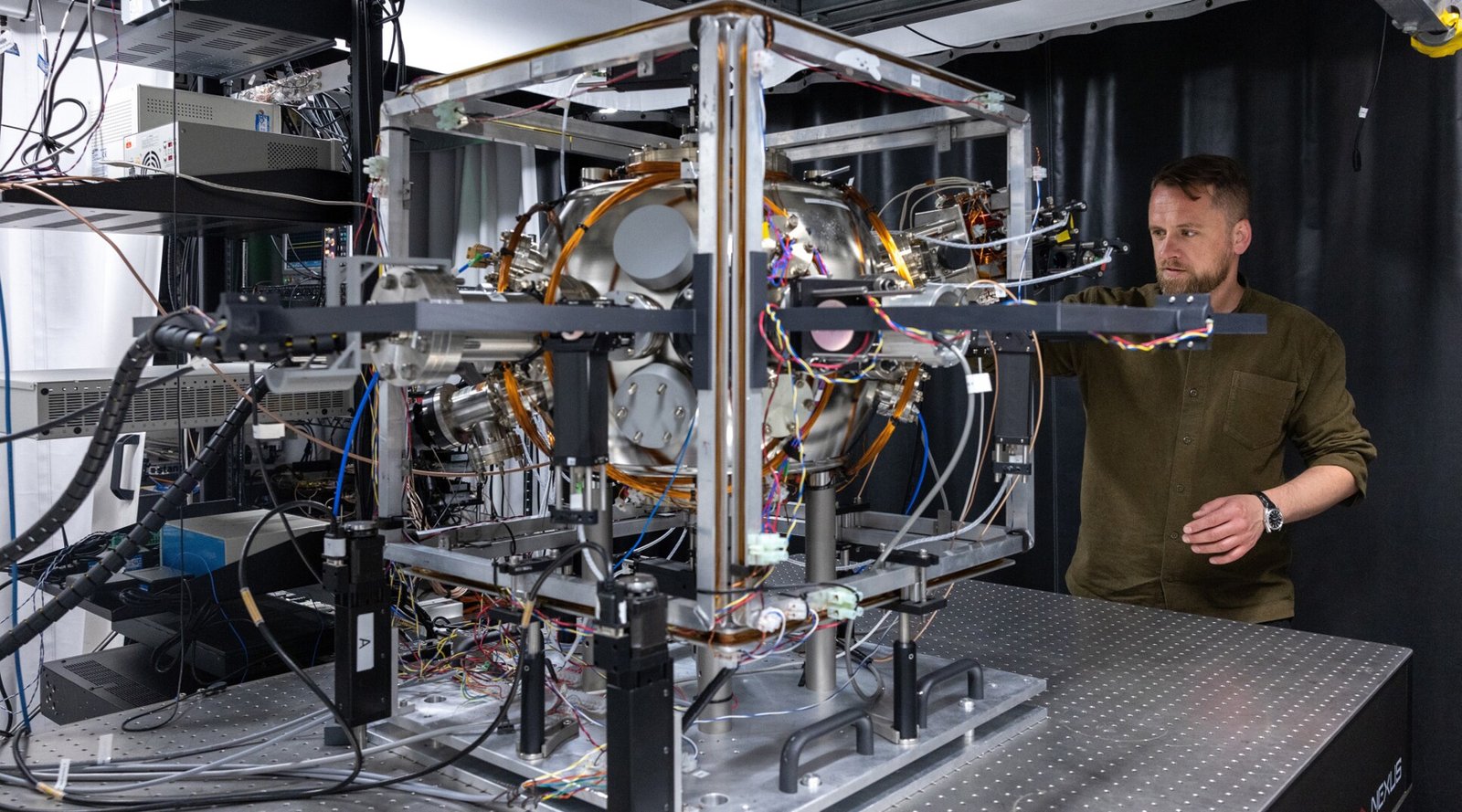
Instead of relying on traditional sensors, these devices use clouds of atoms cooled to near absolute zero. At those temperatures, atoms start to behave strangely – acting as both particles and waves. As the atoms “fall” through the sensor, their wave patterns change in response to the acceleration. Effectively using an ultra-precise optical ruler, the system can read these changes with extraordinary accuracy, without the need for satellites.
That technology is now getting closer to the railways. Research firm Monirell has received an additional £1.25 million from the UK government’s Quantum Technology Program to further the work. This funding supports the next phase of the Rail Quantum Inertial Navigation System (RQINS) roadmap, which aims to develop quantum navigation for the London Underground – and potentially the wider national rail network.
Monirail’s approach goes beyond simple positioning. Sensors onboard trains already provide a non-intrusive way to monitor track conditions, collect ride-quality data, and flag emerging faults in real time.
Naturally, trains already have track-based location systems, but they are usually based on being within a “moving block” of the train, so their accuracy is down to meters rather than centimeters. If you want to monitor track conditions, the more precise the location of a suspected fault, the less time workers will spend fixing it.
Quantum navigation could reduce that uncertainty to centimeters, making it much faster to find where the fault is. Underground, it can provide the kind of precise location that travelers expect above ground – while also acting as a strong fallback above ground when GPS is unavailable.
This may sound good, but in times of trouble, it would not be unrealistic to expect that a hostile government (or solar power) would destroy the satellite network, which would have a considerable impact on society, especially as it is estimated that a single day of GPS disruption could cost the UK economy more than £1.4 billion. A system that can operate independently of space-based infrastructure suddenly looks less like a luxury and more like an insurance policy.
As long as the vehicle has a known starting point, the quantum accelerometer can continue to accurately track its motion, no matter what is happening above the atmosphere. In other words, the future of mobile navigation may depend on supercooled atoms behaving in very strange ways.
The project is being run in collaboration with Transport for London, QNETQ, PA Consulting, Imperial College London and the University of Sussex.
Steve Venables, Senior Engineer at Transport for London, said: “Being a partner in the RQINS project highlights the transformative potential of quantum navigation and the importance of continued investment and collaboration to bring these innovations to life. We look forward to our support and partnership with industry and academia to deliver tangible benefits to UK rail infrastructure, with a focus on real-world impact and long-term resilience. We look forward to being part of the development roadmap in this next phase of UKRI funding.” Looking forward.”
<a href