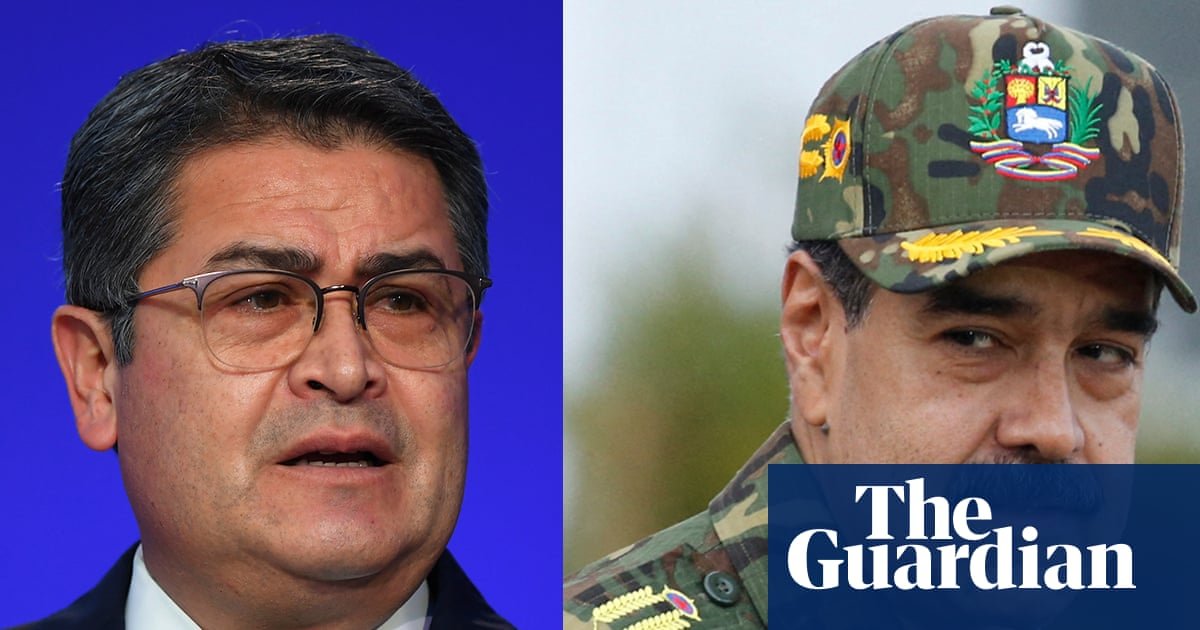
He was a Latin American president accused of colluding with some of the region’s most ruthless narco bosses to bring a flood of cocaine into the United States.
“(Let’s) stuff drugs up the gringo’s nose,” the double-dealing politician once reportedly boasted as he stuffed millions of dollars in bribes into his pockets and turned his country into what many called a narco-state.
The description might sound like a sketch of Venezuelan authoritarian President Nicolas Maduro, whom Donald Trump’s administration has accused of being a “narco-terrorist” leader and is trying to bring down with a $50 million bounty and a massive show of military force on the South American country’s Caribbean coast.
But it’s actually a portrait of Juan Orlando Hernandez, the former president of Honduras — painted by US prosecutors, whom Trump promised to pardon last week, despite the fact that Hernandez was sentenced last year to 45 years in prison for allegedly building a “cocaine superhighway to the United States.”
“The people of Honduras really thought they were set up and that was a terrible thing,” Trump told reporters Sunday. “He was the president of the country and he basically said he was a drug dealer because he was the president of the country… and I looked at the facts and I agreed with him.”
Trump’s surprise intervention in favor of Hernandez, known by his initials JOH, has baffled many observers, with one Drug Enforcement Agency (DEA) agent calling the move “madness.”
Why is the US President using his “war on drugs” as justification for overthrowing Maduro – despite what many see as weak evidence that the Venezuelan leader is actually a narco boss – while simultaneously offering a get-out-of-jail-free card to a man already convicted of such crimes in Manhattan federal court?
Why did Trump spend recent weeks blowing up alleged narco boats in the Caribbean – which had negligible impact on the flow of drugs into the US – and also why did he decide to go after a major trafficker convicted of smuggling large quantities of drugs?
Former DEA chief of international operations Mike Vigil said, “It just shows that Donald Trump’s entire anti-drug effort is a sham – it’s based on lies, it’s based on hypocrisy.” “He’s granting amnesty to Juan Orlando Hernandez and then going after Nicolás Maduro… It’s all hypocritical.”
Contrary to Trump’s claims that Hernandez, 57, was a victim of the “Biden setup,” Vigil said there was overwhelming evidence that the Central American politician was a “big fish in the narco world.” Hernandez had not only helped turn Honduras into a major transit point for South American cocaine bound for the U.S., but Vigil said he had also turned it into a cocaine-producing center, now home to coca plantations and makeshift laboratories for processing coca leaves.
“When you look at Pablo Escobar and (Joaquin) ‘El Chapo’ Guzman, they were big drug traffickers — but they were never presidents of any country,” Vigil said.
“So if Donald Trump is pardoning this guy, why isn’t he pardoning (imprisoned Mexican cartel boss) Chapo Guzman? El Chapo Guzman is less important in the drug world than Juan Orlando Hernandez.”
Ian Grillo, author of a trio of books on Latin America’s narco underworld, was also surprised by Trump’s “overwhelming” offer. Grillo said, “This is crazy… This really weakens his hardline ‘war on drugs’ position.” He wondered whether Trump might reconsider his move in light of the outrage.
U.S. prosecutors alleged that even before taking power, Hernandez began conspiring with Latin American narco bosses who had long used the Central American country as a trampoline to smuggle drugs into the United States. Jurors agreed and, in July 2024, Hernandez was sentenced to more than four decades in prison “for cocaine importation and related weapons offenses.” His younger brother, Juan Antonio “Tony” Hernandez, was sentenced to life in prison in 2021. Among his crimes was accepting $1 million from El Chapo “to support the presidential campaign of Juan Orlando Hernandez.”
Vigil believed Hernandez was responsible for helping move billions of dollars worth of cocaine into the US – far more than the fast boats destroyed by Trump’s “kinetic strikes” in the Caribbean and Pacific since September.
“He’s killed about 80 people, destroyed about 20 boats, and he hasn’t provided any concrete evidence that they were carrying drugs,” Vigil said. He believes many of those killed on fast boats were poor fishermen who, in some cases, could earn $200 a month transporting drugs.
Meanwhile, despite Trump’s claims that Maduro is the leader of a narco organization called the “Cartel of the Sons”, many experts doubt that such a group even exists.
“Maduro is no saint,” Vigil said, noting how he and several of his associates were convicted of cocaine smuggling into the US in 2020. “(But) they’re not cartels, they don’t have any infrastructure,” he said, calling such allegations “nonsense.”
Orlando Pérez, a Latin America expert at the University of North Texas at Dallas, said Trump’s double standards on which presidents prosecute drug traffickers showed there was no coherent strategy to fight the region’s drug traffickers. “It’s all ad-hoc and based on political considerations,” he said.
“One (Hernández) is a right-wing supporter of the US – and the other (Maduro) is not,” Pérez said. “It’s ideological. It’s political. It’s selfish in terms of pushing an ideological agenda – and it has nothing to do with effective anti-drug policies.”
<a href