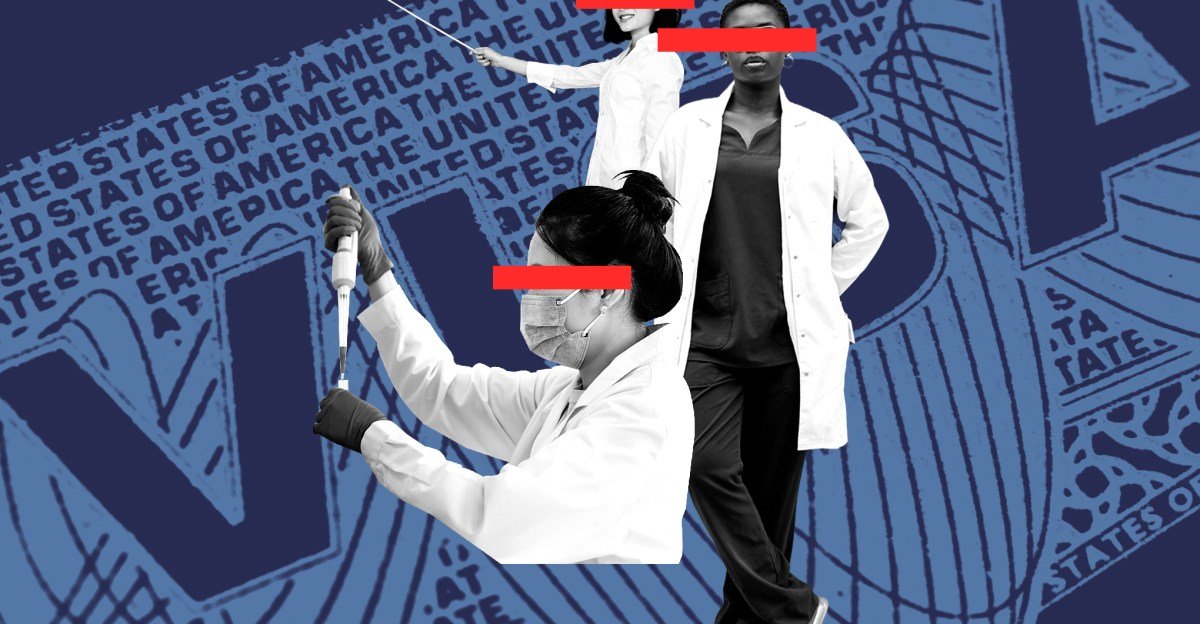
Last fall, President Donald Trump’s executive order raised the fee for H-1B visas to $100,000 — like many of his immigration policies — causing almost immediate chaos. Thousands of workers who went abroad to renew their visas got stuck abroad. Details of who would be affected emerged only after the fact. Six months later, the chaos created by the initial announcement has almost subsided. The H-1B registration season for the next fiscal year has just begun. With H-1B applications open until March 19, it’s unclear what impact the new rules will have on hiring, immigration and the workforce, but experts are warning the impact will extend far beyond the tech industry.
Trump’s transition team was divided between a nativist faction led by longtime adviser Stephen Miller and the president’s powerful new tech allies, Elon Musk and Vivek Ramaswamy. These factions were divided on the topic of H-1B visas, which allow skilled foreign workers to come to the US for specific jobs. The visa category is usually associated with Big Tech, and for good reason: Amazon, Meta, and Microsoft are the three largest employers of H-1B workers. Musk’s ouster and the disbandment of his Department of Government Efficiency was the death knell for the tech-MAGA coalition, setting the stage for the H-1B fee increase.
But while H-1B may bring lucrative software engineering jobs to mind, the policy change has affected other industries more. In fact, companies like Amazon can easily bear the cost of the increased fees and have also found ways to pay it. Instead, the H-1B fee increase is disproportionately impacting rural schools and hospitals already struggling with labor shortages. Simply put, Trump’s efforts to punish Big Tech are actually hurting underfunded schools and hospitals, many of them in the deep red rural districts that supported his candidacy.
There are two big changes: the fee increase, which attracted the most attention, and a new priority system that favors higher-earning applicants. Because there are more petitioners than open slots, H-1B visas are issued by lottery. But now, new applications will be weighted based on income, and people with higher paying jobs will have better chances of getting a visa. Applicants will now be divided into four pay tiers: those at Level 1 will be entered into the lottery once, while those at Level 4 will get four entries. Immigration lawyers say that under this system, a higher-paid tech worker would be given priority over a teacher making less money. U.S. Citizenship and Immigration Services, the federal agency that handles H-1B and other visa applications, did not respond. The VergeRequest for comment.
Anchorage-based immigration attorney Margaret Stock says fee increases are already impacting public schools in her state. “We have a major labor shortage in Alaska,” he said, “and that shortage extends to the school system.” Stock represents several school districts that have hired foreign teachers on H-1B visas. Teachers are hired under a union contract that sets their pay, Stock said.
Partly because teachers are so difficult to find, Alaska is one of the highest paying states for teachers. Some counties also offer signing bonuses and relocation allowances. But these resources can only go so far. “The state doesn’t have the money to pay $100,000 per teacher for an H-1B worker,” Stock said. “They will pay millions of dollars to the federal government for teachers.”
According to the Alaska Council of School Administrators, there are about 600 international teachers in Alaska, 341 of whom are on H-1B visas. That’s a small percentage of the total H-1B workforce — per Pew, 400,000 applications were approved in 2024, the majority of which were renewals — but it makes a big difference in Alaska, the least populous U.S. state. Alaska’s international teachers come largely from the Philippines, Ghana and India – countries with large English-speaking populations. Last year, before the fee increase, Nome, Bering Strait and Kenai Peninsula school districts also organized a recruiting trip to the Philippines.
Stock said the fee increase won’t just affect potential immigrants.
“Alaska’s population is declining and one of the reasons our population is declining is because people don’t want to live here when they can’t afford to send their kids to a good school,” he said. “If class sizes are too large, or there are no teachers, or no activities, or no healthcare, people won’t want to live here. It’s not just an H-1B issue. It has an adverse impact on the entire economy.”
State and federal officials are hoping to get a waiver to fund the fee increase. After the fee increase was announced, the administration clarified that the Department of Homeland Security would grant exceptions in “exceptionally rare” circumstances where hiring foreign workers “is in the national interest” and only when U.S. workers are not available to fill those roles. Exemption would be granted only in cases where the employer’s inability to pay would “substantially impair the interests of the United States.”
The only way to apply for a rebate is via email, and Stock hasn’t heard of a rebate being offered.
The fee increase also impacts Alaska Native Corporations, which are 13 regional companies across the state whose shareholders are Native Alaskans. These companies often hire H-1B workers for specialized roles, Stock said. “I know an H-1B worker who is working on hazardous waste management related to military bases in Alaska,” Stock said. “There are all types of workers there: engineers, health workers, doctors, teachers at universities and public schools. In Alaska, the majority of H-1B workers are not technical workers.”
Alaska isn’t the only state facing a severe labor shortage. Rural clinics across the country have become increasingly dependent on immigrant workers. Since the fee change was announced, some jobs have become completely vacant. Last September, the National Rural Health Association and the National Association of Rural Health Clinics asked the Trump administration to implement a “sweeping exception for health care providers.” He did not hear any reply. (National Rural Health Association did not respond) The VergeRequest for comment.)
Global Nurse Force, a nurse recruiting firm, sued the Trump administration last October over the fee hike. It is one of three federal lawsuits that have been filed since the changes were implemented.
At a February hearing in the Global Nurse Force case, government lawyers said about 70 employers had paid the fees so far. The administration claims the low number of applicants proves the increase “is not a tax because it is not increasing revenue.” It may also indicate that employers have found ways to pay the fees.
Fariba Faiz, an immigration attorney based in San Francisco, said the fee has changed companies’ hiring practices — but it hasn’t stopped them from hiring immigrant workers. “What we are seeing in practice is a change in employer strategy rather than a complete abandonment of the H-1B program,” Faiz said.
The $100,000 fee applies only to first-time petitioners applying from outside the United States. For example, the increased fees will not apply to someone on a student visa in the US who applies for an H-1B. This workaround means some companies are “prioritizing cases that can be filed as state conditions change,” Faiz said, while others are hiring foreign workers remotely rather than bringing them into the country.
“The practical effect is that companies are adjusting recruitment models to avoid fees rather than eliminate the need for highly skilled workers,” Faiz said. “In many cases, talent is still being hired, although the jobs are no longer located in the United States.”
Even with these solutions, the Trump administration’s sweeping immigration policies have made some companies more hesitant to hire immigrant workers. Some employers do not understand the new rules.
“The questions I’ve fielded about the $100,000 tax are endless,” said Boston-based immigration attorney Matt Maiona. Maiona said he often talks to customers who don’t realize there are ways to get rid of the fees. “But it’s not necessarily the $100,000 that makes companies not want to take jobs; it’s the environment, it’s the economy, and it’s the uncertainty of how their workers can or can’t come into the country, even if they’re doing everything right.”
In addition to going after so-called “criminal aliens,” the Trump administration is also cracking down on nearly all forms of legal immigration. The administration recently reduced the duration of work permits for asylum seekers to 18 months. Before the change, work authorization for asylum seekers lasted for five years. The administration also announced last August that it was reviewing the records of all visa holders — including those with H-1B — for any violations that could lead to their deportation. Since December, H-1B applicants have also been subject to increased scrutiny, and petitioners who have engaged in content moderation may have their requests denied.
“$100,000 is something you can get answers about,” Myona said. “You can call an immigration lawyer and we’ll say, ‘We really don’t think you have any need to worry. It looks OK, you’re in good standing.’ But other things we can’t really promise. In fact, this is what is exacerbating it. This is that fear.”
<a href