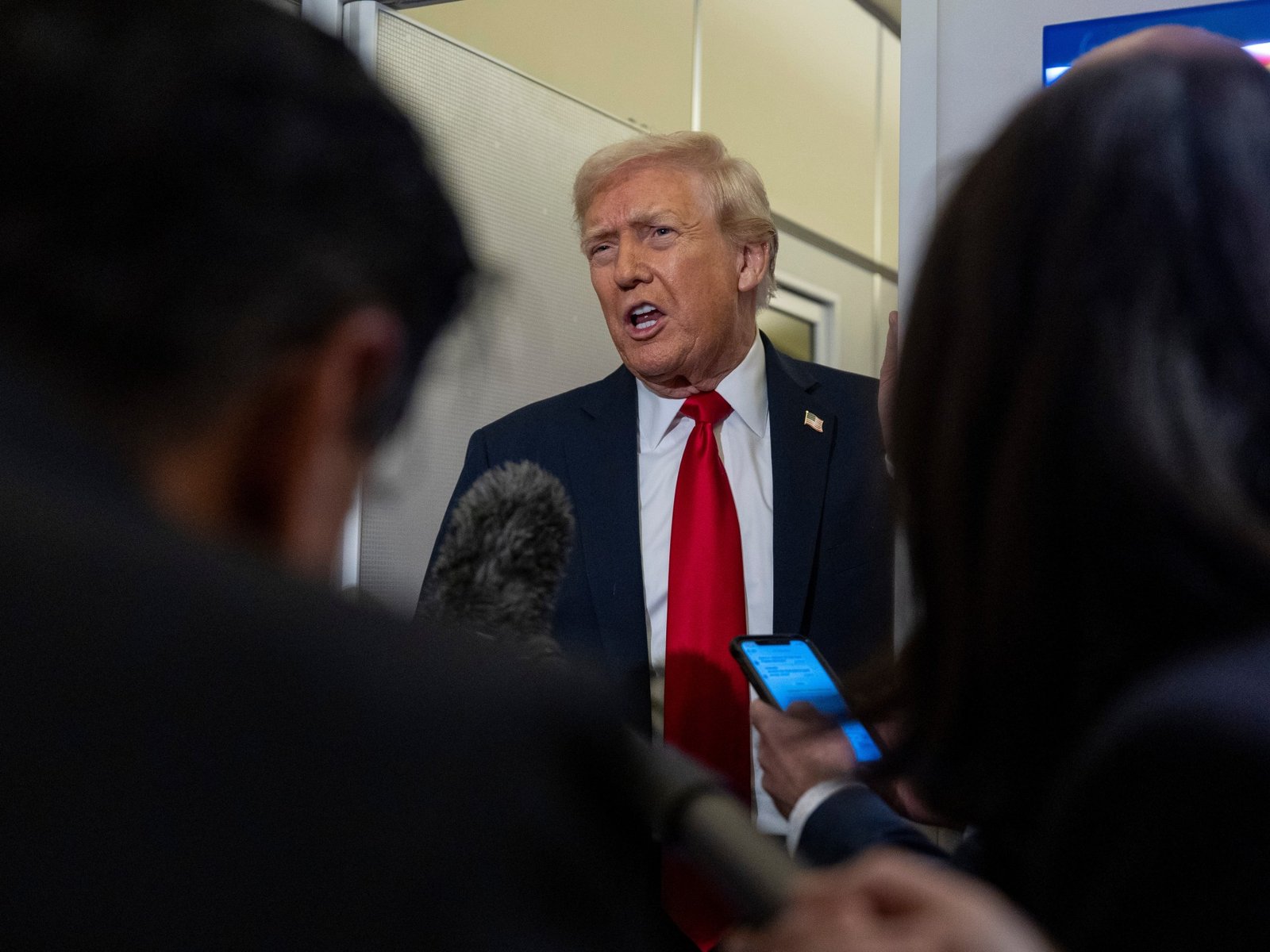
In Wednesday’s post, Trump repeated false claims that white “genocide” was taking place in the African country.
Recommended Stories
list of 3 itemsend of list
He also repeated his threat that South Africa would no longer receive funding from the US, a policy he had implemented earlier this year.
“South Africa has shown the world that they are not worthy of membership anywhere,” Trump wrote. “We are going to stop all payments and subsidies to them with immediate effect.”
The message on Truth Social was the latest escalation in Trump’s ongoing dispute with South Africa, a country he has accused of “shocking disregard” for the rights of white African people.
Human rights experts agree that Trump’s claims of African genocide have no basis.
Nevertheless, Trump has repeatedly cited such claims as he puts pressure on the government of his South African counterpart Cyril Ramaphosa. He has also blamed the media for failing to spread his message.
“The South African government has refused to acknowledge or address the horrific human rights abuses endured by Africans and other descendants of Dutch, French and German settlers,” Trump wrote on Wednesday.
“To put it more bluntly, they are killing white people, and randomly allowing their farms to be taken away from them. Perhaps, worst of all, the soon-to-be-out-of-business New York Times and the fake news media will not issue a word against this genocide.”

passing the gavel
Trump’s latest comments come after an awkward diplomatic incident over the weekend that highlighted the increasingly fraught nature of US-South African relations.
In recent decades, the two countries have enjoyed largely cordial relations.
The US is South Africa’s second-largest single-country trading partner after China, and trade between the two countries is expected to be valued at approximately $26.2 billion by 2024.
But last weekend’s G20 summit in the South African city of Johannesburg signaled how dramatically relations between the two countries have changed.
The summit was a big deal for Africa as a whole: it was the first time the continent had hosted G20 leaders.
But while the US usually has a prominent presence at the G20, this time the Trump administration decided to boycott the proceedings. Trump not only refused to attend, but he also refused to send any top officials from Washington, DC to the event.
“It is an absolute disgrace that the G20 will be held in South Africa,” he wrote in a post on November 7.
“No American government official will participate in these human rights abuses as long as they continue.”
The G20 has traditionally been a meeting place for leaders of the European Union, African Union and other major world economies to discuss technology, environmental initiatives and shared financial development.
Next year, the summit is scheduled to take place in Miami. Traditionally, the host of the G20 summit closes the meeting by banging a gavel and then passing a small wooden hammer to officials of the next country to hold the meeting.
But on Sunday, Ramaphosa did not give this responsibility to anyone.
Trump on Wednesday confirmed reports that he had offered to send a member of the US Embassy to accept the gavel, but the offer was rejected by Ramaphosa’s administration as trivial.
“At the conclusion of the G20, South Africa refused to hand over the G20 presidency to a senior representative of our U.S. Embassy who attended the closing ceremony,” Trump wrote. “Therefore, on my instructions, South Africa will not receive an invitation to the 2026 G20.”
tension increased
Ramaphosa largely avoided addressing the US absence during the G20 summit, instead emphasizing global unity and efforts to tackle inequality.
“Our G20 presidency is based on the belief that the world needs greater solidarity, equality and stability,” Ramaphosa wrote on social media on Tuesday.
“While some have sought to create division and polarization among nations, we have strengthened our shared humanity. We have fostered cooperation and goodwill. Above all, we have affirmed that our shared goals far outweigh our differences.”
Increasingly hostile relations between South Africa and the United States began at the beginning of Trump’s second term as president.
On February 7, Trump issued an executive action condemning South Africa for alleged human rights abuses against white Africans and saying all aid and assistance to the country would be cut off.
According to government data, through fiscal year 2023, US aid to South Africa was approximately $441.3 million. In fiscal year 2024, which is currently only partially reported, the total rises to about $581 million.
In the February order, Trump also directed US government agencies to assist in the resettlement of Africans as “refugees” to the US.
He doubled down on that call in late October, when he set the lowest limit on refugee admissions in US history.
Of the 7,500 available refugee slots, the Trump administration called for the majority to be allocated among “African people of South Africa and other” victims of illegal or unjust discrimination.
In May, Trump also hosted Ramaphosa at the White House, where he attempted to confront the South African leader with allegations of genocide in his country. Some critics have compared the meeting to an “ambush”.
Ramaphosa, for his part, has repeatedly denied the allegations. When reporters asked him about the US boycotting the G20 this year, he bluntly said, “Their absence is their loss.”
<a href
Carbon credits https://offset8capital.com and natural capital – climate projects, ESG analytics and transparent emission compensation mechanisms with long-term impact.
Свежие новости SEO https://seovestnik.ru и IT-индустрии — алгоритмы, ранжирование, веб-разработка, кибербезопасность и цифровые инструменты для бизнеса.
Бассейн с подогревом под ключ https://atlapool.ru
Хочешь помочь своей стране? заключить контракт на сво требования, документы, порядок заключения контракта и меры поддержки. Условия выплат и социальных гарантий.
Подробности внутри: https://paradstars.com/catalog/212/
Лучшие фриспины за регистрацию — бесплатные бонусы для старта, подробные обзоры и сравнение условий различных платформ.
Найкращі бонуси казіно — депозитні акції, бездепозитні пропозиції та турніри із призами. Огляди та порівняння умов участі.
Грати в найкраще найкраще онлайн казино — широкий вибір автоматів та настільних ігор, вітальні бонуси та спеціальні пропозиції. Дізнайтеся про умови участі та актуальні акції.