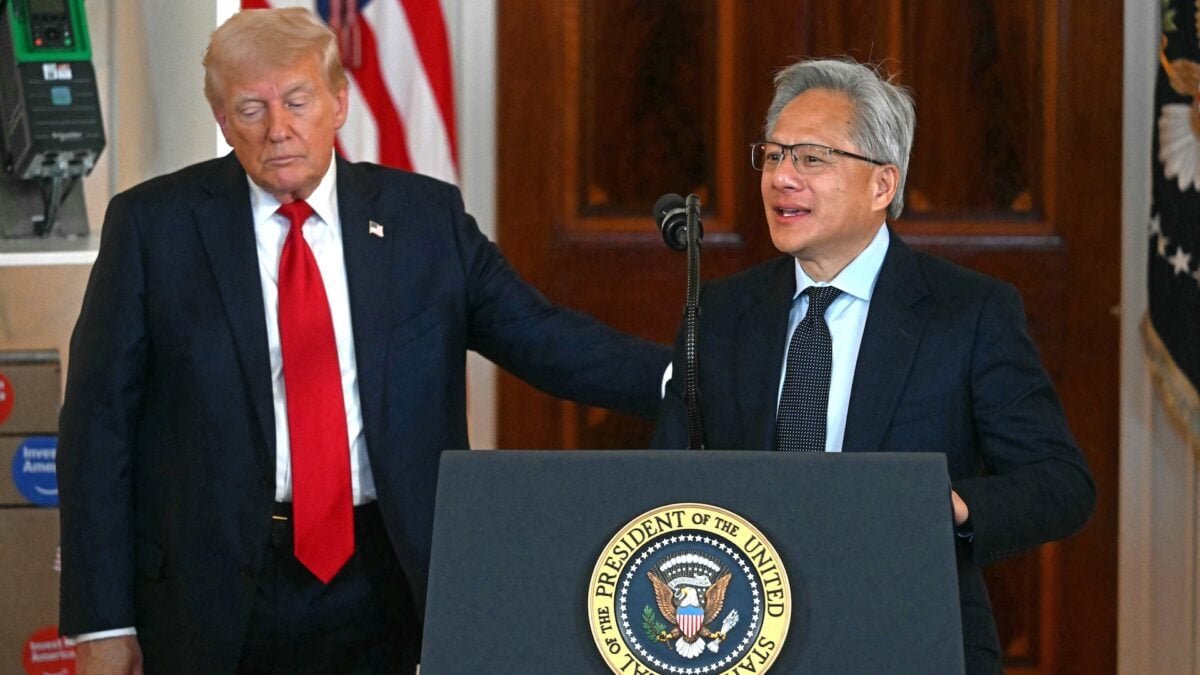

Trump wrote on Monday that he has informed China’s President Xi Jinping that he will allow the sale of H200 chips “under conditions that allow us to maintain strong national security.” Trump did not say what those terms might be, but said Nvidia would pay the U.S. government 25% from chip sales to China.
Over the summer, Nvidia and AMD agreed to give the U.S. government 15% of revenue from chip sales to China in a bizarre quid pro quo arrangement, according to the Financial Times. Experts noted at the time that no private company had ever made such a deal and the legality was questioned. Trump’s second term has been full of extreme actions that often confound experts in a given field. Can the President unilaterally declare birthright citizenship invalid? Virtually every constitutional expert says ‘no’, but the US Supreme Court has taken up the case, and if members of the conservative-dominated court wanted to, they could very well invalidate the 14th Amendment.
Trump on Monday hailed the sale of the H200 chips as a victory for American workers, although it has yet to be formally finalized by the US Commerce Department, which handles export controls. But federal agencies under Trump aren’t in the business of second-guessing them these days.
“This policy will support American jobs, strengthen American manufacturing, and benefit American taxpayers,” Trump wrote. The president claimed that President Joe Biden’s administration had “forced” American companies to spend billions of dollars to make “‘bad’ products that nobody wants”, which he called a terrible idea that slowed innovation and harmed American workers. Apparently those “offended” products are designed to give America a technological edge, as their government has allegedly tried to do.
“That era is over! We will protect national security, create American jobs, and maintain America’s lead in AI,” Trump wrote. “NVIDIA’s US customers are already moving forward with its incredible, highly advanced Blackwell chips, and soon, Rubin, none of this is part of the deal.”
As Bloomberg notes, the Chinese government has urged potential customers to reject the less powerful H20 chips. It wasn’t an outright ban, and there is reportedly still demand for H20 in the country, but if the cut in the world’s second-largest market for chips was unlikely, it probably put some pressure on the US to re-examine the issue.
Nvidia CEO Jensen Huang, like nearly every other tech CEO in the country, is cozying up to Trump during the president’s second term. And it looks like Nvidia’s lobbying has indeed been successful. According to the New York Times, so-called AI and crypto czar David Sacks also raised security concerns about selling chips to China. Sachs and Huang have reportedly argued that selling more advanced chips to China would make the country more dependent on American technology.
It remains to be seen what will happen to the SAFE CHIPS Act, a bipartisan bill unveiled last week to restrict any efforts by Trump to loosen export restrictions, according to Reuters. The bill is sponsored by Republican Senator Pete Ricketts and Democrat Chris Coons. Resisting Chinese technological influence seems to be the only thing most elected Republicans and Democrats can agree on, although when Trump wants something it often doesn’t matter what Congress says. For example, the ban on TikTok was a bipartisan law that even Trump supported, until he pulled a 180 in 2024. Trump has unilaterally extended enforcement of the sanctions several times while working on an agreement. The next deadline is December 16.
“My Administration will always put America first,” Trump wrote on Monday. “The Commerce Department is finalizing the details, and the same approach will apply to AMD, Intel, and other great American companies. Make America Great Again!”
President Trump is scheduled to visit Beijing and meet Xi in April.
<a href